Get Full Government Meeting Transcripts, Videos, & Alerts Forever!
Get email alerts on the Hospital Assessment topic
No spam. Unsubscribe anytime.
Committee hears $190 million hospital assessment supplemental tied to UPL changes from 2022 law
Summary
Legislative analysts told the committee that changes to upper payment limit (UPL) methodology following 2022 legislation increased the assessment hospitals must pay and prompted a supplemental request to process the higher assessments and draw federal matching dollars
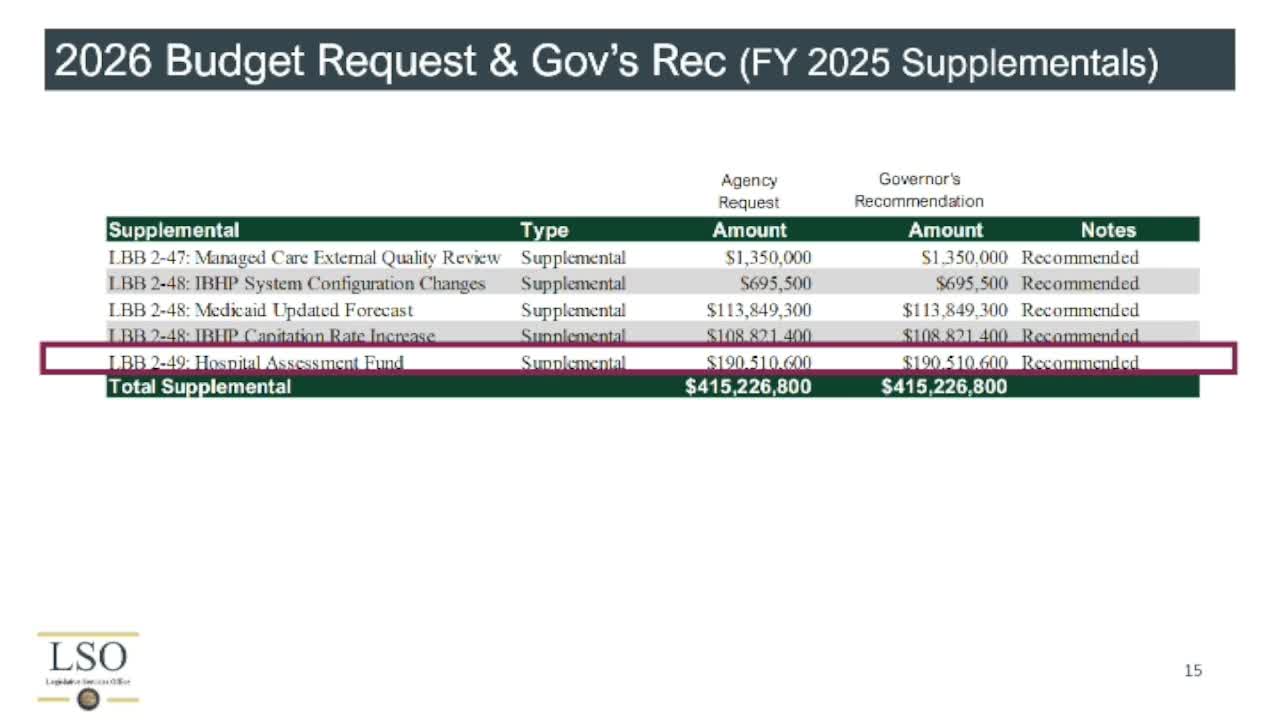
The joint appropriations committee was briefed on a roughly $190 million supplemental request tied to hospital assessments and changes to the upper payment limit (UPL) calculations enacted in 2022.
Analyst Alex Williamson described the supplemental as a request of about $190,000,000 in benefit payments, with approximately $77,000,000 from the hospital assessment fund (a dedicated fund) and roughly $113,000,000 from federal funds. The change follows Senate Bill 1350 (2022), which altered the methodology for calculating the UPL for hospitals and skilled nursing facilities and therefore changed the assessment that hospitals pay.
Williamson told the committee that hospitals realized the assessment under the new methodology would be higher than forecasted, which allowed them to access additional federal dollars; a similar supplemental was passed mid‑year for fiscal 2024 and the department is requesting the approach be ongoing beginning fiscal 2026.
Representative Tanner asked whether the assessment functions as a “blank check” to hospitals and whether it could be redirected to offset medical costs directly; Williamson and Director Adams said a portion of the assessment stays with the state and is used to offset provider rate increases but changing how the assessment is used would require policy changes.
Adams added the assessment is based on hospitals' net patient revenue and that the state retains a portion (the department cited retained funds used to offset provider rate increases), while the rest flows through the assessment mechanism to draw federal match.
No formal action was taken in the hearing; the supplemental was presented as a recommended request to JFAC and committee members requested additional explanation of mechanics and possible policy options.