Get Full Government Meeting Transcripts, Videos, & Alerts Forever!
Get email alerts on the Enterprise It Luma topic
No spam. Unsubscribe anytime.
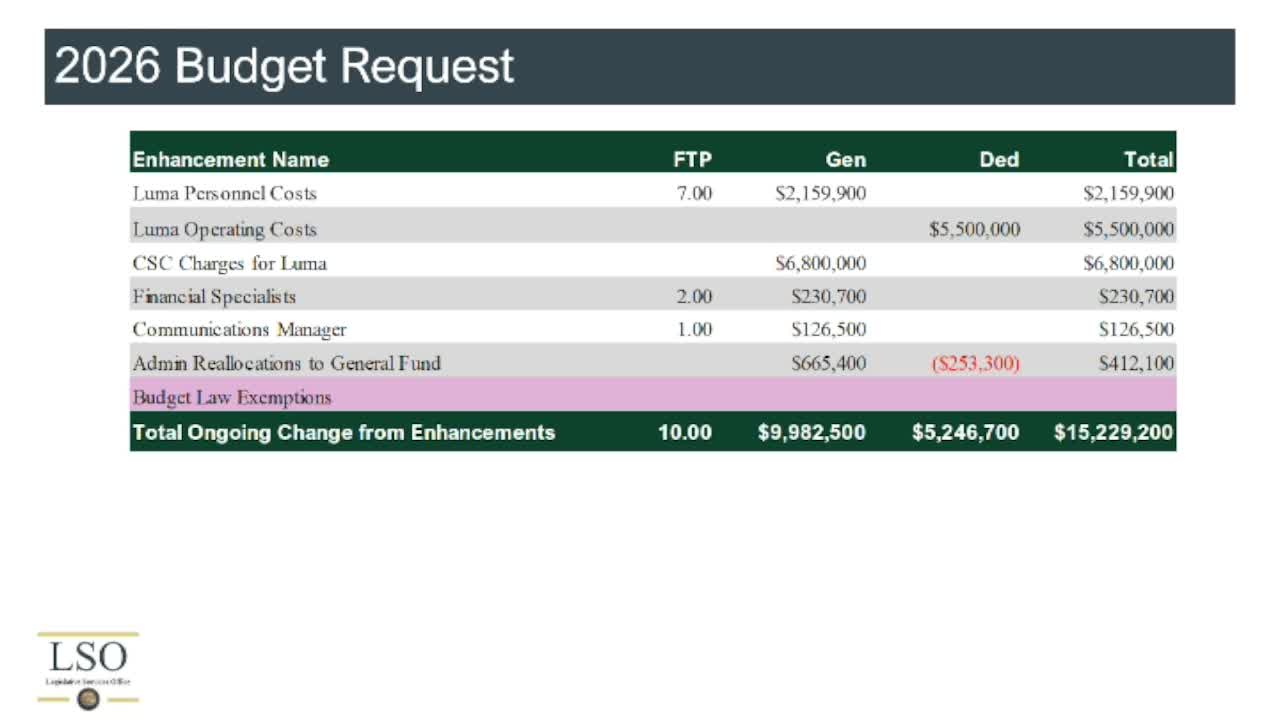
State controller seeks $15.2 million to bring LUMA ERP support onto the budget; lawmakers warned of operational risks if unfunded
Summary
The State Controller outlined a fiscal 2026 request to shift LUMA enterprise-resource costs from an expiring Business Information Infrastructure Fund onto the controller's appropriation and warned that losing the requested staff would sharply reduce the project team and could impair payroll and financial reporting.
State Controller Brandon Wolf told the Joint Finance-Appropriations Committee Feb. 17 that his office needs $15.2 million in fiscal 2026 to move LUMA (the statewide enterprise resource-management system) support onto the controller's appropriation now that the Business Information Infrastructure Fund (BIF) will expire at the end of the fiscal year.
LUMA combines financial, budget, procurement, human-resources and benefits modules for state agencies. The computer-service center and controller's office have used the BIF as a funding mechanism while the system was implemented; the BIF was supported by transfers of statewide cost-allocation fees from agencies. Controller Wolf said the BIF ends June 30 and that his office has 47 employees working on LUMA. He said 13 positions previously approved for the project were not funded through the BIF, and his request would formalize funding for 20 positions that have been paid through continuous appropriation as well as additional infrastructure and shared-services appropriation.
"If you think about that, 20 of the positions, if we did not have the funding, then we would almost cut the LUMA team in half," Wolf told the committee, stressing the consequences for payroll and financial operations if funding is not continued. He and his staff said the system is functioning in production but that ongoing sustainment, enhancements and agency training require a staffed team. Wolf described legacy-system constraints prior to LUMA and said other states that attempted similar large-scale ERP conversions have struggled; he argued Idaho is on the right path but still needs time and staff to stabilize operations.
Committee members pressed the controller on consequences for audits and reporting. Representative Orrin said delays in agency audits and federal reporting have been a problem during the LUMA transition; Wolf acknowledged reporting delays and said the office is working with agency fiscal teams to close the books and catch up on the annual comprehensive financial report (ACFR) and single audit. He estimated the office was about eight weeks behind on closing the books at the time of the presentation.
Wolf also said his office is requesting two financial-specialist positions to build shared-services offerings for agencies with limited fiscal staffs and $5.5 million in dedicated-fund appropriation for the computer service center's LUMA infrastructure. The governor recommended the requested enhancements.
Legislators asked for lessons learned from the LUMA implementation. Wolf said change-management, testing, procurement and user training were key takeaways and that his office would share lessons learned with other state entities considering similar projects. The committee did not take a final funding vote during the hearing; the controller requested continued legislative support and oversight as the project moves from implementation to sustainment.