Get Full Government Meeting Transcripts, Videos, & Alerts Forever!
Get email alerts on the Public Works Capital Projects topic
No spam. Unsubscribe anytime.
Lawmakers review $122.9 million in public-works recommendations, projects total $1.9 billion active
Summary
Legislative analysts and the Division of Public Works outlined the permanent building fund's multi-year structure, revenue sources, and a slate of fiscal 2026 capital and maintenance requests; committee members pressed officials on project timelines, deferred maintenance and workforce constraints.
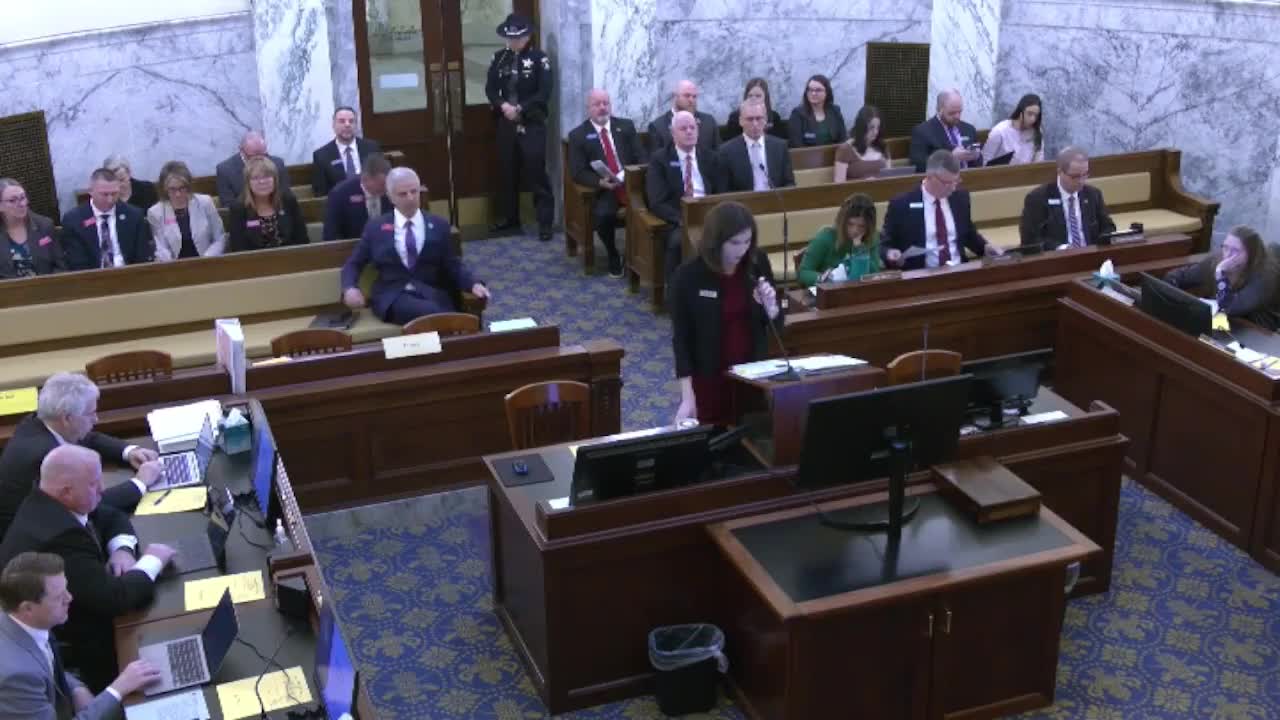
Legislators reviewing the permanent building fund on Feb. 17 were briefed on the fund's multi-year accounting, statutory revenue streams, the value of active public-works projects, and specific fiscal 2026 requests from the Division of Public Works.
Frances Lippitt, legislative analyst, told the Joint Finance-Appropriations Committee the fund receives several statutory revenue sources and often carries appropriations across multiple years: "Projects receive an appropriation once, and at the end of the fiscal year any unexpended funds become continuously appropriated pursuant to section 57-1105 of Idaho Code," she said. (Transcript citation as given by the analyst during the presentation.)
Lippitt said the division currently reports about $1.9 billion in active public-works projects, $1.4 billion of which are capital projects, and that 42% of capital funding has been committed. The Legislature and division have used transfers of general fund dollars in recent years to invest in capital projects and deferred maintenance; Lippitt said the state invested roughly $1.1 billion toward that work in prior years and that interest earnings on investments have increased accordingly.
The fiscal 2026 recommendation for public works Lippitt summarized totals about $122,861,900 and includes six capital projects plus restoration of repurposed appropriations for deferred maintenance and $68,208,800 for alterations and repairs and building maintenance. Lippitt described the major capital requests:
- $6.5 million to expand the Department of Lands' Ponderosa office, adding restroom/shower facilities and improving reception security and space for a 20-person hand crew; deputy public-works staff said security concerns at the reception area prompted the improvement work.
- $5,560,000 for utilities connections (electric, gas, data, water and sewer) to support a future Idaho National Guard readiness center in Bonneville County; the readiness center is planned for a 2029 construction timeline and will support as many as 350 military personnel at peak occupancy.
- $5,525,000 for the Idaho State Police (ISP) Lewiston District 2 facility; the legislature previously appropriated $9,975,000 for the project in fiscal 2024 to purchase and retrofit an existing building, but that purchase became infeasible after the seller raised the price, so the agency returned seeking funding for land acquisition and new construction.
- $2,500,000 to add lab space in the Micron Center for Materials Research at Boise State University to fund additional research labs in shelled space.
- $14,000,000 toward a life-science complex at Idaho State University that, if completed, would be a roughly 108,000-square-foot complex estimated at $127,770,000 total; Lippitt said the project plan relies on a combination of $35,770,000 in agency funds and roughly $78,000,000 in bonding.
- $8,000,000 for a joint military science and veterans assistance center at the University of Idaho.
Lippitt said the permanent building fund is structured to encourage agencies to seek matching funds and outside sources; matching funds are requested in each agency's budget and then become continuously appropriated once appropriated.
Lawmakers asked several operational questions. Senator Cook asked for a definition of deferred maintenance; Lippitt described it as end-of-life replacement costs such as roofs and HVAC systems and noted that a statewide deferred-maintenance program is being managed by an external contractor. Representative Miller and others pressed officials on project timelines and bottlenecks; Lippitt estimated average project lifespans at two to four years but deferred to Division of Public Works (DPW) administrator Dale Reynolds for specifics. Reynolds said timeframes vary by project delivery method and scale and provided an example: a prison project under construction would take roughly 2.5 years from the start of construction to completion.
Reynolds and deputy administrators also described occupancy and Chinden Campus matters: Director Bailey reported the state had completed about $70 million in Chinden Campus projects and had $30 million in progress, with an additional estimate of $145 million to $160 million in future deferred-maintenance work. He said roughly 7% of rentable square footage at Chinden is vacant (about 2,100 square feet on one floor), Building 3 remains vacant, and a private tenant (HP) occupies three of eight buildings (about 40% of rentable square footage) under a lease extended to 2029 with an option for another five years.
Committee members raised workforce and cost-escalation concerns, citing higher construction costs and material procurement challenges; Reynolds said labor and materials are constrained but that some cost escalation has flattened recently. Co-chair Harmon noted reporting language inserted last year and asked DPW to provide a list of projects that have not executed within the committee's four-year start timeline; the analyst said she would provide that list.
The committee did not take final action on the request during the briefing. Members asked for additional project-status detail, a list of inactive or long-delayed projects, and the DPW capital-status report referenced by Lippitt, which is available to committee members on SharePoint.