Get Full Government Meeting Transcripts, Videos, & Alerts Forever!
Get email alerts on the Ibhp Implementation topic
No spam. Unsubscribe anytime.
State officials say Idaho Behavioral Health Plan implementation produced expected fixes but early provider payment issues prompted corrective actions
Summary
Department leaders told the committee that the July 2024 go‑live for the Idaho Behavioral Health Plan (IBHP) required larger system configuration work than historical contracts, producing implementation costs and early provider payment problems that the department and contractor addressed with corrective actions and liquidated damages
Director Alex Adams and Deputy Director Juliette Sharon addressed committee questions on Feb. 26 about Idaho’s July 1, 2024 launch of the Idaho Behavioral Health Plan and related contract implementation costs.
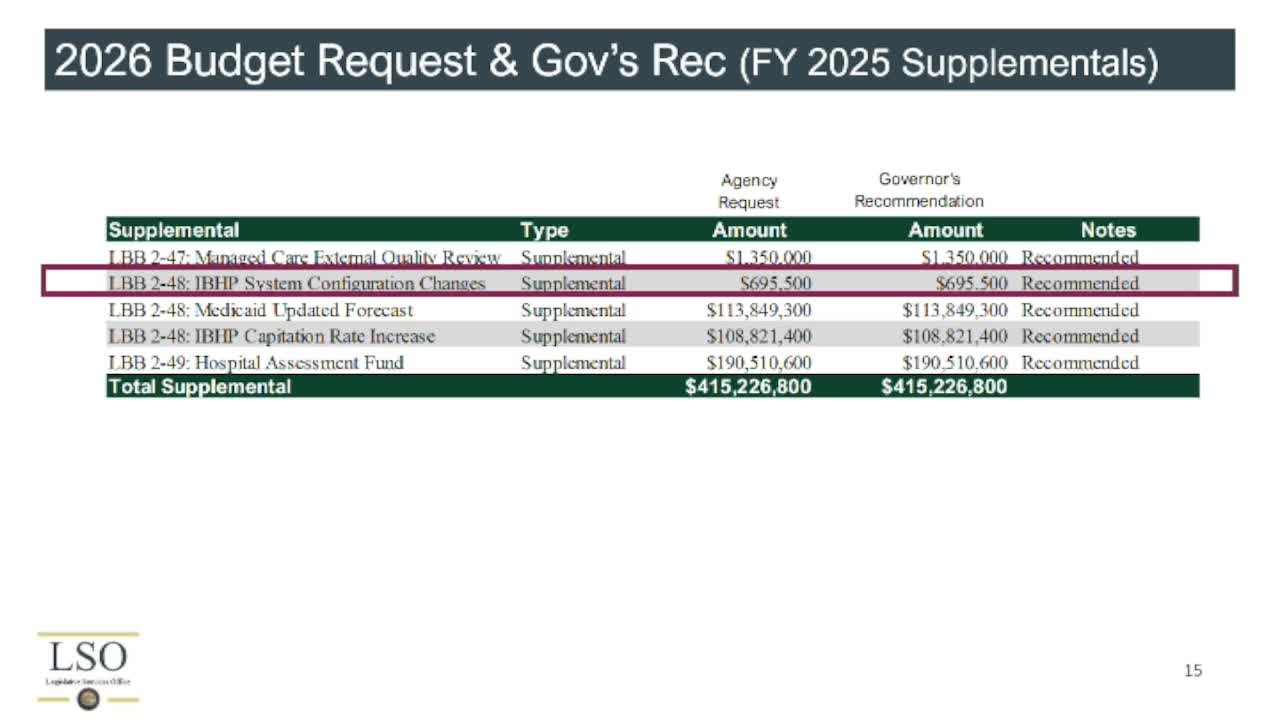
“These are costs that have already been incurred for system configuration changes made and completed around the start of the new IBHP contract,” Juliette Sharon said, explaining why the department requested one‑time supplemental funds to cover additional system updates, interfaces and testing.
Sharon said the 2024 contract’s scope was larger than the historical contract because services that had been paid fee‑for‑service or delivered by the Division of Behavioral Health were consolidated under the managed care contract. That expansion of scope required additional configuration to ensure the department could report utilization and conduct appropriate oversight.
Committee members raised provider payment delays. Sharon acknowledged initial payment problems after go‑live and said the contractor Magellan and the department “addressed those very, very quickly in partnership,” adding that some payment timeliness issues prompted liquidated damages and corrective action plans.
Adams said the department had imposed more than $100,000 in liquidated damages on Magellan and that monthly contract reporting and management letters were in place. “They are back in compliance with timeliness requirements, and I believe some of the more recent concerns … mailing issues and some provider education … have been addressed,” Sharon said.
Analyst Alex Williamson had described a supplemental request tied to system configuration (her presentation cited an amount near $695,500 one‑time) and a separate capitation rate increase request split across plans (about $108.8 million one‑time federal), both of which the department staff discussed as part of implementation and reconciliation activities.
Sharon said the department continues to monitor provider payment denials, timeliness metrics and other contract performance measures, and acknowledged that while problems remain possible, Magellan had taken steps to improve performance and the department continues oversight.