Get Full Government Meeting Transcripts, Videos, & Alerts Forever!
Get email alerts on the Child Welfare Safe Haven topic
No spam. Unsubscribe anytime.
Committee advances bill to speed placement of infants surrendered under Safe Haven law; tribes and agencies worked on ICWA language
Summary
Senate Bill 1058 would require Health and Welfare to maintain a list of licensed adoption agencies and enable transfer of custody to an adoption agency within 24 hours of a safe-haven surrender, with ICWA notification requirements; the committee sent the bill to the floor with a do-pass recommendation after mixed testimony.
The Senate Health and Welfare Committee voted to send Senate Bill 1058 to the Senate floor with a do-pass recommendation after hearing testimony on amendments to Idaho's safe-haven provisions intended to speed placement of newborns surrendered anonymously at licensed hospitals, fire stations, law enforcement sites or safe-haven boxes.
Senator Tammy Nichols, the bill sponsor, said the measure directs the Idaho Department of Health and Welfare to maintain a list of licensed adoption agencies to facilitate faster placement and requires that custody of a surrendered child be transferred to a selected adoption agency within 24 hours unless the infant requires additional medical care. "The goal of this bill is clear: to place abandoned children quickly with families who are ready and waiting," Nichols told senators.
Key provisions described in committee testimony include: transfer to a licensed adoption agency within 24 hours after surrender unless medical care requires hospitalization; if no adoptive family is identified and the infant needs medical care, the child remains in the hospital and a shelter-care hearing is to be triggered within 48 hours; and notification procedures consistent with the Indian Child Welfare Act (ICWA) — any notice required by ICWA must be issued within 10 days.
Sponsor and tribal representatives said the bill was negotiated with Idaho tribes and the Department of Health and Welfare. Tyrell Stevenson (identified to the committee as legislative director for the Coeur d'Alene Tribe) and Blake Hude of the Shoshone-Bannock Tribes said they worked with the department and the sponsor to align the language with ICWA and Bureau of Indian Affairs guidance. Stevenson described ICWA as federal law designed to protect tribal families and preserve tribal connections.
Adoption-agency witnesses supported the bill. Kara Walsh, a licensed social worker with New Beginning Adoption Agency, said agencies operate 24/7 pregnancy crisis lines and can place infants quickly with vetted families. "By making this change we reduce unnecessary transitions," Walsh said, adding that early placement with a stable adoptive family improves infant attachment and development.
Not all testimony was in favor. Whitney Wunderlich, who adopted a child after a safe-haven surrender and later foster-adopted, testified that placing babies directly with adoption agencies could expose adoptive parents to infants with complex or unknown medical needs and shorter training than foster parents receive. "I don't think it's in the best interest of the potential adoptive child to be placed with adoption agencies with less required training and experience," she said. Wunderlich recommended expediting adoption within the foster-care system as an alternative.
Senator Maryanne Wintrow expressed concern about normalizing safe-haven abandonment and said she would vote no, citing worries about coercion, unknown medical conditions and the desirability of better social services that encourage parents to seek help and counseling.
Supporters said the measure does not eliminate foster care but aims to shorten the time infants spend in temporary custody by connecting them more quickly with licensed adoption agencies that have pre‑approved families ready to adopt. Sponsor Nichols and tribal leaders said the bill includes safeguards to identify and notify tribes if a child may be an Indian child; the bill allows a parent to volunteer tribal affiliation but does not require identification.
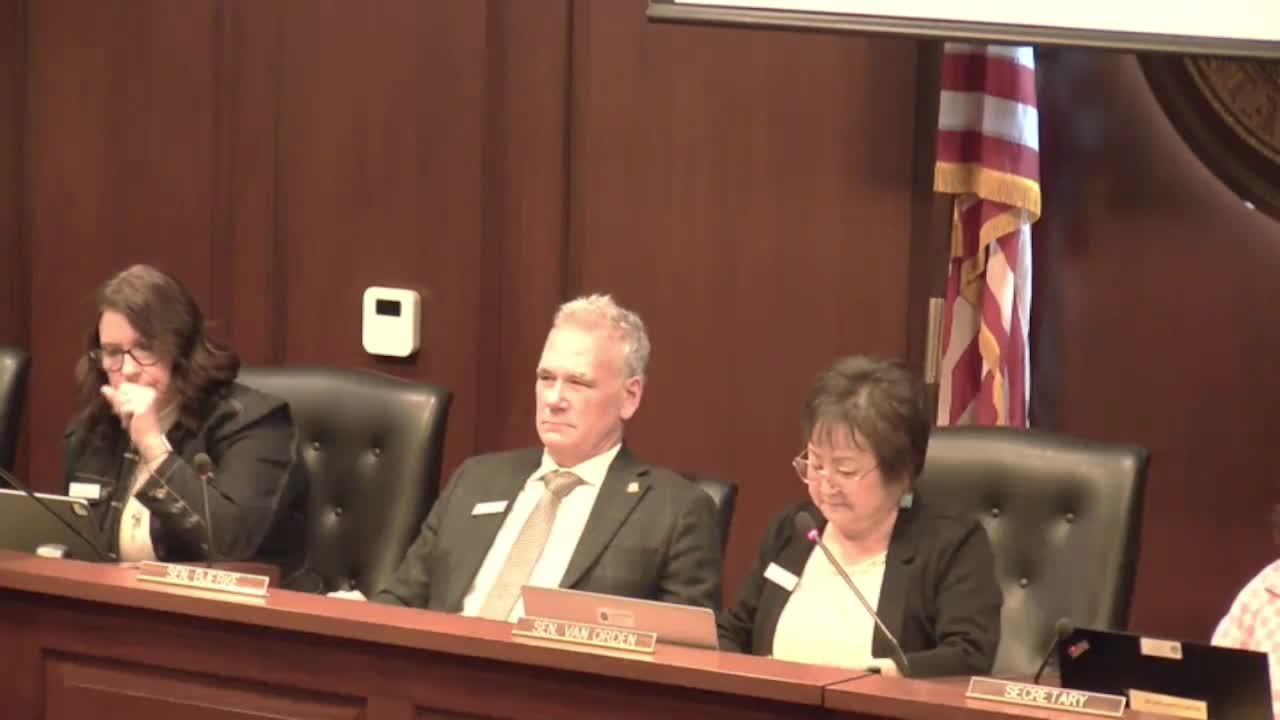
Senator Keiser moved and Senator Beierke seconded that the committee send S.B. 1058 to the Senate floor with a do-pass recommendation; the motion passed on a voice vote with at least one recorded no (Senator Wintrow).
Votes at a glance: Senate Bill 1058 — motion to send to the Senate floor with a do-pass recommendation moved by Senator Keiser, seconded by Senator Beierke; outcome: approved by voice vote with one senator recorded opposed.
If advanced by the full Senate, the bill would change how Health and Welfare coordinates placement after safe-haven surrenders and trigger additional operational work between the department, licensed adoption agencies and tribal authorities.