Get Full Government Meeting Transcripts, Videos, & Alerts Forever!
Get email alerts on the Substance Abuse Funding topic
No spam. Unsubscribe anytime.
Department proposes fund swaps and limited staff reductions to comply with federal caps on substance use block-grant administrative spending
Summary
Officials told the Joint Finance-Appropriations Committee the Substance Abuse Treatment and Prevention program needs fund-source adjustments after federal guidance placed Idaho on a corrective action plan for exceeding the 5% administrative cap on the substance use block grant. The department proposed shifting personnel costs
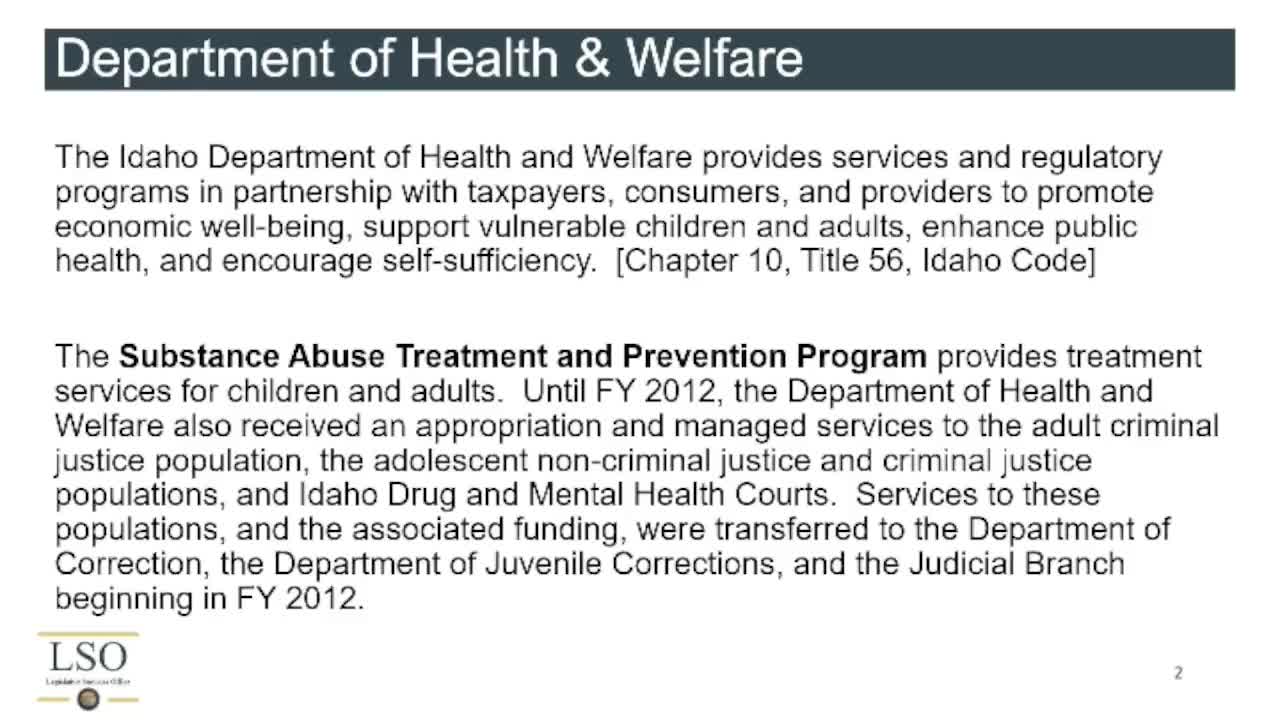
Legislative analysts and the Department of Health and Welfare told the Joint Finance-Appropriations Committee that federal guidance has placed Idaho on a corrective action plan for the substance use block grant because the state exceeded the federal 5% cap on administrative personnel spending. To address the federal finding and preserve current staffing, DHW proposed shifting personnel costs to liquor-control (dedicated) funds while moving federal funds into trustee-and-benefit payments.
Alex Williamson, LSO analyst, described the requested fund swaps: the department asked to move approximately $533,900 from liquor-control funds to cover personnel and to move $673,900 in federal funds into trustee-and-benefit payments to restore compliance with the federal administrative cap while keeping current staff levels. She noted the department is constrained by statutory limits on transfers between personnel and trustee-and-benefit appropriation categories and therefore needs legislative approval for the swaps.
Senator Cook framed the issue bluntly: “It sounds like we got our hands slapped because we were spending too much on administrative fees. And instead of fixing the problem, we're just going to shift some money, so it doesn't — so it looks like we stay underneath the 5%.” Williamson and Director Adams said the swap aims to preserve operating capacity tied to the grant while meeting federal administrative limits. Adams said the department proposed net reductions in FTP and personnel where possible and emphasized that some federal grants are recurring; the department sought to avoid asking for additional general funds.
The program’s recent history includes a multi-year state opioid response grant that the committee heard was made ongoing after recurring federal awards; the division also received Millennium Fund resources for community-based recovery centers and a $2.5 million one-time prevention appropriation. Adams said the department moved to reduce the program’s FTP from 16 to 12 in the proposed budget and cut personnel costs modestly, while covering gaps with dedicated funds and existing federal grants where allowable.
Ending: Lawmakers asked for follow-up information about performance and outcomes for prevention and recovery grants. Director Adams said many reporting documents are available and offered to supply additional performance data; he emphasized the department acts as a pass-through for some grants and recommended lawmakers consider whether the department should continue in that pass-through role for certain programs.