Get Full Government Meeting Transcripts, Videos, & Alerts Forever!
Get email alerts on the Employee Benefits topic
No spam. Unsubscribe anytime.
JFAC approves $14,130 per‑FTE health insurance funding for FY2026
Summary
The Joint Finance‑Appropriations Committee voted Jan. 31 to increase the state health insurance appropriation to $14,130 per eligible full‑time equivalent for fiscal year 2026, a change that raises projected reserve balances and will increase General Fund and other appropriations.
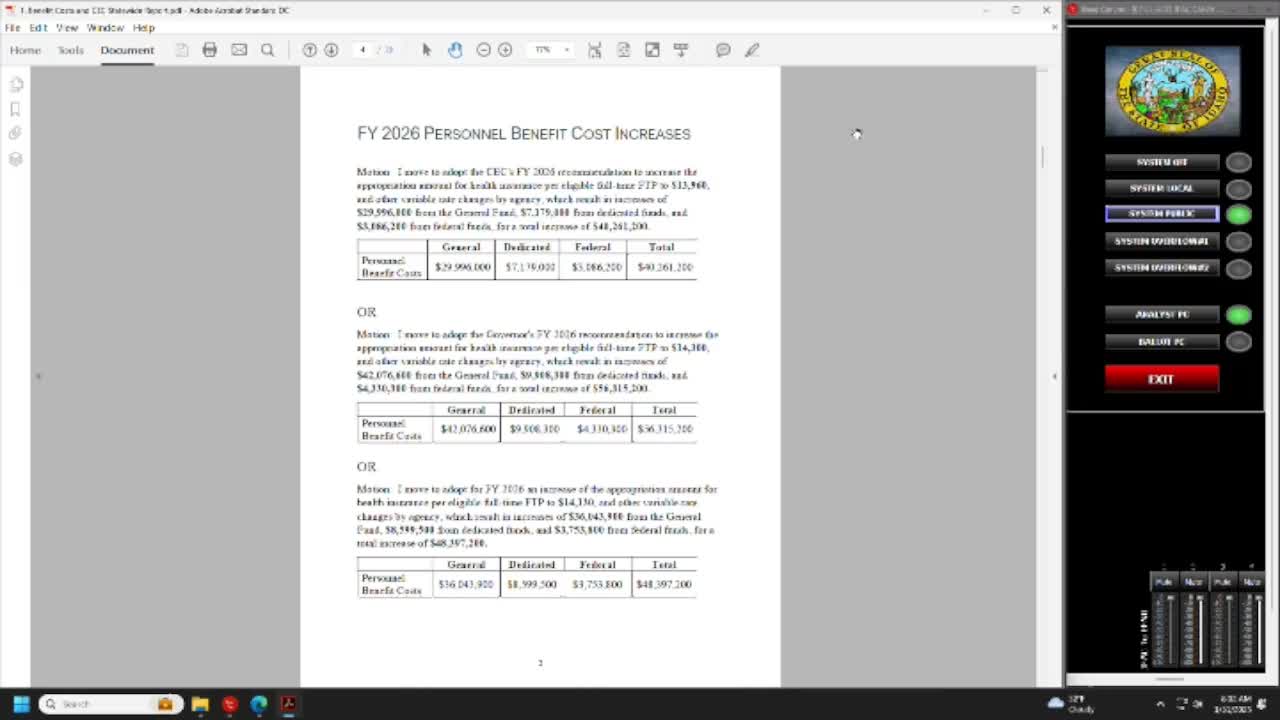
BOISE — The Joint Finance‑Appropriations Committee approved an increase in state health insurance funding on Jan. 31, setting the appropriation at $14,130 per eligible full‑time equivalent position for fiscal year 2026. The committee voted to increase budget authority by $36,043,900 from the general fund, $8,599,500 from dedicated funds and $3,753,800 from federal funds — a total increase of $48,397,200.
Committee analysts had presented three options for the committee to consider: the State Employee Compensation (CEC) committee recommendation of $13,960 per FTE, the governor’s recommendation of $14,300 per FTE, and a midpoint compromise of $14,130 per FTE. After discussion and roll call, the committee adopted the $14,130 figure and will transmit the recommendation as a “due pass” to the next step in the budget process.
The vote followed questions about the effect of each option on the insurance reserve account. Committee analysts reported projected year‑end reserve balances the committee was shown: about $51.6 million if the $13,960 figure were adopted and about $61.4 million under the governor’s $14,300 recommendation; the midpoint option adopted by the committee fell between those projections. Representative Jeff Bybee, the committee analyst presenting the options, described the calculations and the fund‑source splits used for institutions and agencies.
Members who spoke during the discussion framed the choice as a tradeoff between reflecting the actual cost of insurance and limiting reserve growth. Senator Ward Engelking said the governor’s number reflected the actual cost of insurance and warned that using reserves to “buy down” premiums in one year creates a misleading baseline in later years: "If we buy it down again this year, we're gonna see a big—it's gonna look like a bigger increase next year than it actually is. I think we should be reflecting the actual cost of insurance." Representative Furness, who supported a lower figure, questioned the reliability of actuarial projections and cited reserve‑account history: "[Actuarial firm] Milliman...they've consistently been wrong over the years. They've consistently been...too conservative," she said, arguing that lower funding would better reflect recent reserve trends.
The committee also discussed mechanics of the vote: the joint committee voting procedures and whether majorities should be calculated from those present in each chamber. After a short procedural review the chair confirmed the method used for the roll call that adopted the $14,130 level.
The committee recorded a unanimous affirmative outcome in the joint roll call for the motion as tallied in the committee's final count; staff will incorporate the adopted figure into budget bills and related documents for remaining steps in the session.
Looking ahead, the committee moved on to debate broader change‑in‑employee‑compensation (CEC) proposals, which include separate salary‑increase proposals and related language for distributing raises.