Get Full Government Meeting Transcripts, Videos, & Alerts Forever!
Get email alerts on the Licensing And Certification topic
No spam. Unsubscribe anytime.
DHW asks JFAC to allow personnel-to-operating transfers for licensing and certification
Summary
Idaho—s Department of Health and Welfare requested an exemption from a transfer restriction so licensing and certification can fund contract nurses when capacity gaps arise; the governor recommended the supplemental and enhancement.
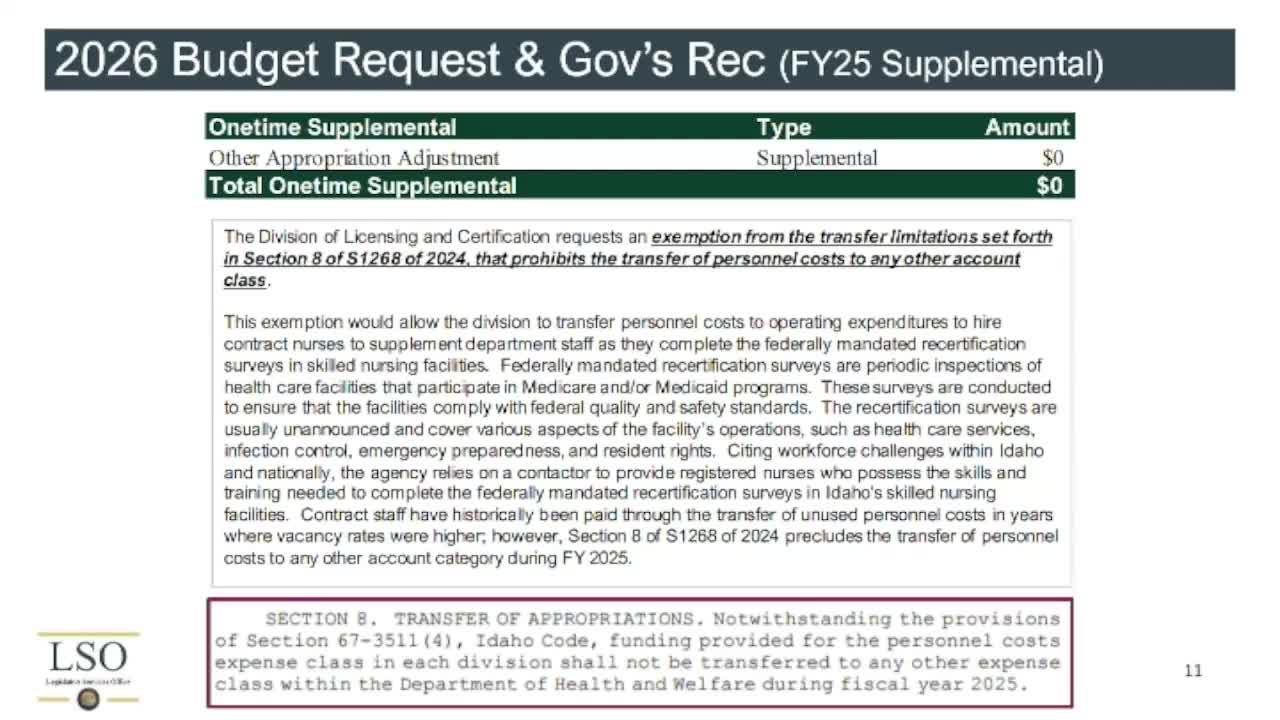
The Idaho Department of Health and Welfare asked the Joint Finance-Appropriations Committee on Jan. 13 for an exemption from a recent transfer limitation so the division of Licensing and Certification can shift personnel dollars to operating as needed to pay contract nurses.
Alex Williamson, budget and policy analyst with the Legislative Services Office, explained the request and the statutory language the division seeks to be exempted from. "The division of licensing and certification, they're requesting an exemption from the transfer limitations set forth in section 8 of Senate Bill 1268 of 2024," Williamson said. The cited restriction bars transfers from the personnel cost expense class to other expense classes within Health and Welfare.
Background and why the request is made: licensing and certification inspects and certifies health-care facilities (including long-term care). The division historically has supplemented staff shortages by hiring contract nurses to perform surveys and certifications. Because the committee placed a restriction on transfers (personnel to operating) in last year—s legislation, the division has sought a one-time supplemental and an ongoing exemption to allow the transfers as needed. Both the supplemental and the ongoing exemption were recommended by the governor in the budget recommendation.
Senator Woodward asked whether the division—s approach meant the work would be one-time only. Williamson said outsourcing surveys is not new; the division has historically used contracted nurses because it does not have enough full-time personnel to perform all surveys.
Director Alex Adams described operational impacts and staffing. He said contract surveyors were paid significantly more than staff: "For staff employees who do this, we pay about 35 an hour. For contract employees, we pay about 90 to 95 an hour." He told the committee long-term-care inspection staffing shortages spiked during the pandemic and have since declined but that some contract support remains necessary to meet federally required inspection intervals (he cited a 15.9-month inspection requirement for skilled nursing facilities).
Williamson told the committee that last year's transfer request had been $400,000; the department used roughly $300,000 and reverted about $100,000. Committee members asked the director and analysts to provide more detail about how much is spent on contractors versus employees and whether the transfer restriction applied to other agencies. Analysts and the director said they would follow up with procurement and spending detail.
Why it matters: the transfer restriction removed an administrative tool licensing and certification used to maintain inspection capacity. Allowing transfers in this division would restore the agency—s ability to continue surveys and certifications when hiring full-time staff is not immediately possible.