Get Full Government Meeting Transcripts, Videos, & Alerts Forever!
Get email alerts on the Prison Security topic
No spam. Unsubscribe anytime.
After prison transport ambush, Idaho corrections requests surveillance tech, transport expansion and body‑worn cameras
Summary
Following a spring transport ambush that left three IDOC staff shot, the Department of Correction told the Joint Finance Preparations Committee it seeks digital mail scanning, drone detection and phone‑call transcription technology plus a 12‑person expansion of its transport bureau and a federally funded pilot for body‑worn cameras.
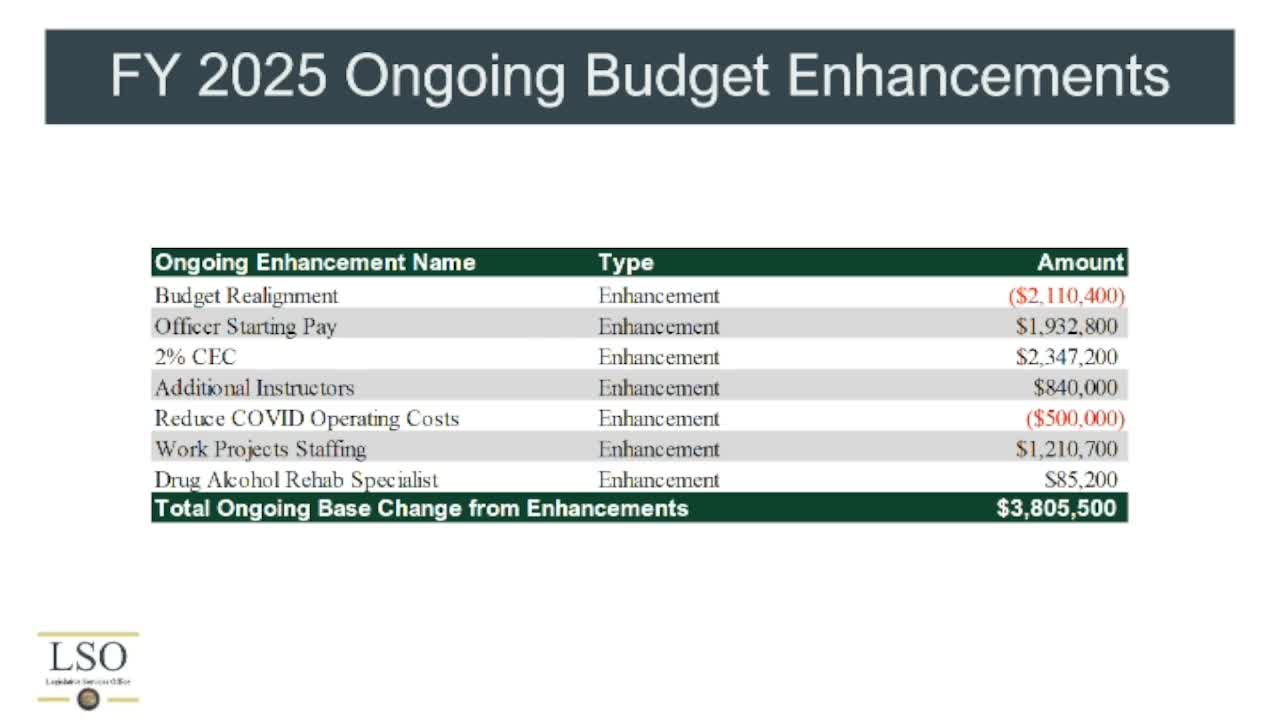
The Joint Finance Preparations Committee heard on Feb. 4 from the Idaho Department of Correction about supplemental and ongoing funding requests aimed at reducing contraband and improving safety after an inmate transport ambush last spring.
Noah Peterson, budget analyst for the Legislative Services Office, and Director Josh Tewalt described a package of items the agency says respond directly to vulnerabilities exposed by the incident in which three IDOC staff were shot while escorting a resident to and from an Idaho hospital.
Agency proposals presented to the committee - Advanced surveillance technology: a supplemental request for the remainder of FY2025 and an ongoing FY2026 request to install digital mail scanning, drone‑detection systems and phone‑call transcription and analysis (the “LEO” intelligence software). The agency characterized these items as aimed at reducing contraband and improving investigative capacity. For a full year, the agency presented an ongoing cost estimate of roughly $2.4 million; a one‑year partial implementation for FY2025 was presented at roughly $795,000. The FY2026 breakout given on the record included an estimate of about $1.011 million for digital mail scanning, $385,500 for drone detection, and $1.0 million for phone‑call transcription and analysis. - Transport bureau expansion: following the hospital transport ambush, the agency requested a one‑time FY2025 supplemental of about $1.15 million to expand the statewide transport bureau. That request included funding for 12 positions for the remainder of FY2025 (roughly $455,000 in personnel costs for the remainder of the year) and about $693,000 in operating costs (noted line‑items included seven vehicles outfitted for secure transport). The agency described the expansion as establishing a trained, fully equipped group to handle high‑risk and emergency transports statewide rather than relying on ad‑hoc, facility‑assigned staff. - Body‑worn camera pilot: the department requested a federally funded pilot to equip three locations (Idaho Maximum Security Institution, district 3 probation and parole, and the IDOC special investigations unit). The supplemental was presented as primarily federal dollars; the agency said FY2025 request would include most federal funds with a small general‑fund portion for licensing and ongoing expenses.
Why the agency says these changes are needed Director Tewalt told the committee the contraband threat has become unusually sophisticated: “The level of sophistication that is being deployed today to introduce contraband into correctional facilities is unlike anything any of us in the field have ever seen.” He described risks from drones, novel methods for concealing contraband in mail (including inks and treated paper) and the scale of resident phone usage (agency testimony cited about 4 million calls totaling roughly 49 million minutes in 2023). The department argued the proposed tech would close high‑risk entry points and allow staff to be redeployed to other security tasks.
Questions and discussion Lawmakers pressed staff on staffing math and alternatives. Senator Cook asked why the request added 12 full‑time positions rather than reallocating existing staff; agency figures cited thousands of overtime hours logged for transport duties (e.g., 20,000 overtime hours at one maximum facility), making a full reallocation impractical without shutting posts. Representative Petzke questioned the governor’s recommendation to contract for snow removal at St. Anthony work camp ($30,000 ongoing) rather than funding a one‑time skid‑loader purchase the agency proposed (about $83,200). Department of Finance and Management staff said the governor preferred contracting as a response to a seasonal need rather than buying costly equipment that could require future replacement and maintenance.
What was not decided The committee received the proposals and questioned costs and staffing implications; no formal appropriation was passed during the hearing.
Ending: agency representatives said the countermeasures aim to harden transport and mail processes, deploy focused transport teams for high‑risk movements, and test body‑worn cameras with federal support; the committee requested additional details on costs, implementation timelines and alternatives.