Get Full Government Meeting Transcripts, Videos, & Alerts Forever!
Get email alerts on the Employee Compensation topic
No spam. Unsubscribe anytime.
Contentious employee compensation proposals withdrawn after extended debate; committee will revisit
Summary
Committee members debated competing approaches to FY2026 salary adjustments'a $1.55-per-hour across-the-board approach advanced by the CEC motion and a substitute that would raise ongoing annual pay by $1.55/hour or 4%, whichever is higher, with merit elements and targeted market adjustments for troopers, nurses and IT/engineering. After lengthy,
A lengthy and sometimes heated debate over change in employee compensation ended Friday with lawmakers withdrawing competing motions and deferring a final decision.
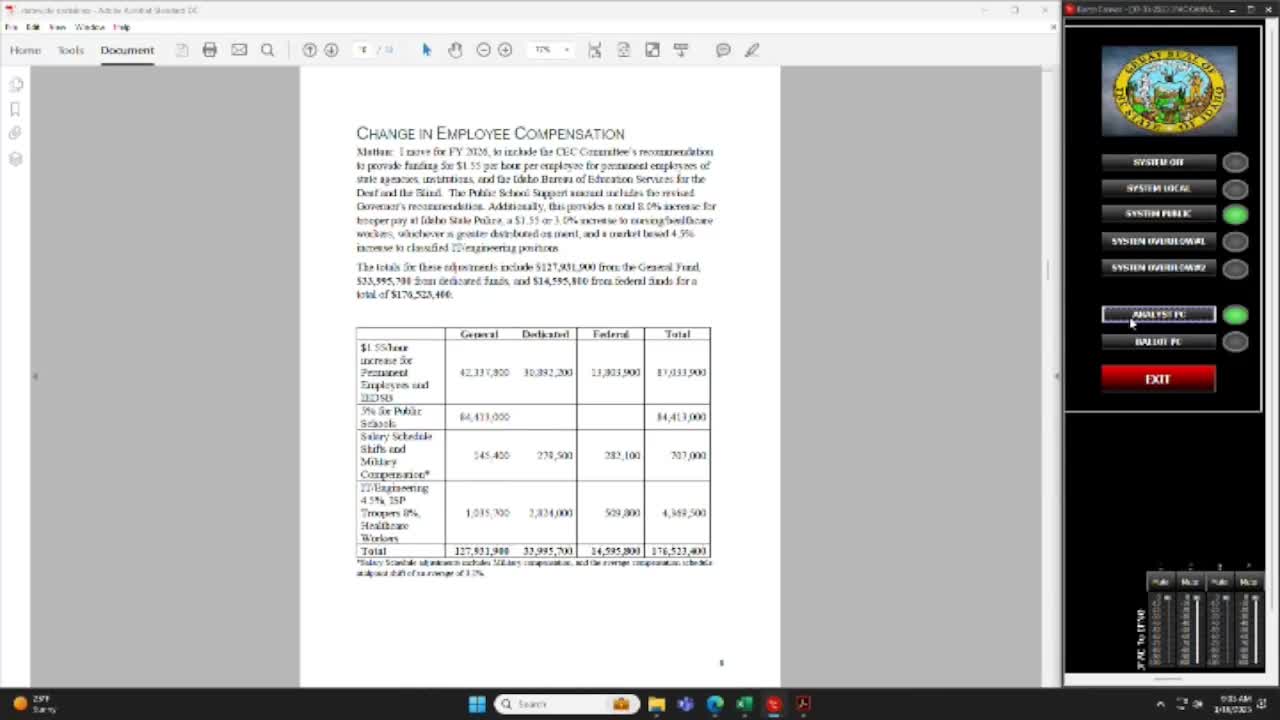
Representative Furness introduced the CEC committee's recommendation to provide a $1.55-per-hour pay increase for permanent state employees (with additional targeted changes: 8% for Idaho State Police troopers, $1.55 or 3% for nursing/healthcare workers, whichever is greater, and a 4.5% market-based increase for classified IT and engineering positions). Furness later amended his motion to explicitly include non-classified IT and engineering positions and provided updated totals; the full motion as revised listed $128,373,200 from the general fund, $34,322,100 from dedicated funds and $14,785,400 from federal funds for a total of $177,480,700 (the packet previously omitted some non-classified IT positions, which Furness corrected on the record).
Senator Cook offered a substitute that would raise ongoing annual salary for each permanent state employee by $1.55 per hour or 4%, whichever is higher, and included the same targeted market adjustments for troopers, nurses and IT/engineering positions. Cook's substitute totaled $42,233,900 from the general fund, $32,460,800 from dedicated funds, and $13,918,700 from federal funds (total $88,613,400); some members noted the difference stemmed in part from how public school support was counted.
The floor heard extended arguments over whether a flat dollar-per-hour raise better helps low-wage workers (a higher percentage increase at the bottom of the pay scale) versus a merit- or percentage-based increase that preserves market differentiation at higher pay levels. Senator Cook framed the substitute as preserving merit and market incentives; Representative Furness and other supporters said the CEC approach targets lower-paid employees who were most affected by cost-of-living pressures. Several members said they supported compromise; others warned about driving up private-sector wages and creating recruitment pressures.
During the debate staff repeatedly checked statutory language about merit and market adjustments in chapter 53, title 67 and advised the committee on limits and typical practice. After extensive discussion and last-minute clarifications of the original motion, both the substitute offered by Senator Cook and the corrected original motion were withdrawn by unanimous consent to give staff time to reconcile numbers and ensure the packet reflected the motions accurately. Committee leadership said the maintenance budget process would proceed the following day and the compensation decisions would be revisited with corrected paperwork and more time for deliberation.