Get Full Government Meeting Transcripts, Videos, & Alerts Forever!
Get email alerts on the Digital Identity topic
No spam. Unsubscribe anytime.
House panel advances bill to allow optional mobile driver's licenses, sends voting-use restriction to floor
Summary
The House Transportation Committee advanced House Bill 78 to authorize optional mobile driver's licenses (MDLs), approved a committee amendment to ban MDLs as proof at polling places, and sent the amended measure to the floor for further action following a roll-call vote.
The House Transportation Committee on a voice and roll-call vote advanced House Bill 78, a bill to authorize an optional mobile driver's license (MDL) issued by the Idaho Transportation Department, and forwarded the measure to the House floor for amendments after a committee substitute that would prohibit use of an MDL for voting.
Proponents said the technology is optional and aims to modernize identity verification. Representative Stephanie Mickelson, sponsor of H78, told the committee the mobile licenses are "100% optional" and said the system uses national standards and digital-trust audits to reduce identity fraud and speed transactions. Lisa McClellan, administrator of the Idaho Department of Transportation's Division of Motor Vehicles, told members that issuance requires a live selfie and "a liveliness check" and that states and DMVs must meet ISO and AMBA-related audit standards before placing keys in the AMBA Digital Trust Service.
Supporters said banks and other reliant parties would need equipment and time to adopt the technology. Stacy Satterly of the Idaho Bankers Association said a secure, real-time credential could help reduce fraud but noted adoption will require investment and that MDLs in Idaho would be optional and issued in addition to the physical card.
Opponents on the committee raised cybersecurity and law-enforcement safety concerns and questioned whether the state should move now. Representative Harris questioned the need and noted implementation costs and safety issues for officers on traffic stops, and Representative Mitchell and others cited security research and lingering vulnerabilities in early MDL implementations. McClellan and Mickelson responded that the current ISO/NIST/AMBA standards and the Digital Trust Service address the vulnerabilities flagged in older systems.
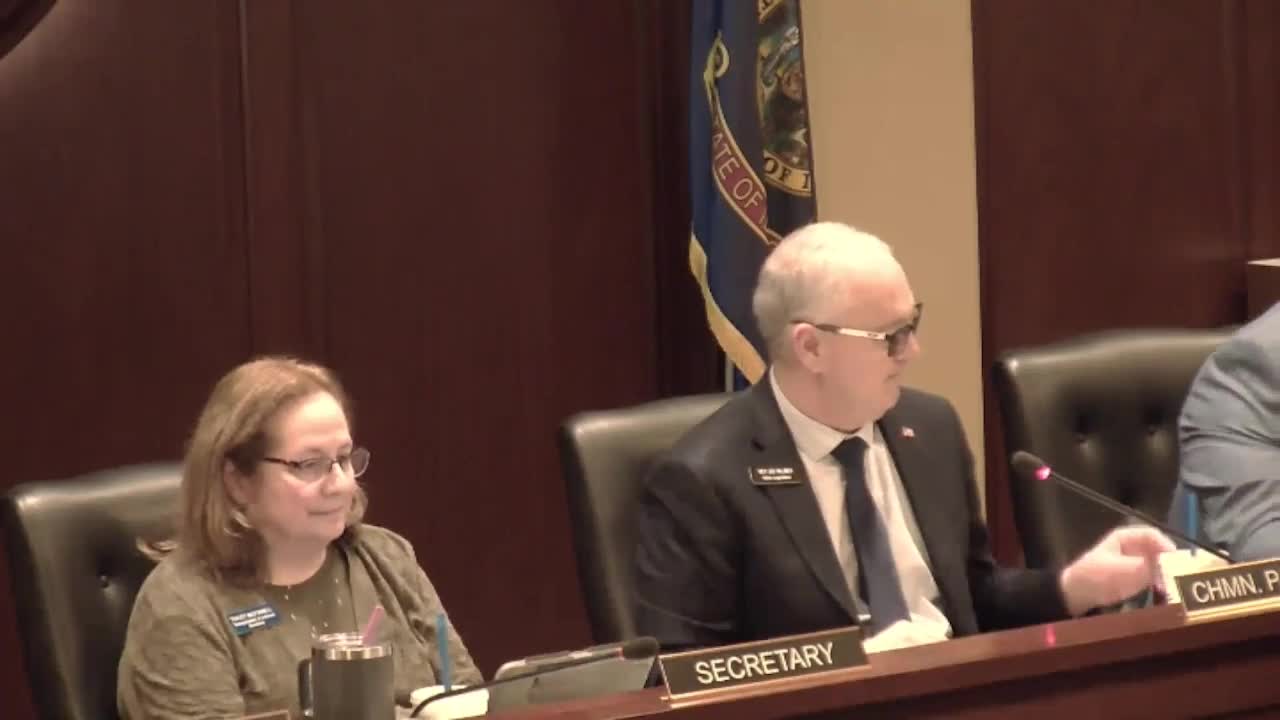
Representative Jim Petzke offered a substitute motion to send H78 to general orders (the House floor for amendment) with a committee amendment that would add language explicitly excluding electronic driver's licenses from being accepted for identification at the polls; Petzke said the amendment would add statutory text to Idaho Code addressing identification at polling places. The substitute motion carried on a roll-call vote; the secretary read individual member votes in the record and the chair concluded, "ayes do have it, it will be sent to the floor for amendments." The roll call recorded several 'aye' and 'no' votes (see action record).
The bill sponsor and DMV staff said the state would still require drivers to carry the physical plastic card while the MDL program ramps up, and they estimated full adoption would take up to one to two years and require additional work with reliant parties. McClellan said MDL issuance is provisioned by DMV and that real-time suspension status would be available to reliant parties that are authorized to consume that information.
Committee members asked about data residency and cross-border use; Mickelson and McClellan said the standards are the same technologies used for passports and other secure credentials and that AMBA is a non‑federal member organization that operates a Digital Trust Service used by many U.S. jurisdictions.
The committee advanced the bill to the floor for amendment; the committee action does not itself change law. The bill will next appear on the House calendar for consideration of the committee amendment and further floor debate.