Get Full Government Meeting Transcripts, Videos, & Alerts Forever!
Get email alerts on the Hb364 Doge Task Force topic
No spam. Unsubscribe anytime.
Legislature creates temporary task force to hunt redundancy and inefficiency in state government
Summary
House Bill 364 would codify the Idaho Department of Government Efficiency (DOGE) task force, establish membership and subgroups, and set a sunset date; the committee gave the bill a due-pass recommendation after testimony and debate.
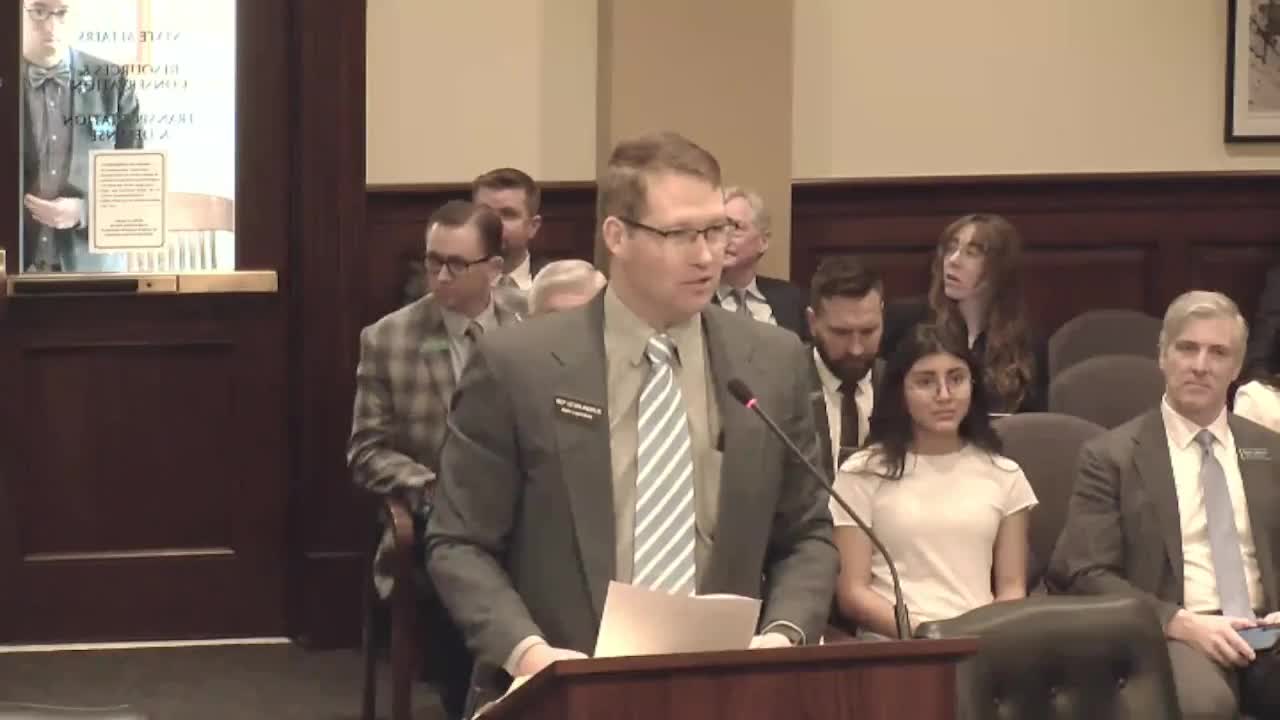
Representative Jaren Crane (Representative, District 12) introduced House Bill 364 to codify and direct a legislative task force — referred to in the bill as the Idaho Department of Government Efficiency (DOGE) task force — to study agency functions, regulatory processes and budget authority and recommend streamlining and consolidation where appropriate.
Crane described the bill as a targeted effort to identify redundancies across roughly 189 state agencies and multiple boards and commissions. "Government inefficiencies, redundancies, and regulatory burdens contribute to unnecessary costs and operational delays and they hinder economic growth and effective public service," Crane said.
The bill sets membership (three House members appointed by the Speaker, three senators appointed by the Senate President pro tem, and three legislative members from the Joint Finance-Appropriations Committee), allows two nonlegislative advisers, and authorizes three subgroups focused on regulatory accountability, budget accountability and government operations and oversight. It also includes a sunset date: the task force shall operate until Nov. 30, 2029.
Committee members probed for overlaps with existing oversight and evaluation mechanisms. "What would you say to those who do say this is a redundant program being we do have JFAC, we have the legislature, we have the office of performance evaluations that delves into a lot of this?" Representative Hostetler asked. Crane said the group would be a year-round working body able to meet more frequently and bring focused, implementable recommendations to the legislature.
Public testimony included opposition from Laura Miller, who said the task force would be redundant and risk shifting regulatory authority from agencies to statute. Supporters Billy Norp and Jordan Redmond testified in favor, arguing the task force could find savings and improve government efficiency; Redmond suggested starting with Medicaid improper payments as a target.
Representative Boyle moved to send HB364 to the floor with a due-pass recommendation; the motion carried by voice vote. The committee record shows one negative in-person testimony and multiple supporters; no amendments were adopted during the committee action.