Get Full Government Meeting Transcripts, Videos, & Alerts Forever!
Get email alerts on the Campaign Finance topic
No spam. Unsubscribe anytime.
Committee reviews wide-ranging campaign finance overhaul; trigger to raise contribution limits cut to $10,000
Summary
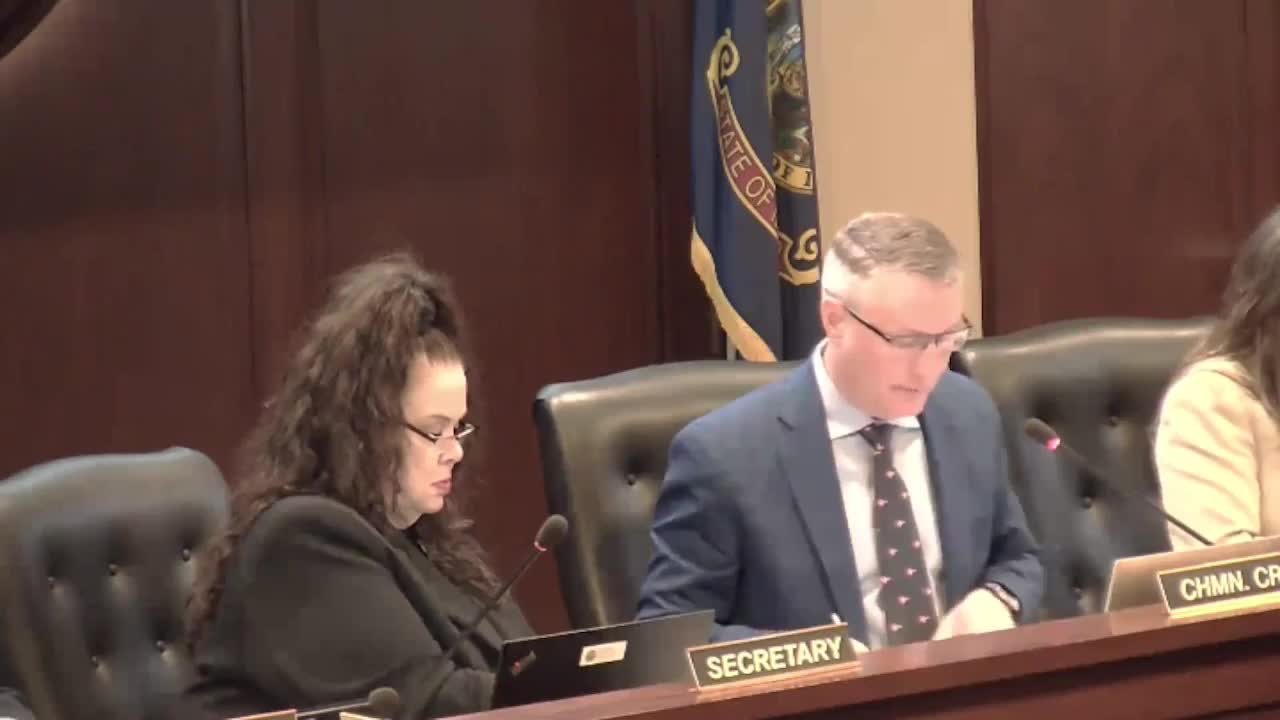
Secretary McGrane, the state elections official, spent the committee's time detailing a proposed recodification of Idaho's Sunshine Law aimed at separating campaign finance rules from lobbying law and increasing transparency in political spending.
Secretary McGrane, the state elections official, spent the committee's time detailing a proposed recodification of Idaho's Sunshine Law aimed at separating campaign finance rules from lobbying law and increasing transparency in political spending.
The measure under discussion would require more frequent reporting by political committees, add 48-hour reporting for independent expenditures over $1,000, create an online ad library that requires digital copies of paid communications, and revise the fine structure. It would also raise contribution limits for legislative candidates from $1,000 to $1,500 and statewide offices from $5,000 to $6,000. The earlier draft included a trigger allowing candidates in a race to accept larger contributions if negative independent expenditures against that race reached $50,000; the committee later voted to reduce the post-trigger maximum from $25,000 to $10,000.
Why it matters: supporters said the changes would make disclosure more timely and easier for candidates and the public to use; opponents warned higher limits and the trigger could let out-of-state money drive races and escalate overall spending.
Key points from the presentation and debate
Secretary McGrane framed the bill as a modernizing recodification. "This legislation really aims to increase transparency by increasing the frequency of reporting," he said, describing monthly reporting for political committees year-round, quarterly or monthly reporting for candidates depending on the year, and a 48-hour requirement for independent expenditures over $1,000. He also described an ad library requirement that would let the public see the artwork and text of paid communications, and said the bill restructures fines to be more formulaic so penalties scale with the size of a violation.
McGrane provided data from the last election cycle, saying "during the last election cycle ... there was over $17,000,000 spent just in legislative races alone. Of that $17,000,000 about $7,000,000 came from candidates [and] the other $10,000,000 came from independent expenditures" to underline the bill's aims.
Supporters and details
Proponents argued the reorganization would make compliance simpler for candidates and smaller groups by separating candidate rules, political committee rules and independent-expenditure rules. The ad library provision, modeled on the commercial platforms' libraries, would require independent-expenditure committees to upload digital versions of what they spent on so "in addition to the funding, you'd get to see the actual artwork of whatever was done," McGrane said.
The bill replaces a small flat fine structure with percentage-based penalties and distinct late-report fines (an example given was lowering a $50-per-day approach to $50 plus $10 per day with a $1,000 cap for certain late reports) so small clerical errors are treated differently than large, knowing violations.
Concerns and amendments
Several members warned the changes could increase the role of large donors and out-of-state groups. Representative Crane said he worried that raising limits and a large trigger could inflate costs in otherwise moderate legislative races. Representative Boyle and others argued the trigger needed to be high enough for candidates to have the ability to respond to large negative independent expenditures.
Representative Achilles proposed and the committee approved an amendment to lower the post-trigger contribution cap from $25,000 to $10,000 on page 13, line 9 of the RS. The committee's action altered the earlier version's emergency threshold and reduced the amount candidates could accept after the trigger was reached.
Formal action
- The committee voted to hold House Bill 399 in committee. (Motion to hold by Representative Mickelson; motion carried.) - Representative Alfieri moved to introduce RS32713C1 and send it to the second-reading calendar. During consideration, Representative Achilles offered an amended substitute reducing the post-trigger cap from $25,000 to $10,000. The amendment passed; the RS as amended was introduced and sent to the second-reading calendar. Representative Scott and Representatives Barbieri and Palmer were recorded voting no on the amendment.
What remains unclear
The RS as introduced keeps the trigger tied to a $50,000 threshold of negative independent expenditures that would enable the higher per-donor limits; committee members debated whether the threshold and the post-trigger amount strike the right balance. Several speakers said they expected further refinements after implementation.
Ending note
Committee members signaled broad interest in improving disclosure but divided views on contribution limits and the trigger mechanism. Supporters urged adoption to give the public more timely data; critics urged narrower, more incremental changes so constitutional and administrative issues can be worked out before broad changes take effect.