Get Full Government Meeting Transcripts, Videos, & Alerts Forever!
Get email alerts on the Public Health Governance topic
No spam. Unsubscribe anytime.
Committee holds bill that would require elected officials on district health boards
Summary
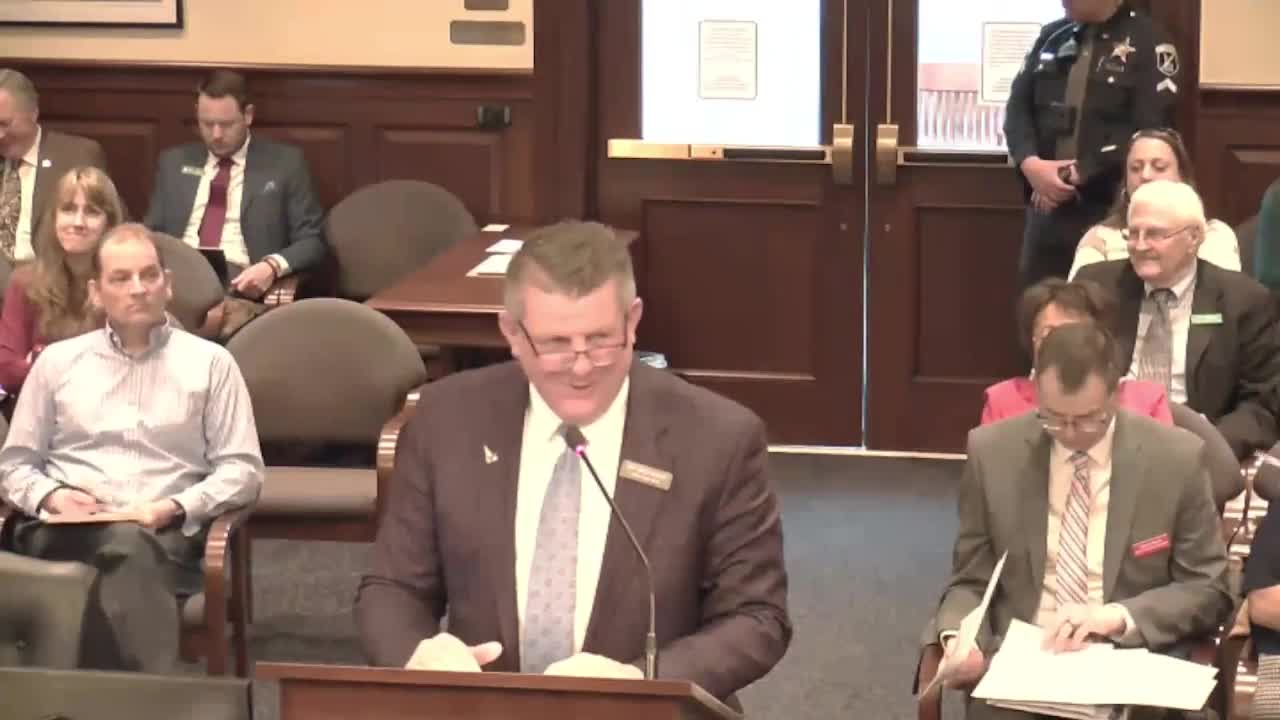
Representative Doug Pickett (R.-Dist. 27) introduced House Bill 366 on the Idaho House Health and Welfare Committee agenda, saying the measure would require representatives on district health boards to be elected officials or other elected officeholders appointed by county commissions.
Representative Doug Pickett (R.-Dist. 27) introduced House Bill 366 on the Idaho House Health and Welfare Committee agenda, saying the measure would require representatives on district health boards to be elected officials or other elected officeholders appointed by county commissions.
The bill was prompted by county commissioners in Pickett’s district and, he told the panel, aims to ensure those who sit on district health boards are “accountable to the public.” “This bill is intended to ensure that representatives on District Health Boards are elected officials,” Pickett said.
The measure would preserve an existing allowance for a physician to serve on district health boards, and — after changes made during drafting with county feedback — would permit a county commission to appoint other elected officials (for example, a sheriff or clerk) where county commissioners themselves cannot serve. The printed draft also contains language giving appointment priority to the county that provides the greatest share of district funding.
Former state Rep. Greg Furch testified in opposition on his own behalf, telling the committee the concerns HB 366 aims to address are largely covered by a 2021 law. “In 2021, those of us that were here, we passed Senate Bill 1060, and what Senate Bill 1060 did is required that any mandate of a health district be rubber stamped by the county commissioners in that jurisdiction within seven days,” Furch said. He argued that the statute already gives elected officials accountability over district mandates and that removing non‑elected subject‑matter experts from boards could reduce technical competence on issues ranging from dental sealant programs to mobile clinics.
Committee members asked how widely counties already use elected officials on district health boards and how the appointments would be prioritized. Pickett said he had not completed an inventory of every district but that county commissioners in his region raised the issue and requested the committee consider where accountability should reside: “Where should the accountability lie? And should the accountability be exercised by an employed position or by an elected official?” he said.
Members also questioned two specific draft provisions: a clause that would let the county that contributes the most funding appoint an additional seat, and a change that would increase the vote threshold for removing a board member from a simple majority to two‑thirds. Pickett said the priority language and the two‑thirds removal threshold were added after county discussions and reflected feedback received during drafting.
Committee debate produced three competing motions. Representative Kaler moved to hold the bill in committee, saying she supported the accountability principle but worried about concentrating offices in one person and preferred keeping subject‑matter experts available for appointment. Representative Furman offered a substitute motion to send HB 366 to the floor with a due‑pass recommendation. Representative Rubell then offered an amended substitute: send to general orders but change the two‑thirds removal requirement to a simple majority. The amended substitute motion failed on a roll call vote (4 ayes, 11 nays). The substitute motion to send the bill to the floor with a due pass recommendation also failed on a roll call vote (4 ayes, 11 nays). The committee then approved the original motion to hold the bill in committee by roll call, 13 ayes to 2 nays. The committee chair announced: “House Bill 366 will be held in committee.”
Why it matters: HB 366 would change how local health districts are governed across Idaho, potentially replacing appointed subject‑matter members with elected officials. Supporters framed the proposal as a question of fiduciary accountability for the disposition of public resources; opponents and some committee members warned it could reduce technical expertise on boards and concentrate multiple offices in single individuals. The bill’s hold leaves the current statutory framework in place for now.
Votes at a glance
- Amended substitute motion (Representative Rubell): change two‑thirds removal to simple majority and send to general orders — failed, roll call 4 ayes, 11 nays. (Yes: Wheeler, Furman, Rubell, Egbert.) - Substitute motion (Representative Furman): send to floor with due pass recommendation — failed, roll call 4 ayes, 11 nays. (Yes: Wheeler, Furman, Rubell, Egbert.) - Main motion (Representative Kaler): hold the bill in committee — passed, roll call 13 ayes, 2 nays.
What’s next: With the committee vote to hold, HB 366 will not advance this week. Sponsors and interested counties may return with amendments or additional information if they pursue reconsideration.