Get Full Government Meeting Transcripts, Videos, & Alerts Forever!
Get email alerts on the Provider Payments topic
No spam. Unsubscribe anytime.
Committee clears bill letting providers opt into credit-card payments if fees disclosed
Summary
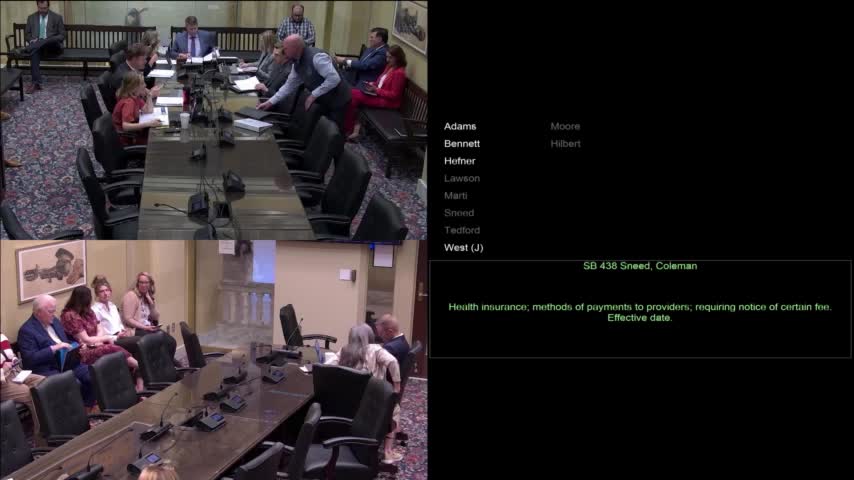
A House insurance subcommittee advanced Senate Bill 438, which would ensure health-care providers are notified when insurers send payments by credit card and allow providers to opt in rather than be required to accept card payments; sponsors said providers must be told of any fees.
Chairman Sneed explained Senate Bill 438 to the committee and said the bill would require that providers be notified when insurers send payment by credit card, Automated Clearing House (ACH) or check.
The measure matters because it addresses a payment method some members said can delay or complicate providers' access to funds and may carry transaction fees.
Sneed, the bill presenter, told members the bill's intent is narrowly procedural: to ensure providers are notified of the payment method used by insurers. A committee member asked whether providers actually receive insurer payments on physical credit cards or by a printed card-like instrument; Sneed replied, "Not to my knowledge." During discussion, a member who said they had been a provider described receiving credit-card–style payments as more difficult to access than a check or ACH deposit.
The committee debated whether the bill should prohibit credit-card payments or preserve provider choice. Sneed said the committee could clarify that the provider chooses ACH, check or credit card, and added that "if you choose credit card, then they would have to notify you of any fees as well that you could possibly be charged when transferring your money." A member suggested the card option should be opt-in; Sneed confirmed, "You would have to opt into the credit card." Another member, Leader West, made a light remark about adding data-privacy language to the bill.
After questions, a motion to advance the bill was seconded and the committee opened the vote. The roll-call exchange included members recorded as voting in the affirmative: Marty and Tedford. Staff then declared the vote and returned the gavel to the chairman.
The committee record shows the motion carried and the bill will be recommended to the next committee for further consideration. The discussion on the floor left clear distinctions between discussion (concerns about payment mechanics and fees), direction (draft language to make provider choice explicit and require fee notice), and the formal action to advance the bill.
Votes: The transcript shows Members Marty and Tedford recorded as voting "aye." A complete roll-call tally was not provided in the transcript excerpt.
What happens next: The committee recommended SB 438 to the next committee; any technical changes (opt-in wording, fee-notice requirements) could be drafted before the next hearing.