Get Full Government Meeting Transcripts, Videos, & Alerts Forever!
Get email alerts on the Agricultural Research Extension topic
No spam. Unsubscribe anytime.
University of Idaho leaders seek continued support for agricultural research and extension; broadband outreach and Parma lab cited
Summary
Dean Michael Perella briefed JFAC on the Agricultural Research and Extension Service’s FY2026 requests including $157,900 for viticulture research and $250,100 for building maintenance. Perella highlighted a new Parma research lab, extension outreach numbers and a federal broadband literacy project tied to rural digital inclusion.
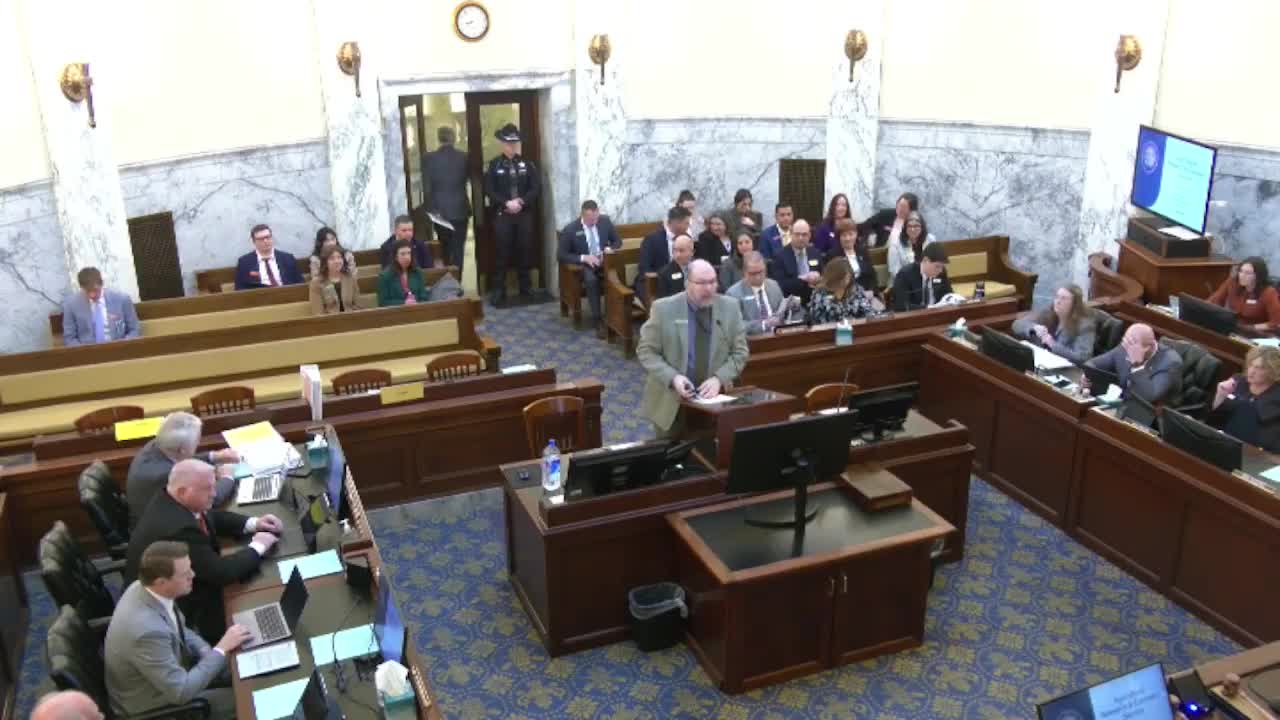
Kevin Campbell, budget and policy analyst with the Legislative Services Office, presented an overview of the Agricultural Research and Extension Service’s base budget and FY2026 requests to the Joint Finance‑Appropriations Committee on Feb. 10. Dean Michael Perella, College of Agricultural and Life Sciences at the University of Idaho, and senior college staff answered committee questions.
Campbell said the research arm — the Idaho Agricultural Experiment Station — operates 10 research and extension centers and has access to roughly 14,000 acres for field research. He reported a current full‑time equivalent staff count of about 341.33 FTP and said roughly 81% of service expenditures are in personnel, with operating costs at about 10% and capital outlay at about 9.1%.
The service’s FY2026 budget requests include $157,900 ongoing for a viticulture and small fruits research faculty position and $250,100 for a portion of building maintenance costs at the Idaho Center for Agriculture, Food, and the Environment in Parma. Campbell said the viticulture position responds to grower requests for research into disease prevention, water and pest management, and post‑harvest storage practices for grapes and small fruits.
Dean Perella described the college’s statewide presence and said extension programs reached Idahoans through “more than 450,000 face‑to‑face contacts” last year and engaged “over 75,000 youth in Idaho 4‑H youth development programming.” He said the college leverages legislative investments to attract federal and private grants and cited the new Idaho Center for Plant and Soil Health at Parma as an important infrastructure upgrade.
Perella announced his impending retirement in June and thanked the legislature for sustained support. “I am joined by several individuals that are critical to the functioning of the college,” he said, and introduced college staff in the room including the interim associate dean for research and the director of extension.
Committee members asked why extension is involved in adult computer literacy and digital inclusion work. Perella and staff explained that Extension’s mission includes community and family programs in addition to production agriculture; those programs target rural residents who face a digital divide and seek to build basic computer and workforce skills. Campbell and Perella said the work was initially supported with ARPA funds and that the college has pursued additional federal funding to sustain the effort.
Perella told the committee the college applied for and won one of 24 Federal Communications Commission‑funded digital inclusion projects, a $13 million award that would expand community digital literacy and is coordinated across two‑year and four‑year institutions and local partners. He said the project aligns with Department of Commerce efforts to expand broadband and digital skills in rural areas.
Senators and representatives asked for measures and outcomes. Perella said extension gathers participant feedback after sessions and uses outcome measures tied to participant‑reported benefits; he pointed to the $47 million in estimated savings reported by program participants in the most recent accounting as an example of measured impact and offered to provide the committee detailed breakdowns.
Lawmakers also raised the broader budgetary question of sustaining programs started with one‑time federal money. Several committee members said they want to identify which programs funded with ARPA and other federal sources are effective and whether state funding should continue. Staff said the committee will pursue follow‑up reviews and deeper analysis in interim work and summer oversight efforts.