Get Full Government Meeting Transcripts, Videos, & Alerts Forever!
Get email alerts on the Savings And Reserves topic
No spam. Unsubscribe anytime.
Budget office: budget stabilization fund near statutory cap; governor proposes $59 million transfer
Summary
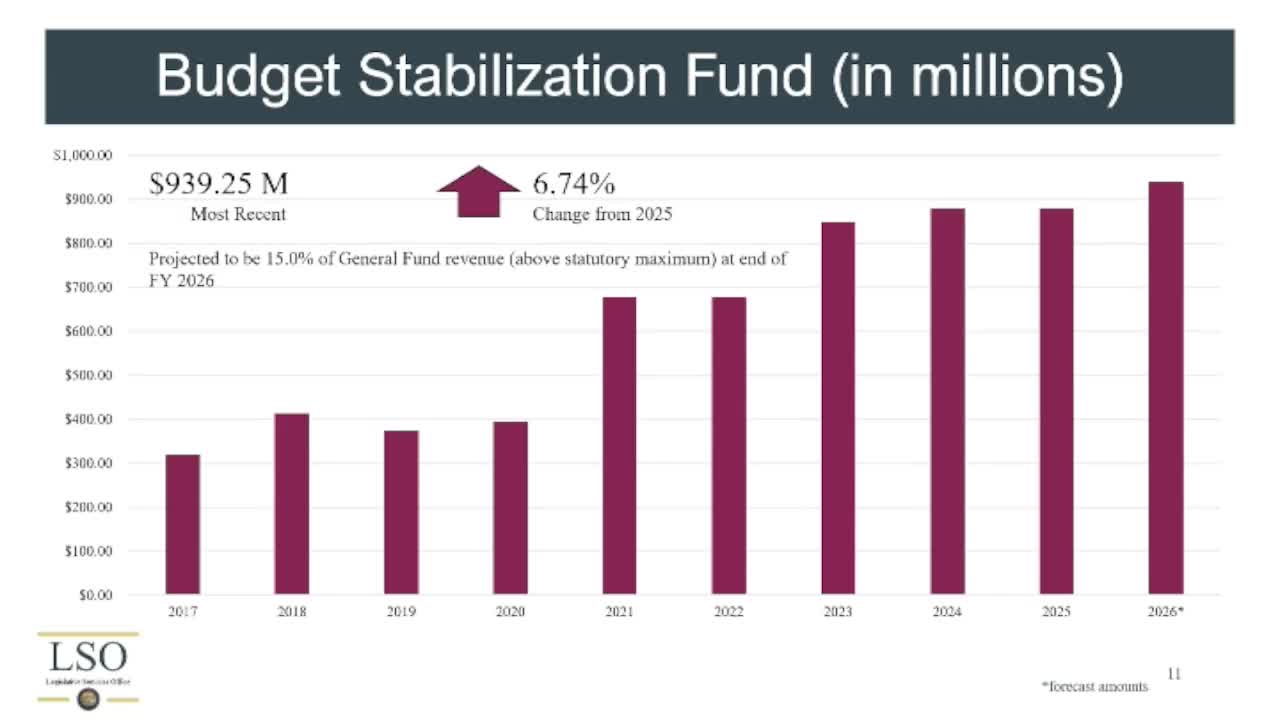
Legislative staff said the governor's recommended transfer would raise the budget stabilization fund to about $939 million (near a 15% statutory cap); committee discussion noted a prior temporary suspension of the cap and asked how interest and TANs interact with cash management.
Keith Bybee, division manager for budget policy analysis, walked JFAC through the state's savings accounts and the budget stabilization mechanics, saying the governor's recommendation would add $59 million to the budget stabilization fund and bring it to its largest balance historically.
"That additional $59,000,000 represents a 6.7% increase from fiscal year 2025. It currently sits at $880,000,000 and that would hit the statutory limit of 15% of general fund revenues, if revenues showed up just exactly as we're projecting them today," Bybee said. He explained the legislature passed a temporary measure last year to set aside the statutory cap so that excess funds would remain in the savings account rather than automatically flow back to the general fund.
Bybee contrasted the budget stabilization fund with the public education stabilization fund (PSIF), which functions as overdraft protection for public school support; with the governor's proposal PSIF would move to about $293.6 million. He also walked members through a historical comparison of cash position in 2009 versus the present, noting that conservative budgeting and savings helped the state weather the 2009 recession and that current cash positions are substantially stronger.
Representative Furness asked about where interest on cash balances is recorded and how it appears in reconciliation. Bybee deferred to a later presentation from the treasurer's office and deputy staff responsible for cash management, noting that interest earnings and tax‑anticipatory note (TAN) borrowing typically offset each other in the general fund reconciliation.
Why it matters: savings account size and statutory caps affect how much one‑time versus ongoing spending the legislature can authorize, and whether lawmakers should prioritize replenishing reserves or using cash for policy investments.
No formal vote was taken; staff flagged that the statutory cap and transfers would be decisions for the legislature when it finalizes FY2026 appropriations.