Get Full Government Meeting Transcripts, Videos, & Alerts Forever!
Get email alerts on the Industrial Commission Budget topic
No spam. Unsubscribe anytime.
Industrial Commission asks for IRIS maintenance, new staff and four SUVs in 2026 budget request
Summary
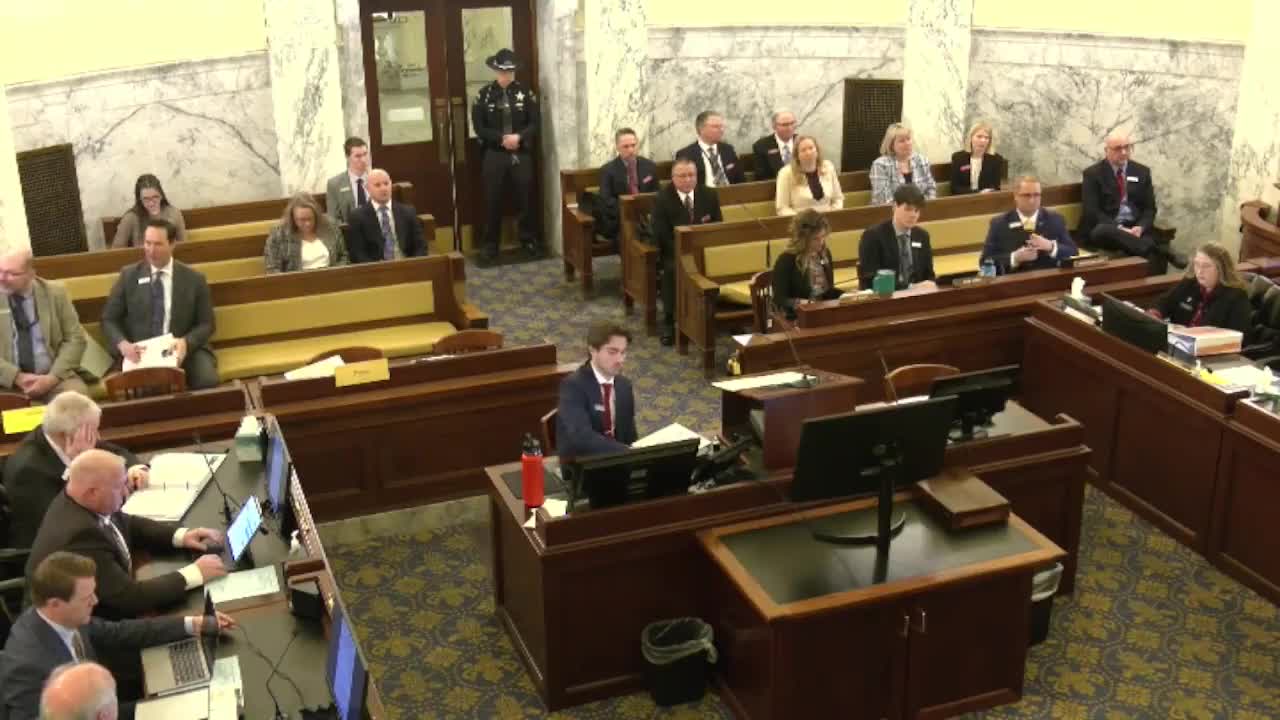
The Idaho Industrial Commission told the Joint Finance Preparation Committee on Jan. 23 that its FY2026 budget request centers on maintaining the IRIS case-management system, filling vacant positions, and replacing high-mileage field vehicles.
The Idaho Industrial Commission told the Joint Finance Preparation Committee on Jan. 23 that its FY2026 budget request centers on maintaining the IRIS case-management system, filling vacant positions, and replacing high-mileage field vehicles.
Noah Peterson, budget and policy analyst for the Legislative Services Office, told the committee the Industrial Commission has 130.25 full-time positions authorized and 12 vacancies as of August, and that the agency is a dedicated-fund agency with no general-fund appropriation. Peterson said the agency reverted $4,555,000 in the prior year, noting in particular that trustee-and-benefit payments were a primary driver of the reversion.
The agency’s IRIS project — a multi-year effort to digitize previously paper-dependent processes — accounted for a large share of one-time appropriations. Peterson said between fiscal years 2021 and 2025 the commission received $12,874,000 in one-time appropriations for IRIS and that the FY2026 request includes a $288,000 one-time maintenance contract to provide longer-term technical support because the state Office of Information Technology Services has not been able to assume that work.
Why it matters: The commission administers workers’ compensation adjudication, rehabilitation and a crime victims compensation program. Delays in processing payments to victims and in adjudicating cases can affect injured workers, claimants and employers.
Director George Gutierrez told the committee the agency has shifted responsibilities as IRIS automated paper workflows, and that some tasks previously done by referees or in-house legal staff now require more advanced review earlier in the process. "The difference here is some of those responsibilities that they were doing before in terms of gathering documentation and just passing it on fell to our, our, referees to work on. So now we're shifting some of that responsibility back to our legal associates," Gutierrez said, explaining why the agency is seeking reclassifications and a referee position.
Key requests and context
- IRIS maintenance contract: Peterson described a $288,000 one-time request to fund contracted technical support for IRIS after ITS said it could not provide that service immediately.
- Staffing and reclassifications: The commission requested an ongoing $66,500 for a senior financial technician to support the Crime Victims Compensation program (intended to improve a target payment turnaround of 30 days), a $111,600 ongoing referee position to reduce hearing and decision delays, a $32,300 ongoing rehabilitation field consultant for the Twin Falls/Burley area, $25,500 to reclassify five adjudication associates, and $62,300 for a technical records specialist. Peterson said no new FTPs were requested; the agency intends to use vacant FTPs for many of the positions.
- IRIS contingency and replacements: The agency requested a $30,000 one-time contingency for IRIS and $104,200 for IT replacement items (laptops, monitors, docking stations). Peterson said the agency had one-time IRIS appropriations of $3,500,000 in a prior year and moved $47,000 across funds to align statutory purposes.
- Vehicles: The commission requested four small SUVs to replace field-office vehicles with mileage from about 82,000 to 98,000 and model years roughly 2006–2011. Director Gutierrez said recurring mechanical failures and safety concerns drove replacement requests for field staff who meet injured workers and employers in remote areas.
Reversions and restrictions
Representative Petzke asked whether reverted funds could be used to fill positions. Peterson and Gutierrez said large portions of the reversion were trustee-and-benefit payments (including payments tied to peace officer temporary disability and crime victims compensation) and that the commission lacks unilateral authority to reallocate those monies; shifting trustee/benefit appropriations would require legislative or other approval. Gutierrez said, "the majority of the reversion that we sent back are from our trustee and benefits," and that those funds are constrained by statute.
Performance and operational effects
Committee members pressed the agency on why IRIS had increased the skill level needed for some positions instead of reducing work. Gutierrez said IRIS increased the volume and number of data sources the agency can ingest, producing more cases and more complex records that must be reviewed before they go to hearing, and that a previous in-house deputy attorney general assignment changed to work handled by the Attorney General’s civil litigation division, which created additional preparation needs for the commission’s staff.
Director Gutierrez said the commission had reduced a backlog of crime-victim payments by shifting staff temporarily and that ongoing staffing would prevent backsliding: "We are caught up. And we want to prevent any backslide and so we need more resources in that area."
What the governor recommended
Peterson said the governor’s recommendation included a 5% CEC (cost-of-living/compensation) increase for commissioners and did not recommend the IRIS contingency fund. The right-hand column of the budget tables Peterson presented showed the governor’s recommended adjustments to each request.
Where to follow up
The commission told the committee it would provide a fleet list and additional detail on the IRIS maintenance contract and overall IRIS expenditures. Representative Tanner requested a written breakdown of all IRIS spending and functionality; Gutierrez and Peterson agreed to provide that report.
Ending
The commission asked for the committee’s support for its FY2026 requests; Director Gutierrez closed by thanking members for prior support of strategic initiatives and asking for continued consideration of the budget requests.