Get Full Government Meeting Transcripts, Videos, & Alerts Forever!
Get email alerts on the Personnel Benefits Health Insurance topic
No spam. Unsubscribe anytime.
JFAC debates health-insurance reserves and compensation; multiple benefit/compensation motions fail or are deferred
Summary
Committee members debated proposed health-insurance premium bases, reserve risk and competing compensation schemes. Motions to adopt both the governor's and CEC's health-insurance recommendations failed to secure required bicameral majorities; separate proposals on employee compensation were withdrawn and deferred for further staff work.
The Idaho Joint Finance-Appropriations Committee spent extended time debating two interrelated subjects: (1) the health-insurance per-eligible-FTE base used for FY2026 budgeting and the plan's contingency reserves; and (2) proposed changes to employee compensation that the Change in Employee Compensation (CEC) committee had recommended.
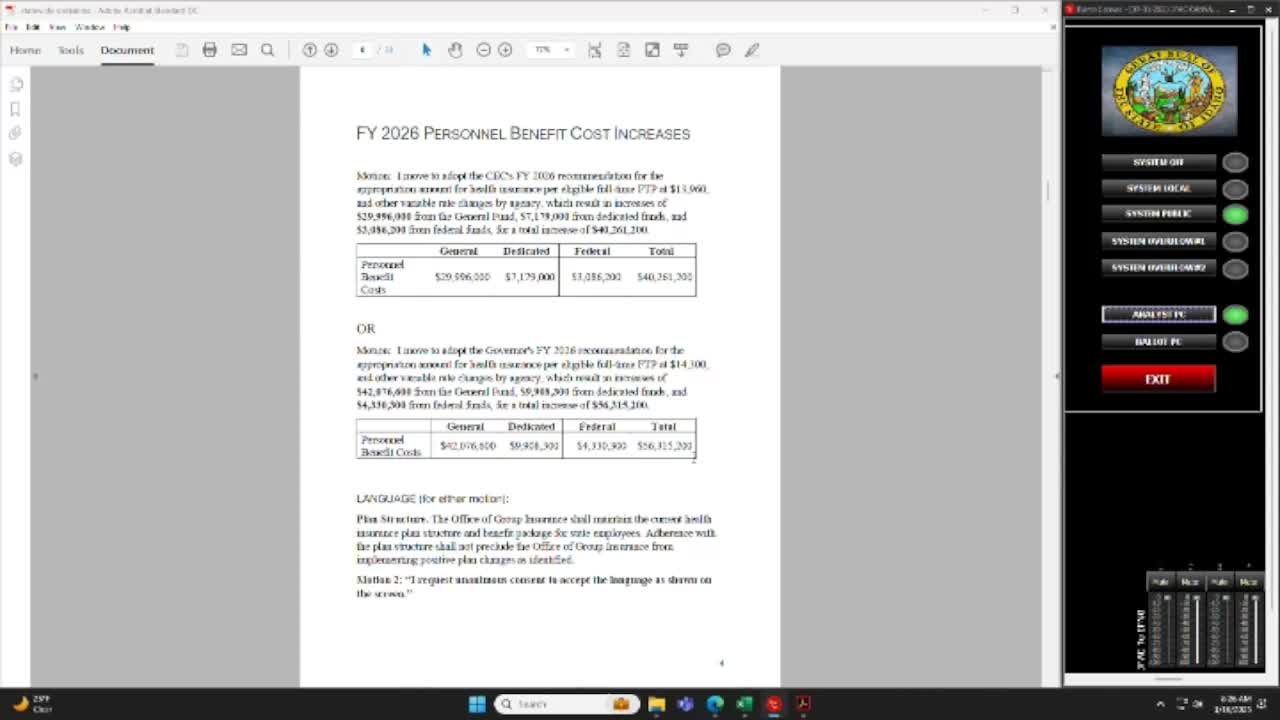
Health insurance: analysts presented two competing proposals for the health-insurance per-eligible-FTE base. The CEC committee recommended $13,960 per eligible FTE; the governor recommended $14,300. Division of Financial Management analyst Keith Bybee cited the Milliman actuarial projections showing the current contingency reserve balance at roughly $80,491,337. Milliman projected that adopting the CEC recommendation would reduce the reserve to about $51,600,000 (near the contractual 10% minimum); adopting the governor's recommendation would leave about $61,400,000, providing an additional roughly $10 million cushion.
Division of Financial Management administrator Laurie Wolf and Faith Knowlton, administrator for the Office of Group Insurance, advised the committee about legal/contractual risks. Knowlton told the committee, "If we fall below the 10% contingency reserve, then a risk charge can be assessed to the state." Wolf said the 10% contingency level is contractual and that budgeting to that floor carries a 50% chance of falling below the contingency in the actuary's stochastic scenarios.
On the floor, Representative Miller moved to adopt the governor's $14,300 per eligible-FTE recommendation; Senator Woodward seconded. Representative Furness (substitute) moved to adopt the CEC recommendation of $13,960. Both the substitute and the original motion failed to achieve the required bicameral majority: the substitute motion failed by a grand total of 9 ayes to 11 nays; the original motion later failed to secure a Senate majority and therefore also failed. Committee members debated risk tolerance, the contractual minimums, historical reserve draws and the possibility of higher premiums in future years if the committee selected the lower amount.
Compensation (CEC) debate: the committee also debated the CEC committee's recommendation for change in employee compensation. The original CEC motion (mover: Representative Furnace) proposed a $1.55-per-hour increase for permanent employees (effectively a sliding percentage that is larger at lower wage levels), plus targeted increases including an 8% trooper pay boost, a $1.55 or 3% nursing/healthcare increase (whichever is greater), and a 4.5% market increase for classified IT and engineering positions; the motion included public-school support amounts as the governor revised them. Senator Cook offered a substitute that would increase ongoing annual salary by $1.55 per hour or 4%, whichever is higher, with the same targeted language for public safety, nursing and IT positions.
The session included extended, sometimes spirited debate over equity versus merit, market-competitiveness, impacts on turnover and whether increasing pay for higher-paid technical staff would drive private-sector wage inflation. Senator Cook argued against a flat across-the-board amount and in favor of merit and market-based adjustments; Representative Furness and others argued the per-hour approach benefits lower-wage employees most. No compensation motion was adopted during the session; by unanimous consent and with leaders and staff asking for time to reformat and confirm numbers, both the substitute and the original compensation motions were withdrawn late in the meeting to allow staff time to produce corrected text and numbers. Chair Groh and committee leaders said the compensation and benefits items will be revisited at a later meeting after staff revisions.
What members said on the record: Faith Knowlton (Office of Group Insurance) cautioned about the contractual consequence: "If we fall below the 10% contingency reserve, then a risk charge can be assessed to the state." Senator Cook characterized the debate over equal-dollar versus merit-based increases sharply, saying in debate, "Equity breeds entitlement." Representative Furness, arguing for the CEC approach, noted that the $1.55 hourly increase represents a higher percentage raise for lower-paid employees and highlighted the committee's aim to help those workers.
Outcome: No health-insurance or compensation motion was adopted in this session; some motions failed on recorded tallies and compensation motions were withdrawn by unanimous consent to allow staff time to rework numbers and language. The committee will return to the items at a later date.