Get Full Government Meeting Transcripts, Videos, & Alerts Forever!
Get email alerts on the Student Technology Safety topic
No spam. Unsubscribe anytime.
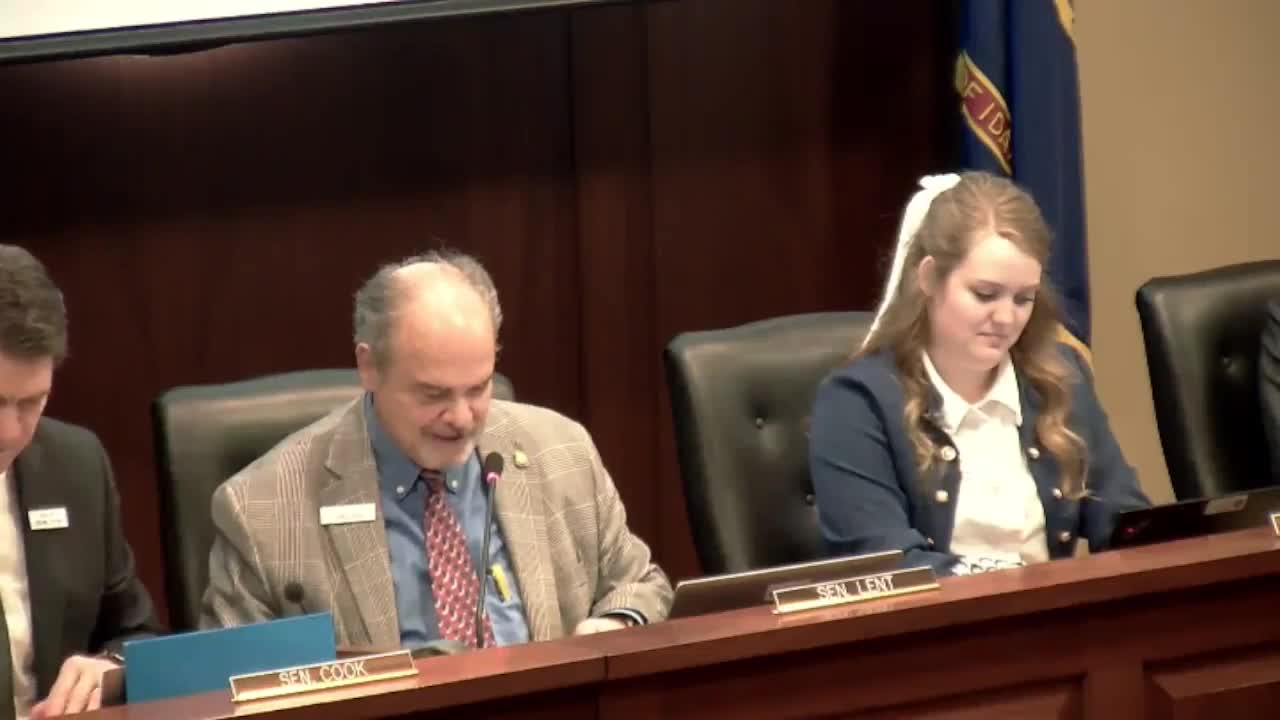
Senate education panel advances bill to require schools to provide parents online training about risks of school-issued devices
Summary
The Senate Education Committee voted to send Senate Bill 1070 to the Senate floor with a due-pass recommendation; the bill would require districts to make available a free online parent education program describing risks and best practices for school-issued devices and obtain acknowledgement that parents received the link.
The Idaho Senate Education Committee voted to send Senate Bill 1070 to the Senate floor with a due-pass recommendation after public testimony from law-enforcement, parent and education groups urging parental education about risks of school-issued devices.
Senator Kevin Cook, sponsor of the bill, told the committee the measure requires each district to make available a free online program for parents that explains 1) potential dangers, 2) the nature of online threats, 3) the ways children participate online that create risk, and 4) best practices parents can use to protect children. The bill requires districts to obtain a signed acknowledgement that a parent received the program URL; whether a parent actually watches the program is not mandated in the bill.
The measure attracted endorsements from several witnesses. Quinn Perry, deputy director of the Idaho School Boards Association, said the bill would “help engage and inform parents about technology and access to those tools that we're providing to them through the school district.” Matt Todd, who testified that he developed the online program being discussed, told the committee the program is provided free to districts and “we are not collecting personal information.” He said districts receive a district-wide login and that the content is intended to document that parents were provided warning materials in the event of a later incident.
Victor Dominguez, executive director of the Idaho Internet Crimes Against Children Coalition, emphasized prevention. “If a child is being provided an electronic device that allows them access to the Internet, it behooves all of us to provide the information to their parents,” he said, citing sexting, cyberbullying and AI-manipulated images as growing threats.
Representatives of Idaho PTA and the Idaho FFA testified in support. Alexis Morgan of Idaho PTA said parents want “transparency about how tech is used in classrooms and knowledge about its safety limits” and encouraged the committee to advance the bill with a due-pass recommendation.
Committee members asked about program cost, legal liability, translation for non-English-speaking families and how districts would store acknowledgement forms. Senator Zito and Senator Nichols pressed whether any districts have faced liability; Senator Cook said he did not know of any district liability lawsuits but noted police have at times collected school-issued devices as evidence. On cost, witnesses said a private nonprofit currently provides the program at no charge; the Department of Education could develop or contract for a program in the future.
Multiple speakers also described technical limits of existing in-school protections. A parent and a witness described how students at home can bypass school filters and monitoring tools such as GoGuardian, underscoring testimony that filters alone do not eliminate risk once a device leaves school grounds.
The committee approved a motion to send Senate Bill 1070 to the full Senate with a due-pass recommendation by voice vote. The transcript records committee approval but does not include a roll-call tally.
The bill text, as discussed in the hearing, directs the State Department of Education to make a program available to districts and permits the department to develop the program or contract with a third party. The bill does not require private schools to participate; witnesses said the State Department could make materials available to private and home-schooling families if requested.
The committee hearing included multiple public commenters and detailed back-and-forth on implementation questions; sponsors and supporters said the bill is designed to increase parental awareness rather than to supplant parental responsibility.
The bill will move to the Senate floor for further consideration.