Get Full Government Meeting Transcripts, Videos, & Alerts Forever!
Get email alerts on the Wind Turbine Lighting topic
No spam. Unsubscribe anytime.
Senate committee advances bill to require FAA-approved radar lighting for commercial wind farms
Summary
A Senate committee sent House Bill 146 to the amending order after testimony about radar-activated light-mitigation systems that would limit nighttime red-flashing turbine lights except when aircraft are present; the bill requires FAA approval and differentiates between new and existing projects.
An Idaho Senate committee voted to send House Bill 146 to the fourteenth order for amendment after Representative Jeff Ehlers and others described radar-activated light-mitigation technology intended to reduce nighttime flashing red lights on commercial wind turbines.
Representative Jeff Ehlers (R., Meridian), sponsor of HB 146, told the committee the technology "turns the lights off unless there's, like an airplane flying through the area, and then it will turn them on to flash for safety, and then when all is clear, the lights will go back off." He said similar systems are in use in at least 10 other states and on Navy ships.
Under the bill as presented, new commercial wind projects would be required to install an FAA-approved light-mitigation system and would have 24 months after approval to complete installation. Ehlers said the committee should amend the draft to give existing projects a longer compliance window and recommended changing the existing-project window from 24 months to 60 months.
Ehlers and witnesses told the panel the radar base system is a fixed-cost installation that covers about an 18-nautical-mile radius; the industry estimate provided to the committee was about $1 million for a base system that would typically cover most Idaho wind farms. Ehlers said typical individual turbines cost roughly $2.5 million each, and a very large project such as Lava Ridge might need two radar bases (about $2 million total) rather than one.
Committee members asked several technical and policy questions. Senator Van Orden asked who in the state seeks FAA approval; Ehlers said the operator, owner or developer would apply and that FAA responses in other states took about 60 days. Senator Taylor asked why the FAA might withhold approval; Ehlers and other members responded that proximity to airports or military bases could be reasons to deny approval.
Senator Hart and others raised the bill's threshold: the draft defines a "wind energy conversion system" such that the light-mitigation requirement applies only to systems of five or more turbines. Senator Hart suggested a very tall single turbine could present the same hazard as a cluster and said that point could be addressed on amendment.
Senator Guthrie expressed concern about imposing retrofit costs on projects in remote areas with no residents present; Ehlers and other supporters said the bulk of the cost is the fixed radar base and that retrofitting is often comparable to installing at project start because the base system is the primary expense.
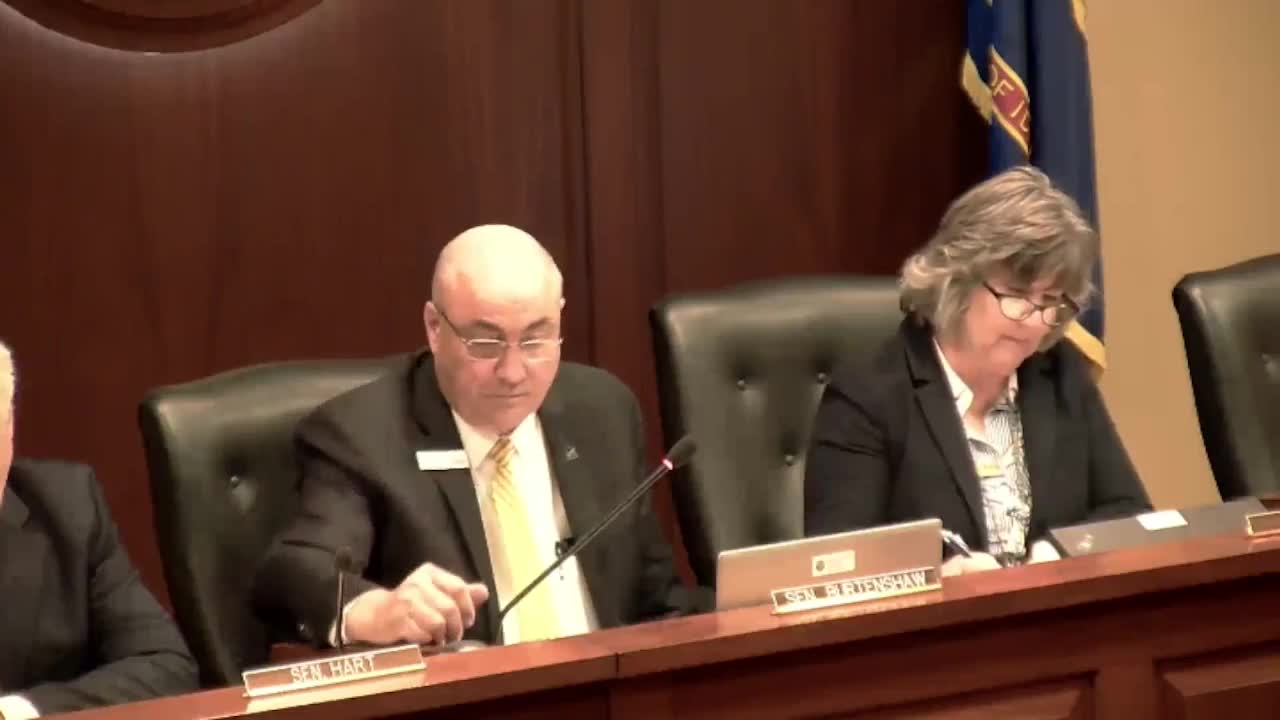
Senator Hart moved to send HB 146 to the fourteenth order for amendment; the motion was seconded by Senator Van Orden and carried on a voice vote. One senator told the committee he reserved the right to vote differently on the Senate floor.
The bill will proceed to the committee's amending order, where members expect to consider changing the compliance window for existing projects and other technical language.