Get Full Government Meeting Transcripts, Videos, & Alerts Forever!
Get email alerts on the State Budget topic
No spam. Unsubscribe anytime.
Governor's "keeping promises" budget frames education, water, transportation and public safety priorities
Summary
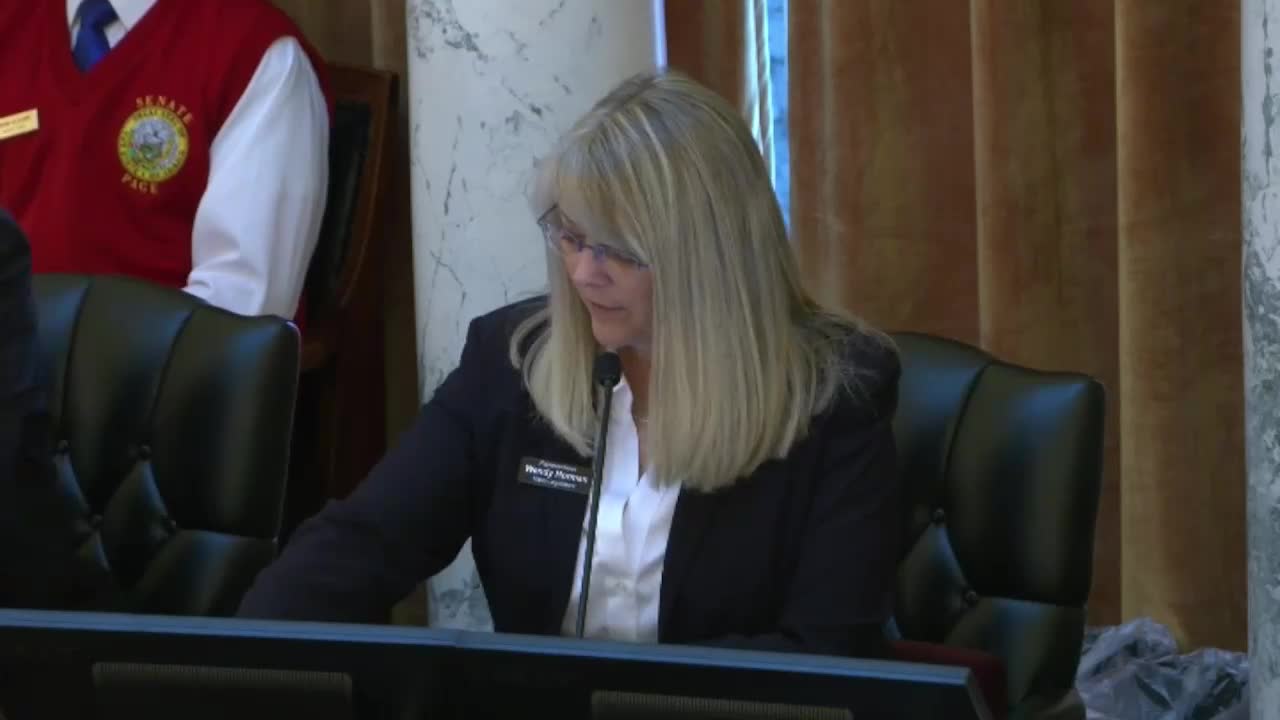
Laurie Wolf, administrator of the Division of Financial Management, presented Gov. Brad Little’s executive budget to the Joint Finance and Appropriations Committee on Jan. 8, calling it “his keeping promises budget.”
Laurie Wolf, administrator of the Division of Financial Management, presented Gov. Brad Little’s executive budget to the Joint Finance and Appropriations Committee on Jan. 8, saying the plan is “his keeping promises budget.”
The administration framed the request around continuing education investments, infrastructure and natural‑resource priorities while maintaining cautious revenue assumptions. Wolf said the budget seeks to preserve structural balance, grow rainy‑day funds and set aside $100 million for tax relief for later legislative action.
Why it matters: the governor’s proposals would direct new general‑fund resources into K‑12 teacher pay and health insurance, workforce and technical‑education capacity, transportation and water projects, plus new recurring funds for wildfire suppression and cyber security. Those decisions will shape the Legislature’s deliberations during JFAC’s multiweek hearing schedule.
Key numbers and priorities Wolf summarized the budget with line items from the committee’s “at a glance” sheet: a FY25 general‑fund revenue projection of about $5.9 billion and a FY26 projection around $6.2 billion; an FY25 projected ending balance near $383 million and an FY26 ending balance near $227 million after recommended transfers. The governor recommends transfers of about $59 million to the budget‑stabilization fund and $50 million to the public education stabilization fund; Wolf said those moves would help produce a roughly $1.4 billion revert‑reserve balance (about 22 percent of the budget) after transfers.
Education: Wolf said the governor’s budget adds roughly $150 million for public schools, including an $83 million line for teacher pay and nearly $30 million for school health insurance. The plan also includes $50 million set aside for “education choice initiatives,” to be deployed only if policy legislation meets the governor’s conditions.
Workforce and higher education: the budget proposes $25 million for workforce training—described as $15 million one‑time grants requiring private match and $10 million ongoing to career and technical education (CTE) operations—aimed at expanding capacity where wait lists prevent enrollment in in‑demand programs.
Transportation and infrastructure: Wolf said the governor would add $50 million to the transportation expansion and congestion mitigation fund to enable additional bonding for high‑value projects; she said Idaho still lists $8–10 billion in unfunded expansion needs. The governor also recommends a 3 percent boost to strategic initiative funding for roads and bridges.
Natural resources and wildfire: the proposal includes a $60 million FY25 supplemental to backfill the fire‑suppression account for last year’s costs and $40 million ongoing in FY26 to stabilize funding for wildfire response. Wolf told members the five‑year average state cost of fire suppression is about $40 million and that an ongoing appropriation improves planning.
Water and permitting: the governor recommends $30 million in ongoing general fund for the Idaho Water Resource Board for prioritized recharge projects and signaled support for permitting‑reform efforts to accelerate large projects.
Public safety, cyber and public defense: priorities include $10 million for statewide cybersecurity investment (administered through ITS), $500,000 to continue the fentanyl response program, and roughly $3.4 million for prison security and contraband mitigation. Wolf also addressed state public defense: she said consolidation shifted costs to the state, recounting a December Supreme Court decision that affected obligations. To respond, the governor recommends a FY25 supplemental of $5.4 million and a FY26 request of $16.8 million; Wolf said the FY26 recommendation for state public defense totals $83 million to support the consolidated system and that one‑time treatment of some funding reflects policy choices the Legislature must consider about how to finance the public‑defense fund (a distribution tied to online sales tax).
Fiscal approach and reserves: Wolf described the administration’s revenue approach as conservative and the budget as structurally balanced. She highlighted recorded rainy‑day balances and said the administration intentionally reduced reliance on transfers compared with the prior year’s proposal. Wolf summarized: “it’s not what we do in the bad years that puts us out of business, it’s what we do in the good years that sets us up for success.”
Committee reaction and next steps Committee members asked detailed questions about specific line items: contract inflation, the composition of maintenance versus enhancement costs, the rationale for the $50 million transportation request, the rationale and mechanics of the fire backfill and ongoing funding, workforce housing program design, and public‑defense funding and statutory issues. Wolf and staff said agencies will present detail during their scheduled hearings and that the administration will provide follow‑up materials on items such as GEAR grants and workforce‑housing statute implementation.
The presentation set the stage for days of agency hearings and work‑group work scheduled over the coming weeks. The committee’s staff will provide agency slide decks, motion sheets and the legislative budget book via SharePoint and the session record for members and the public to review.