Get Full Government Meeting Transcripts, Videos, & Alerts Forever!
Get email alerts on the Medical Education topic
No spam. Unsubscribe anytime.
Idaho College of Osteopathic Medicine updates committee on growth, residency pipeline and partnerships
Summary
The Idaho College of Osteopathic Medicine told the Senate Health and Welfare Committee it has increased class size, graduated students who are entering residencies, and is pursuing institutional accreditation and research collaborations with Idaho State University to address the state's physician shortage.
President Farnsworth of the Idaho College of Osteopathic Medicine briefed the Senate Health and Welfare Committee on the college's enrollment, graduate placement and partnerships, urging lawmakers to view medical education as a long-term way to address Idaho's physician shortage.
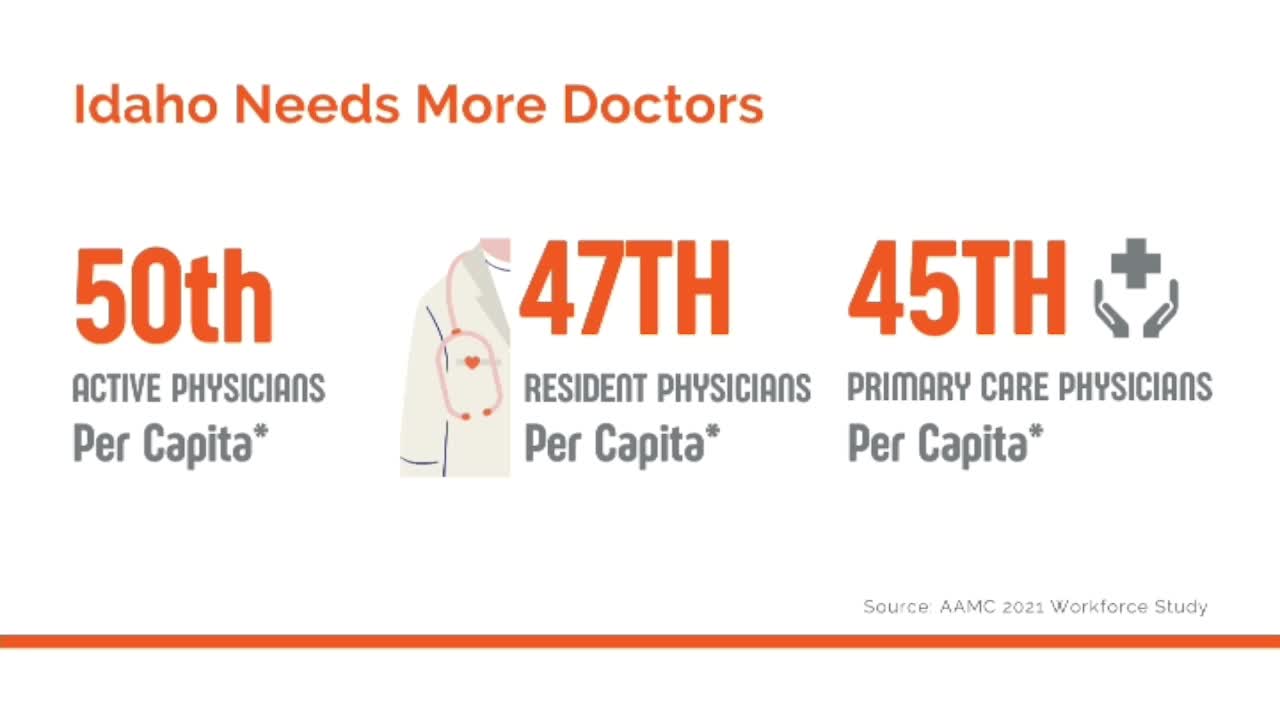
Farnsworth said Idaho ranks near the bottom nationally in physicians per capita and in resident physicians per capita, and that the state must grow its physician workforce. "Idaho ... we are dead last in the nation in physicians per capita," Farnsworth said, adding the state would need roughly 1,400 additional physicians to reach the national average and noting that about one-third of Idaho physicians are over age 60.
Farnsworth summarized ICOM's history and progress: the college matriculated its first class in August 2018; since then it has enrolled roughly 1,150 students and graduated about 450; more than 99.5% of its graduates are in residency programs in Idaho and elsewhere, the college said. Four years ago ICOM received full program accreditation and recently was authorized to increase class size from 150 to 220 students per year.
Farnsworth described an expanding partnership with Idaho State University on the Meridian health-sciences campus, including shared anatomy facilities, interprofessional education and a recent announcement of a research collaborative and affiliate faculty appointments between the institutions. Farnsworth said the college is pursuing institutional accreditation to offer complementary degrees such as master's degrees in public health and health administration.
Two third- and fourth-year student doctors, Annie Hoffman and Joshua Morcom, spoke briefly about why they chose ICOM and their plans to practice in Idaho. Hoffman said her experience at Boise State and contact with an osteopathic physician on an athletics team influenced her choice. Morcom, who said he was born in Weiser and whose father worked as a wildland firefighter and later as a federal manager, said ICOM offered opportunities he would not otherwise have had.
Committee members and Farnsworth discussed the aging population and preventive care. Farnsworth urged a greater emphasis on prevention and public health spending, saying about 97% of U.S. health-care spending goes to treatment rather than prevention.
Farnsworth also told the committee that ICOM is privately owned in part by a Texas-based foundation and that the owner may adjust ownership in the coming year; Farnsworth said the college would provide updates if that ownership changes.
Senators who toured the college described hands-on visits to anatomy and simulation labs and encouraged their colleagues to visit. No committee action was required on the presentation.