Get Full Government Meeting Transcripts, Videos, & Alerts Forever!
Get email alerts on the Dhw Fleet Licensing Mmis topic
No spam. Unsubscribe anytime.
Health and Welfare seeks vehicle replacements, MMIS hires and licensing transfer exemption to fund contract surveyors
Summary
Department of Health and Welfare requested one-time vehicle replacements and IT hardware upgrades, said MMIS IT hires are imminent, and asked the legislature to allow licensing and certification to transfer personnel dollars to operating expenditures to fund contract nurses used for surveys.
At the Jan. 13 Joint Finance-Appropriations Committee hearing, the Idaho Department of Health and Welfare requested one-time capital funding to replace vehicles and upgrade IT hardware, provided an update on hiring for the Medicaid Management Information System (MMIS) project and asked for an exemption that would permit the Division of Licensing and Certification to transfer personnel- cost dollars to operating expenditures.
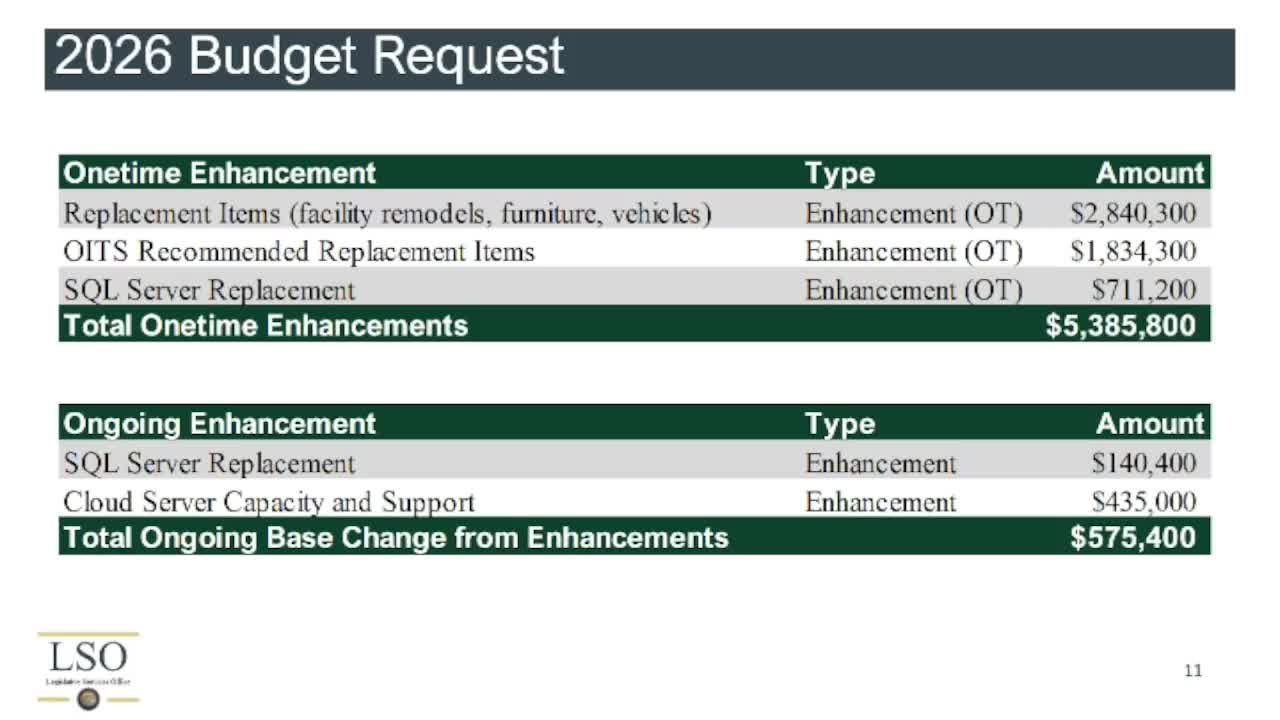
Legislative analyst Alex Williamson said the department requested $2.8 million in replacement items that included $1.8 million to replace 60 vehicles, $384,000 for visitation room upgrades and roughly $648,000 for office remodels and furniture. She said the governor recommended funding those replacement items as requested and that the agency had also requested $1.8 million in hardware replacement and other IT requests; the governor recommended most IT items except a requested cloud server capacity line that was zeroed out after the agency found other solutions.
Representative Tanner asked why the vehicle replacement request appeared higher than prior years. Director Alex Adams told the committee DHW has a statewide fleet of 435 vehicles and a goal of replacing the fleet every seven years; vehicles proposed for replacement have between about 105,000 and 159,000 miles. He said two-thirds of vehicle use is child-welfare related (transporting children to visits, court and appointments) and that vehicle prices and supply constraints have increased replacement costs.
"Goal as a department is to replace the entire fleet every 7 years," Director Adams said. "Last year doing only about 30 kept, took us off schedule of a 7-year replacement."
Williamson also reviewed the department's request to upgrade SQL Server from 2017 to 2022 (an estimated $711,000 item with a $140,000 ongoing software assurance request) and said the agency intends to hire MMIS operational data personnel funded in last year's budget; the director said the IT positions were posted and expected to be hired in February.
On licensing and certification, Williamson said the division has historically contracted outside nurses to perform facility surveys and is requesting a statutory exemption (an exemption from the transfer limitations in section 8 of Senate Bill 1268, 2024) to allow personnel-cost dollars to be transferred to operating expense to pay contract nurses as needed. Last year the division requested a one-time $400,000 transfer and used about $300,000, with approximately $100,000 reverted.
Director Adams told the committee that when the licensing team lacks full-time staff it relies on contract nurses, which cost roughly $90'$95 per hour compared with a staff rate of about $35 per hour. He said long-term care inspection staffing peaked with pandemic pressures and that vacancies in the licensing team have fallen from as high as 80% during the pandemic to about 19% at budget submission; turnover has dropped from 21% in 2021 to 7% most recently.
"For staff employees who do this, we pay about $35 an hour. For contract employees, we pay about $90 to $95 an hour," Director Adams said. "So there is a significant difference."
Why it matters: Vehicle reliability and inspection capacity affect delivery of child-welfare services and the state's ability to meet federal and state inspection timelines for licensed health facilities. The licensing transfer exemption request is procedural but has budgetary consequences: it affects whether the division can use personnel appropriations to contract for temporary clinical staffing during peaks.
What to watch next: The committee will consider these one-time replacement and IT hardware requests and the licensing transfer exemption as part of the "other programs" enhancement bill during the committee's Jan. 24 meeting. The MMIS hires and child-welfare vehicle replacements were described as imminent priorities.