Get Full Government Meeting Transcripts, Videos, & Alerts Forever!
Get email alerts on the Water Domestic Wells topic
No spam. Unsubscribe anytime.
Idaho Senate committee advances bill to curb domestic-well irrigation in critical groundwater areas
Summary
An Idaho Senate committee voted to send Senate Bill 1083 to the fourteenth order for possible amendment after extended testimony on limiting domestic-well irrigation in groundwater-stressed areas, streamlining enforcement and adding local planning requirements.
An Idaho Senate committee voted to send Senate Bill 1083 to the fourteenth order for possible amendment after extended testimony from water users, municipal officials, homebuilders and farmers.
The bill, sponsored in the hearing by Senator Kelly Anthon, would narrow the scope of Idaho's "domestic exemption" in areas designated as having stressed groundwater — allowing in-home water use and watering of personal livestock but requiring a water right for other outdoor irrigation uses in those areas. The measure also would create a voluntary option to combine in-home uses onto a single well, add a new enforcement process with larger penalties, and add local planning provisions requiring counties and cities to analyze water availability in comprehensive plans.
Why it matters
Proponents said the bill addresses a growing mismatch between longstanding agricultural water rights and newer residential development outside municipal boundaries. Senator Kelly Anthon said the measure is intended to create parity for senior water-right holders: "That's the problem ... when there's a water shortage ... the pastures are green, and their sprinklers are pumping. That's the problem, and the problem continues to grow. This is about parity," Anthon told the committee.
What’s in the bill
Paul Arrington of the Idaho Water Users Association told the committee the proposal, three years in development, focuses on four areas: fairness in administration (bringing consumptive uses into priority administration in designated areas by limiting domestic-exemption irrigation); voluntary consolidation of multiple in-home uses onto a single well; a streamlined enforcement path and stiffer penalties for domestic-exemption overuse; and amendments to local-planning and subdivision provisions to ensure new subdivisions consider existing surface-water resources and compatibility with municipal systems.
Arrington described the changes in statutory terms, referencing proposed additions to Idaho Code 42-2-27 (adding a subpart 4), 42-1-11 (subpart 3), a new enforcement provision 42-17O(1)(c), and local-government sections beginning around the draft's page 6. He requested the bill be sent to the fourteenth order to allow several technical amendments to be made.
Public testimony and concerns
Municipal and water-utility witnesses generally supported the bill. Tom Points, senior public works director for Nampa and vice chair of the Idaho Water Utility Council, told the committee the measure would clarify when permits are required and give municipalities a role in construction standards for wells in their areas of impact.
Shelley Roberts of the Idaho Rural Water Association emphasized water-quality risks from increasing private wells, saying, "If you look at the number of wells in just the last five years, there were 3,700 wells that were drilled every year for the last five years. That's a lot of holes in the ground, and that's a lot of opportunity for contamination." She said contamination of a shared aquifer can impose multimillion-dollar costs on communities.
Farmers, real-estate and homebuilder witnesses expressed reservations. Matt Wilkie of Middleton, who described himself as a farmer and real-estate broker, called the bill a "perception bill" and warned of costs and complexity for rural development. The Idaho Home Builders Association said it opposes the bill as written because of concerns about the role and authority of irrigation districts in subdivision reviews.
Key numeric and drafting details raised
- The bill’s proponents cited that roughly 56,000 domestic-exemption wells have been installed in the past 20 years; Arrington said the exemption totals about 2% of overall water use statewide.
- Under existing code, domestic exemption allows in-home use on one home, up to a half acre and 13,000 gallons per day; the bill would limit outdoor irrigation under that exemption in designated groundwater-stressed areas.
- The proposal would allow multiple residences to combine in-home uses onto a shared well and retain eligibility for the domestic exemption for those in-home uses, subject to definition and optional meter provisions addressed in the amendment package.
- The group debated requiring meters at the point of diversion for combined wells; Arrington said the collaborative group ultimately chose not to require meters for in-home uses, arguing the consumptive amounts are small and meters would add political and administrative barriers.
Enforcement and implementation
Arrington said the bill would add a new enforcement mechanism patterned after existing Department of Water Resources processes: notice to the homeowner, an opportunity to respond or cure, and escalated penalties if noncompliance continues. He also said enforcement provisions in 42-17O(1)(c) would allow the department to ask counties to collect fees; counties would retain half of any collected fee if they agreed to collect on behalf of the department.
Committee action and next steps
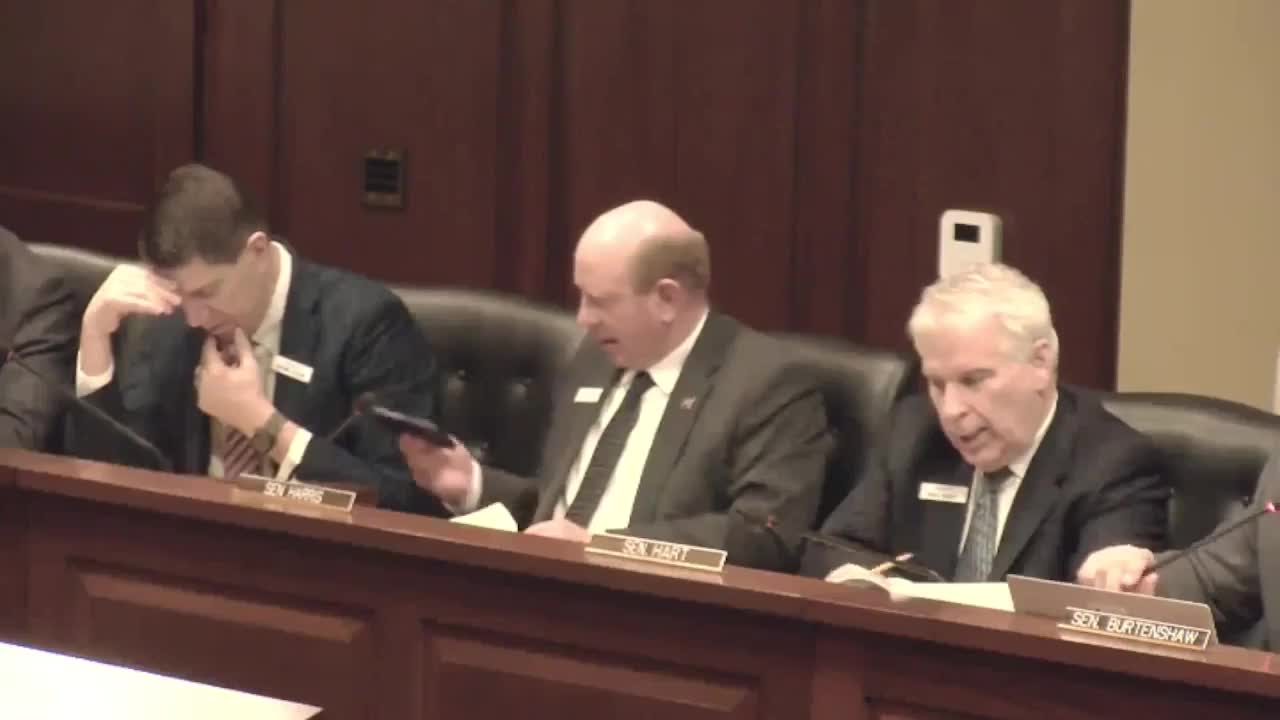
Senator Harris moved to send SB 1083 to the fourteenth order for possible amendment; Senator Taylor seconded. The committee approved the motion by voice vote with no recorded opposition. Sponsors asked the committee to allow amendments on definitional language (for example, a clearer statutory definition of "in-home use") and on language clarifying county participation in fee collection.
Supporters and opponents said the bill is not a silver bullet. Arrington acknowledged domestic exemption uses account for a small share of overall water use, but argued the bill is a targeted step to address cumulative impacts in groundwater-stressed areas and to bring residential uses into a system where priority and mitigation are meaningful.
The committee will consider amendment language in the fourteenth order.