Get Full Government Meeting Transcripts, Videos, & Alerts Forever!
Get email alerts on the Economic Development topic
No spam. Unsubscribe anytime.
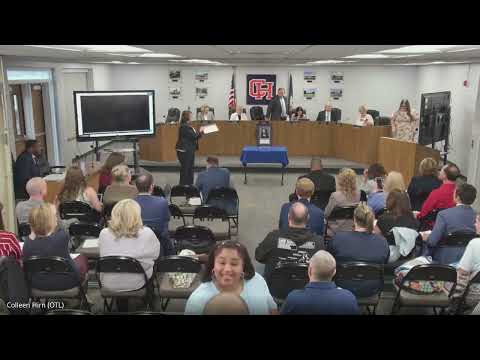
School board approves joint economic incentive for Kroger amid public concern over school funding
Summary
The board voted to approve city resolution 25‑17 supporting an economic incentive for a Kroger project. City staff described a revenue-sharing memorandum of understanding; a public commenter urged the city to use tax incentives rather than school funds.
The Colonial Heights School Board on Jan. 25 voted to approve a joint economic incentive tied to a Kroger development after city staff outlined a memorandum of understanding that shares new tax revenue with the school division.
City staff described the agreement as a revenue-sharing arrangement under which the school division would receive 50.73% of new revenues generated by the Kroger project. A city representative told the board state law prevents sharing property taxes in the rebate calculation but said new sales- and property-tax revenue from the previously vacant building will generate seven-figure amounts that the school division will receive half of under the MOU.
During public comment, resident Nicholas Castrinos urged the board to oppose using school revenue for the incentive. Castrinos said, “We’re going to be taking money from our schools to get to a private entity, $2,100,000, over the course of, I think, 5 years,” and recommended offering Kroger a tax incentive instead of a payment drawn in part from school revenue.
Board and city staff sought to clarify the mechanics. A city official described the deal as largely paid from new revenue generated by Kroger, saying the arrangement produces "new money coming to the city on sales tax and property tax that the school district will get," and that the rebate would be paid out of that incremental revenue. In an illustrative draft staff estimate discussed during the meeting, the parties used a hypothetical fraction that equated to roughly $300,000 per year for seven years, with the school district responsible for half of that fraction under the draft scenario. The city official emphasized that the building had been vacant for seven years and that the project would bring new revenue and jobs.
The city official also cited an estimate of about 250 jobs associated with the Kroger project.
After discussion, the board moved and seconded the resolution (listed in the agenda as City Council Resolution 25‑17 concerning economic incentive grants, Kroger Company project) and recorded unanimous votes in favor. The board did not specify final rebate schedules in the meeting; staff said some figures discussed were illustrative draft estimates and that final numbers would be set by the city and by the terms of the MOU.
Votes recorded during roll call were read aloud and recorded as “yes” for all members present.