Get Full Government Meeting Transcripts, Videos, & Alerts Forever!
Get email alerts on the Land Foreign Ownership topic
No spam. Unsubscribe anytime.
Rep. Ted Hill introduces measure to bar certain foreign purchases near military ranges
Summary
Representative Ted Hill introduced RS 31940, a draft proposal to expand existing limits on foreign ownership of agricultural and other lands within an area he described as a military operations sanctuary. The committee voted to introduce the request for statute (RS) for further consideration.
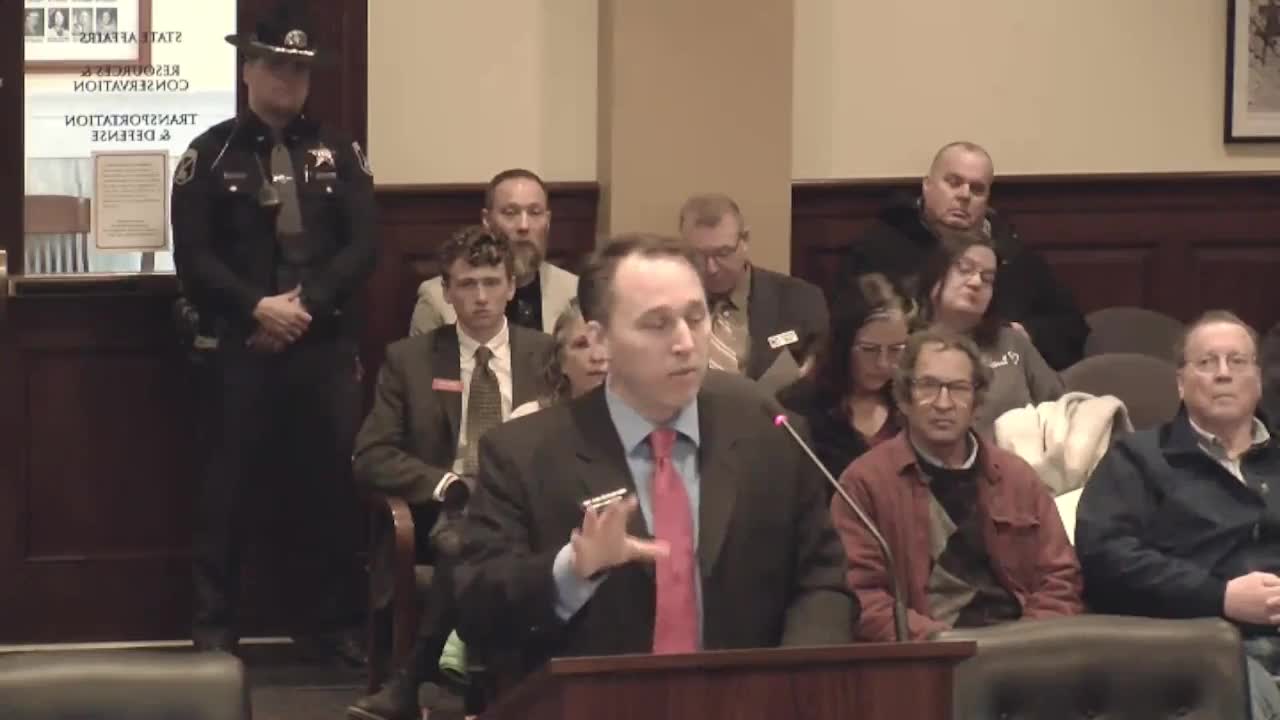
Representative Ted Hill, R-District 14, told the House State Affairs Committee that RS 31940 would expand prior limits on foreign purchases of agricultural and other land near military operations areas to protect what he called national security and food security. “This legislation is decisive as required to protect American national security, sovereignty and food security,” Hill said.
Hill said prior state laws — including House Bill 173 (2023) and House Bill 496 (last year) — had already restricted certain purchases of agricultural, mining and forest land. He described RS 31940 as an incremental expansion that would require entities that fit the bill’s definition of “foreign adversaries” to register within 60 days of enactment and, for agricultural land, permit foreclosure within 180 days in specified circumstances. “If they fit in that category of foreign adversaries … they have to go ahead and register within 60 days of enactment of this bill and within 180 days we can foreclose on them and that is for agricultural land only,” Hill said.
Hill framed the measure around military training ranges and airspace. He said some privately owned parcels are located inside or adjacent to key training areas and that state action to restrict foreign ownership would “sanitize” ranges used for weapons testing and training. He cited an Arkansas case under former Gov. Mike Huckabee that led to confiscation of land tied to Syngenta after acquisition by a state-owned Chinese firm; Hill described that as a legal precedent he and his office had reviewed. He also told colleagues the attorney general’s office had reviewed the draft and was “comfortable with it.”
Committee members asked for clarifications about the scope of the map Hill provided, whether the outlined area included federal or private land, how state processes would handle property disposition, and whether leases as well as sales would be covered. Hill responded that the area included mostly public land with private parcels interspersed and said the bill’s wording applies to leases as well as purchases. He repeatedly characterized the proposal as a deterrent and an incremental, forward-looking step rather than a broad expropriation program.
Representative Palmer moved to introduce RS 31940; the motion was carried by voice vote. Committee members said they want to review the bill clause-by-clause in a hearing if the RS is introduced.
Ending: The committee voted to introduce RS 31940 for further work; no final hearing or substantive legislative action occurred in this meeting. The proposal will return for a formal committee hearing if sponsors pursue that next step.