Get Full Government Meeting Transcripts, Videos, & Alerts Forever!
Get email alerts on the State Budget Health topic
No spam. Unsubscribe anytime.
LSO analyst outlines Health and Welfare budget drivers, recommends where to look for details
Summary
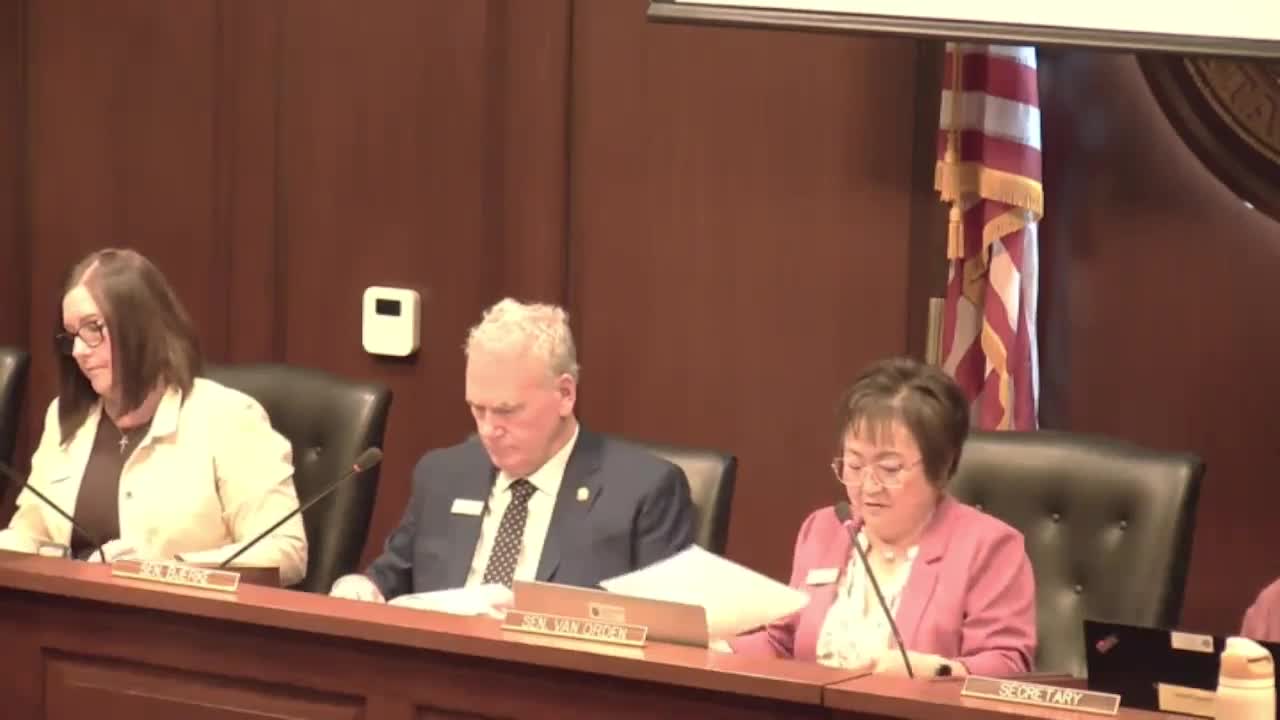
Alex Williamson, a Legislative Services Office budget analyst, told the Senate Health and Welfare Committee Medicaid adjustments and a hospital assessment change were the principal drivers of recent increases in the Department of Health and Welfare’s appropriations and outlined the governor’s fiscal‑year 2026 recommendation.
Alex Williamson, a budget and policy analyst with the Legislative Services Office, briefed the Senate Health and Welfare Committee on the Department of Health and Welfare’s recent spending history, the governor’s fiscal‑year 2026 recommendation, and an ongoing internal reorganization at the agency intended to align programs under renamed divisions.
Williamson told the committee that Medicaid‑related adjustments drove a large portion of recent appropriation increases and that the department’s five‑year appropriations versus expenditures view shows a notable uptick between fiscal years 2022 and 2023 driven primarily by Medicaid changes and hospital assessment adjustments.
“Some of the factors that went into this... was an increase of about, dollars $670,000,000 from the previous year. About two thirds of that came from changes, to Medicaid,” Williamson said as she summarized the main drivers behind recent appropriation fluctuations.
What Williamson presented
Williamson walked committee members through how to read the Legislative Services Office budget materials and dashboards and highlighted the major items in the governor’s fiscal‑year 2026 recommendation:
- Medicaid population and program adjustments (population forecast adjustments and FMAP shifts) that change the federal/general‑fund composition of costs.
- Hospital assessment and upper payment limit changes that increased appropriations for both the dedicated hospital assessment fund and federal matching dollars in recent years; Williamson said the 2024 session added a one‑time adjustment but that a supplemental was needed to make the change ongoing in the current fiscal year.
- MMIS (Medicaid Management Information System) procurement and multi‑year modernization: Williamson noted the state set aside a dedicated fund to cover the state match and that the overall project benefits from a favorable 90/10 federal match for IT modernization.
- A governor initiative funding request for the Idaho Child Care Program and several staffing enhancements focused on child welfare (referred to in the presentation as Youth Safety and Permanency), including a request for new prevention specialists and licensing/clinical staff.
- The LSO analyst pointed committee members to the Legislature’s LSO dashboard and budget book for detailed line‑item data and 10‑year trend visualizations.
Agency reorganization described
Williamson also summarized an organizational realignment at the Department of Health and Welfare described by agency leadership. Key changes outlined in the presentation include:
- Renaming and regrouping several divisions: former Family and Community Services was to be split; Child Welfare was to be retitled Youth Safety and Permanency; Service Integration would become Family and Community Partnerships; Developmental Disability Services would be retitled Early Learning and Development.
- The Idaho Child Care Program would be called out as a stand‑alone budgeted program and moved under the early learning grouping.
- Medicaid Program Integrity, Behavioral Health Plan staff, and certain community disability services would be moved to report under Medicaid leadership to align operations and oversight.
- The department’s executive leadership team would be augmented with a chief of legislative and regulatory affairs (including tribal relations), a CFO reporting directly to the director, and a program manager for communications and customer experience.
Questions from the committee
Sen. Maryanne Wintrow asked for clarification on the hospital assessment and upper payment limit mechanics; Williamson explained that hospitals provide the state share of the assessment to access federal matching funds, and that those dollars must be appropriated before the state remits federal funds back to hospitals as reimbursement.
On the fiscal figures, Williamson said the governor’s recommended total for fiscal year 2026 would be roughly $6 billion in total funds and about $1.2 billion from the general fund if all recommended items were approved.
Why it matters
Williamson’s briefing framed Medicaid as the primary cost driver in the department’s budget and highlighted the technical nature of hospital assessment accounting and the importance of the MMIS modernization project for Medicaid operations. The reorganization described by the department signals a shift to center child‑welfare programs under a Youth Safety and Permanency structure and to align fraud, behavioral health planning and community disability programs more directly under Medicaid leadership.
Next steps
Committee members can use the LSO budget dashboards and the detailed governor’s request documents to examine line‑by‑line changes, supplemental requests and one‑time versus ongoing costs as they consider appropriations and any statutory changes that flow from oversight or policy decisions.