Get Full Government Meeting Transcripts, Videos, & Alerts Forever!
Get email alerts on the Public Notices topic
No spam. Unsubscribe anytime.
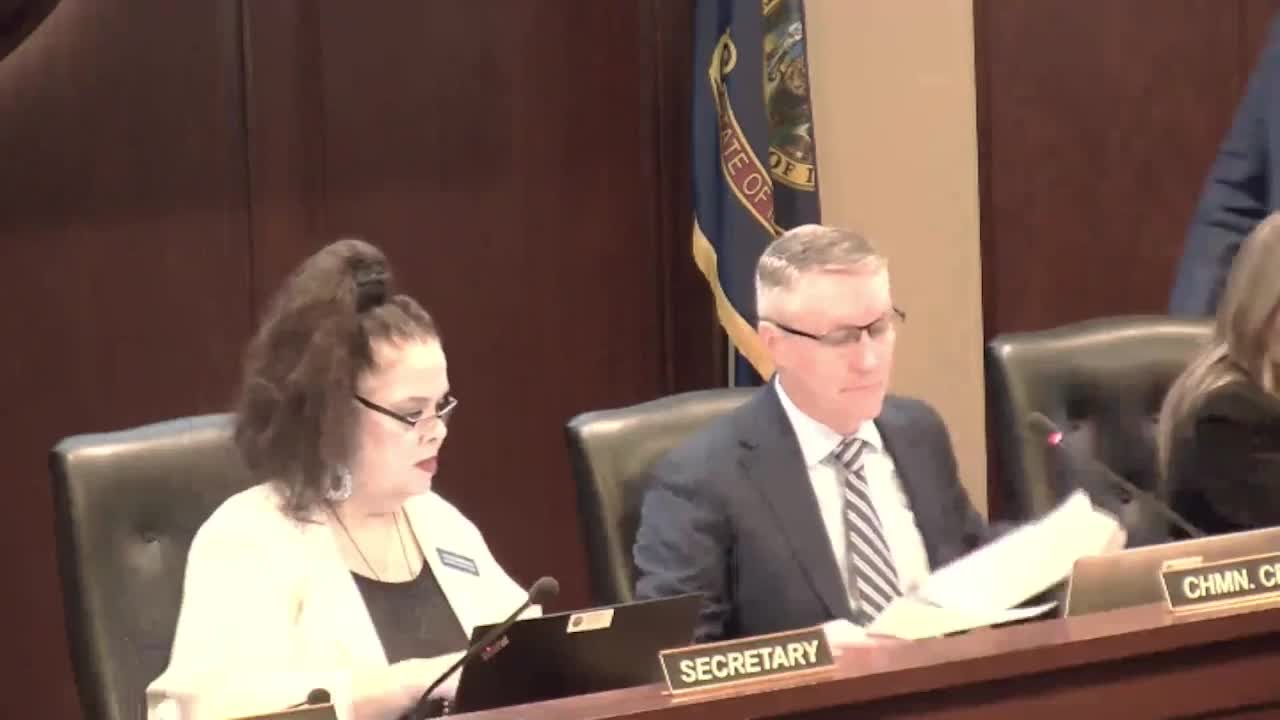
House panel holds HB 33 after hours of testimony for and against moving public notices online
Summary
After hours of testimony from county officials, school boards and newspaper publishers, the House State Affairs Committee voted to hold House Bill 33, a measure that would let public notices be published on a state controller website rather than in a print newspaper in many cases.
The House State Affairs Committee heard more than three hours of public testimony Thursday on House Bill 33, a bill from Representative Jeff Ehlers, R‑Meridian, that would allow public entities and other parties required to publish legal notices to do so electronically on a state controller website in lieu of a print newspaper in many circumstances.
Ehlers said the bill is intended to modernize notice requirements and expand reach: “The intent of why we have public notices … is to notify the public of what's happening, to bring transparency to the actions of the government,” he told the committee, and the bill would create a centralized site with searchable notices and optional push subscriptions. Ehlers said state agencies estimated initial development and one‑time costs and ongoing maintenance; he cited a state controller estimate of about $570,000 to build a site using existing infrastructure and about $300,000 a year in maintenance, while state agencies alone could save approximately $1 million annually and local governments might save $1–2 million.
Local governments and associations testified strongly in favor. Jonathan Wheatley, deputy director of the Association of Idaho Cities, and Sarah Westbrook of the Idaho Association of Counties said local jurisdictions face significant publication costs and that a free statewide site would broaden access. Misty Swanson, executive director of the Idaho School Boards Association, said the bill “provides a much‑needed modernization” and would reduce costs for districts that currently spend from a few hundred dollars to more than $11,000 a year on notices.
Several county commissioners — including Rod Beck (Ada County), Tom Daley (Ada County), Zach Brooks (Canyon County) and Ryan Davidson (Ada County) — urged passage, saying the current print requirement imposes staff time and expense and can delay hearings because of newspaper publishing schedules.
Newspapers and the Newspaper Association of Idaho led opposition testimony. Nathan Alford, editor and publisher of the Lewiston Tribune and Moscow‑Pullman Daily News, noted that a statewide aggregator (idahopublicnotices.com) already exists and is funded by newspapers; he urged the committee to reject HB 33. Other publishers, including Matt Frankel (Idaho Press) and Travis Quast (Adams Publishing Group), said the bill would shift 30,000 annual public and private notices to a government‑run system, adding staffing and technology costs to agencies and potentially moving private‑party notice costs onto taxpayers. An attorney representing the newspaper association suggested concerns about archival permanence and the legal record of notice; newspapers said print records and library microfiche go back decades.
Testifiers pressed several practical questions: whether archives on a state site would be immutable, how small communities with limited broadband would receive notices, whether private‑party notices (probate, name changes, foreclosures) would be included, and how push notifications, template requirements and formatting would work. Ehlers said the bill is permissive — a local entity may still choose print — and that the state controller could build an immutable archive and push notifications. Multiple testifiers noted idahopublicnotices.com, a private industry service created in 2012 and cross‑linked with state pages.
Committee members debated cost, transparency and centralization of control. Representative Alfieri said he feared the government controlling both message and dissemination; Representative Barbieri said she favored holding the bill for more work. Representative Ehlers argued the proposal would expand reach and give localities an option while preserving choice for jurisdictions that prefer print.
Representative Bailers moved to send HB 33 to the floor with a due‑pass recommendation. After discussion, a substitute motion was made to hold the bill in committee for further work. The substitute motion to hold passed on a roll‑call vote, 9‑6. The committee recorded the roll call in the hearing transcript (motion to hold passed 9 to 6) and the bill will be held in committee for additional work and possible amendment.