Get Full Government Meeting Transcripts, Videos, & Alerts Forever!
Get email alerts on the Foreign Land Control topic
No spam. Unsubscribe anytime.
Committee hears proposal to force designated foreign 'adversaries' to sell agricultural and mining land within 180 days
Summary
Representative Ted Hill, sponsor of RS 32‑510, told the House State Affairs Committee that the measure would require owners identified as designated foreign adversaries to sell agricultural land, mining claims or mineral rights within 180 days or face foreclosure.
Representative Ted Hill, sponsor of RS 32‑510, told the House State Affairs Committee that the measure would require owners identified as designated foreign adversaries to sell agricultural land, mining claims or mineral rights within 180 days or face foreclosure.
"Sovereignty over food security and domestic mining claims and mineral rights is essential," Representative Ted Hill said, describing the bill as a national‑security measure. He said the proposal is intended to reduce the state’s economic vulnerabilities, naming seeds among specifically sensitive sectors.
The bill would exempt entities that hold a national‑security agreement with the Committee on Foreign Investment in the United States (CFIUS) as of a specified cutoff date; Hill said that carve‑out was added after earlier drafts. "Provisions . . . shall not apply to an entity that has national security agreement with the committee on foreign investment in the United States as of July 1," Hill said, reading from the revised sponsor substitute (RS). He described that waiver as a frustrating concession and used strong language in characterizing the federal waiver process.
Why it matters: Hill and other supporters framed the measure as protecting military training areas and agricultural supply chains from foreign surveillance or control. Hill pointed to an Arkansas case and to national debate over foreign ownership of seed companies as context, and he said the RS would include a map designating a Southwest Idaho military operations area where foreign ownership or rentals could be disallowed.
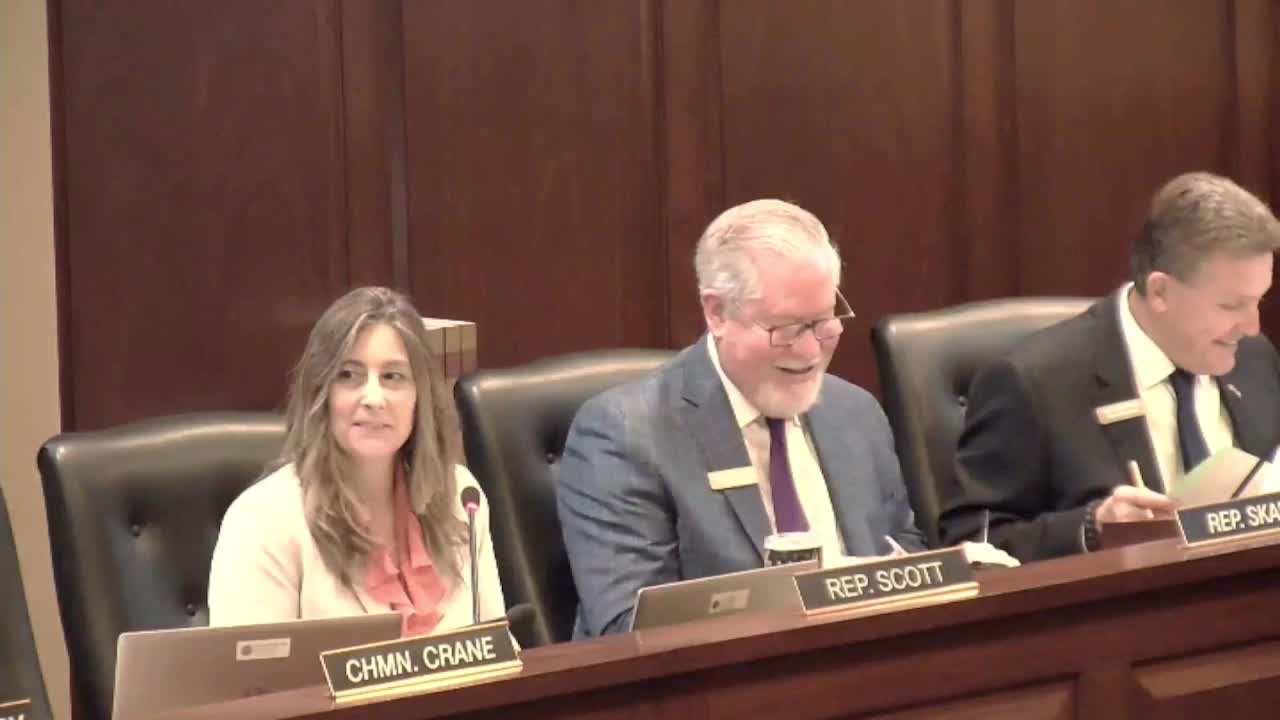
Committee questions focused on scope and mechanisms. Representative Crane asked for the "bullet points" distinguishing the original House Bill 221 from RS 32‑510; Hill said the primary change was the CFIUS waiver carve‑out. Representative Mickelson and Representative Barbieri pressed Hill on the July 1 cutoff and the effect of a CFIUS waiver granted after that date; Hill said the waiver would protect an entity while it remains in place but that administrations can change CFIUS approvals.
On enforcement, committee members asked how ownership would be identified and verified. Hill said existing federal reporting under foreign investment declarations and a state whistleblower mechanism are intended to surface concealed ownership. He described the whistleblower provision in the RS, saying a qualified whistleblower who exposes covered ownership could receive 30% of net proceeds from sales recovered under the statute.
Not all members supported immediate advancement. Representative Boyle, citing a map that includes large portions of Owyhee County and long‑standing local ranching uses, said: "This gives me great pause when I see this map without hearing from the people of [Owyhee] County who were going to be directly affected by this." Several committee members said the proposal is far reaching and deserves a full hearing with affected landowners and Mountain Home Air Force Base representatives present.
Action taken: The committee first voted to hold House Bill 221 in committee. Representative Crane moved to hold House Bill 221; the motion carried. Representative Crane earlier had moved to send RS 32‑510 to second reading, but a substitute motion to introduce RS 32‑510 for a fuller hearing—moved by Representative Boyle—was adopted and the RS was introduced for further consideration.
Background and limits: Hill and others repeatedly said the proposal targets land, mining claims and rights, not immediate nationalization of companies. Hill said the RS is intended to be a mechanism focused on properties and rights that could present surveillance or other national‑security risks; he also said the measure is intended to close gaps left by prior legislation that restricted foreign purchases of certain lands.
Committee members asked whether any covered properties currently exist in the mapped area; Hill said the committee "do[es] not know." Several members requested that the committee hold a full hearing with local landowners and base officials before advancing policy affecting broad swaths of private land.
The RS will return for further committee consideration with additional outreach to affected counties and military representatives expected.