Get Full Government Meeting Transcripts, Videos, & Alerts Forever!
Get email alerts on the Community Colleges topic
No spam. Unsubscribe anytime.
College of Western Idaho tells JFAC enrollment up 13% and details capacity, EWA limits
Summary
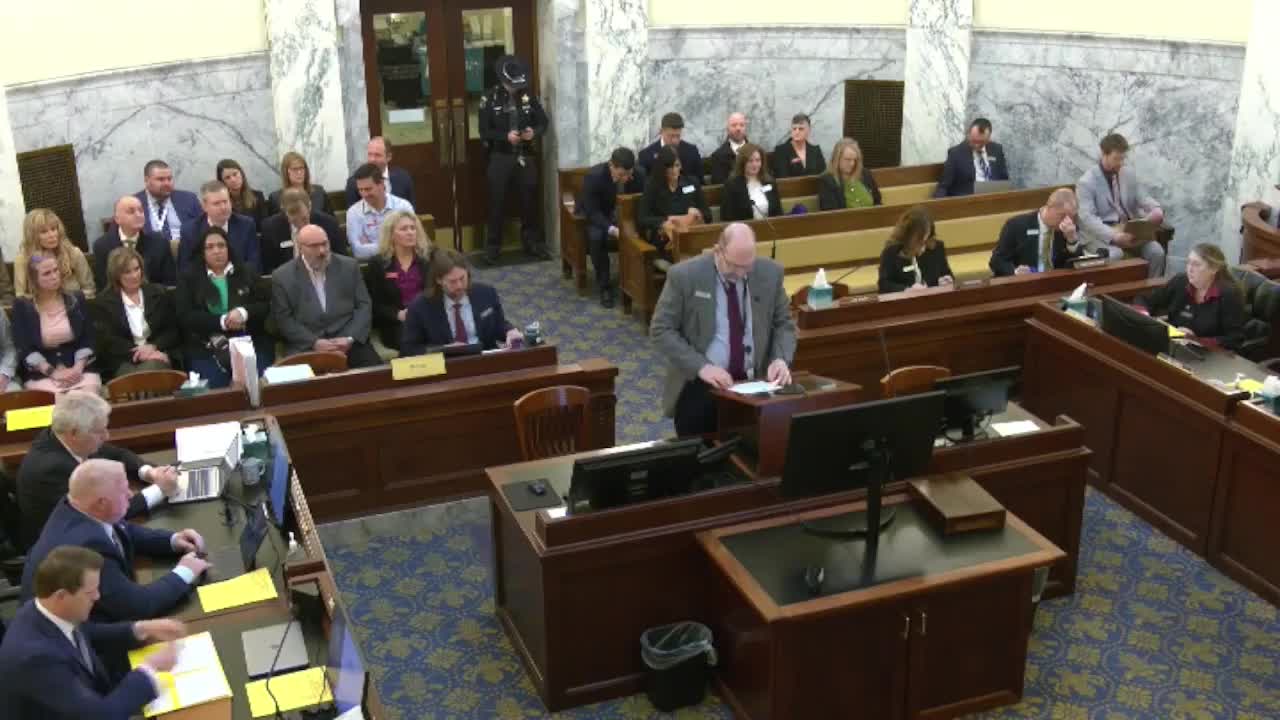
College of Western Idaho President Gordon Jones told the Joint Finance-Appropriations Committee on Thursday that CWI’s academic enrollment rose about 13% this year and that growth has produced capacity constraints in nursing and career-technical programs.
College of Western Idaho President Gordon Jones told the Joint Finance-Appropriations Committee on Thursday that CWI’s academic enrollment rose about 13% this year and that growth has produced capacity constraints in nursing and career-technical programs.
Jones made the remarks during a presentation of CWI’s base budget and FY 2026 request by Kevin Campbell, a budget and policy analyst with the Legislative Services Office. Campbell said CWI’s FY 2024 state appropriation was $20,816,700 and that CWI typically spends 100% of its state appropriation.
Why it matters: Committee members questioned how the state’s Enrollment Workload Adjustment, or EWA, is applied to fast-growing community colleges and heard that a 3% cap imposed by guidance from the State Board reduced CWI’s EWA in the current budget cycle. That cap lowered the college’s calculated EWA from roughly $493,000 to the $265,000 shown in its FY 2026 request, Jones said.
Jones said the college now serves roughly 31,000 individuals across credit and noncredit enrollments, and that CWI reports nearly 22,000 credit students and more than 30,000 students served in the 2023–24 academic year in materials cited to the committee. He told JFAC CWI has nearly 1,000 students on wait lists across programs and “almost a hundred” students on the waiting list for nursing specifically. Jones and Campbell said the fastest growth is in career and technical education (CTE) and dual-credit programs; academic-transfer enrollment is growing more modestly.
Campbell reviewed the college’s five-year budget history, saying CWI’s average annual growth was about 6.6% with FY 2023 an outlier (about 11% growth). He also summarized enhancements the college has received in recent years — including funding for increased nursing capacity, STEM student capacity, outreach and recruitment — and said CWI typically spends all of its state appropriation except for pandemic-related anomalies in FY 2021–22.
Capacity constraints: Jones told the committee the college is constrained by three primary limits: facilities, instructor-to-student ratios set by accrediting or professional standards, and student support services such as academic advising. He said some medical programs are constrained by accreditation rules that require low student-to-instructor ratios and cited nearly 100 students waiting for nursing seats and about 1,000 students on wait lists across programs including automotive technology, welding, cybersecurity and agricultural sciences.
EWA and the 3% cap: Multiple committee members pressed for clarity on EWA calculations after Jones noted that the EWA figure reflected the impact of a 3% cap applied under State Board guidance. Jones said the college’s raw EWA calculation would have yielded about $493,000 but State Board guidance limiting allowed base increases to 3% reduced the amount reflected in the FY 2026 request to $265,000. Kevin Campbell told the committee he will provide additional data on EWA calculations across institutions at the committee’s request.
Program responsiveness and private-sector partnerships: Jones described CWI as “lean,” saying the college operates on roughly $75 million to educate about 31,000 individuals and highlighted program-level responsiveness to employer needs. He said CWI sends faculty to manufacturers such as Rivian and Tesla for training and highlighted an electric-vehicle technician program that uses industry vehicles in instruction. Jones also noted plans to develop programs — for example, mining technician training — to support emerging regional industry demand.
Compensation and tuition: Jones told the committee CWI has not raised tuition in eight years and continues to charge $139 per credit hour. He also said faculty at community colleges have similar credentials to four-year faculty but generally earn $10,000–$20,000 less, and that student-facing faculty at community colleges teach more course sections per term than typical four-year faculty. Jones asked the committee to consider broader structural funding questions for higher education.
No formal action was taken; the presentation concluded with requests for further committee follow-up on specific EWA calculations and a request for a breakdown of capacity constraints (facilities, faculty, support services) to inform budget decisions.