Get Full Government Meeting Transcripts, Videos, & Alerts Forever!
Get email alerts on the Workforce Compensation topic
No spam. Unsubscribe anytime.
ITD seeks targeted pay bump for maintenance workforce, citing retention and training costs
Summary
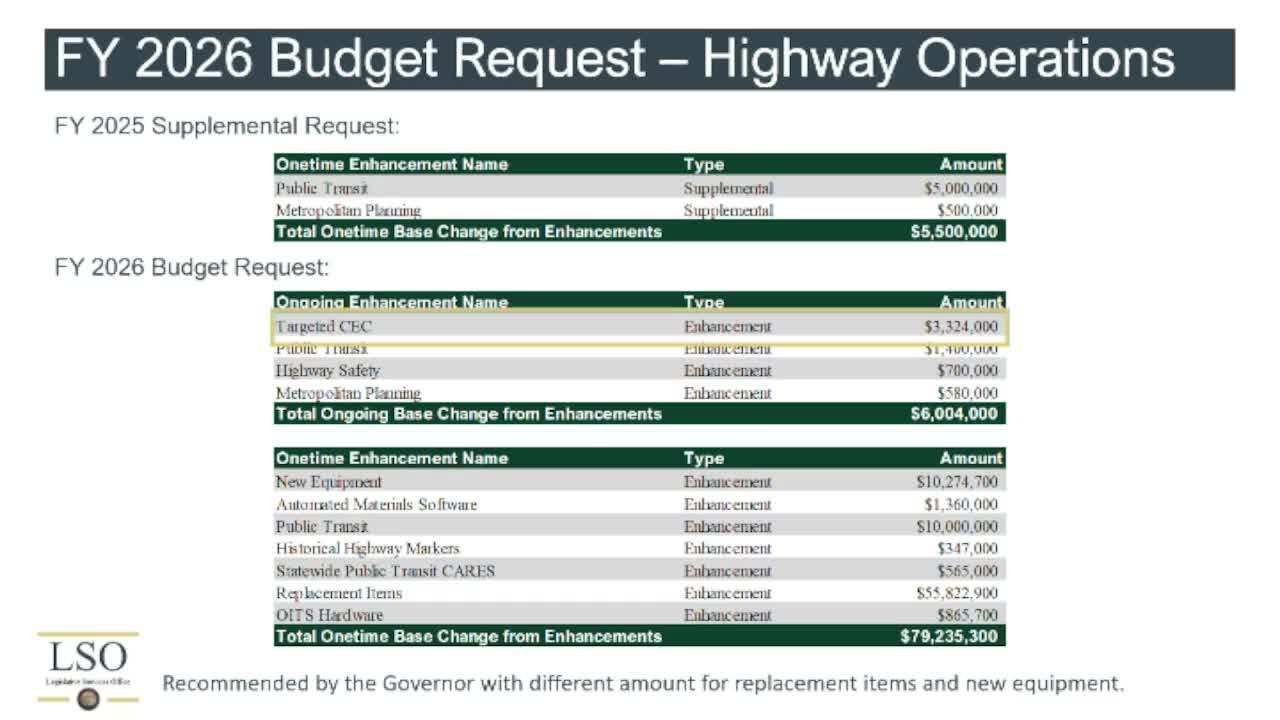
Idaho Transportation Department requested targeted cost‑of‑employment adjustments to raise pay for maintenance horizontal career paths by $2.50 per hour across approximately 505 positions to reduce turnover and the agency’s recurring training costs, department officials told JFAC.
The Idaho Transportation Department asked the Joint Finance‑Appropriations Committee for a targeted cost‑of‑employment (CEC) adjustment to raise hourly pay for maintenance horizontal career paths by $2.50, affecting roughly 505 positions, to address retention problems and training costs.
Director Scott Stokes told the committee the maintenance workforce has had high turnover in recent years. “Our average departure rate, just in maintenance employees, has been an average of 78 per year out of about 400,” he said. Stokes and staff said many new hires arrive without a commercial driver’s license (CDL), requiring 6–12 months of additional training before the employee can fully operate maintenance equipment; repeated turnover increases training costs and slows operations.
Scope and mechanics: LSO analyst Brooke Dupree’s briefing materials described the enhancement as a request to raise the horizontal career‑path pay steps for transportation technicians and related maintenance staff, a uniform $2.50 increase per hour across the pay steps so wage compression would not occur. ITD explained the adjustment would move the whole pay schedule rather than only the entry step.
Why ITD says it matters to Idahoans: ITD told the committee that better retention of trained maintenance crews preserves institutional knowledge and responsiveness for snow removal and other time‑sensitive highway maintenance tasks. Stokes said that when employees stay longer the department avoids repeatedly investing in initial training and CDL certification and gains more reliable crews for emergency response.
Questions from lawmakers: Committee members asked whether raising state pay would simply shift turnover to counties or private employers and whether the market would respond. Stokes said counties and cities often pay $20–$25 per hour at entry and that improved state rates were expected to help retain workers; he said employees who reach five years of service are more likely to stay because of retirement and benefits.
Budget and implementation: Dupree’s materials show the targeted CEC ask was calculated for hundreds of positions in Highway Operations; the request was presented as a department priority. The committee asked for additional staffing and wage‑survey details.
Ending: The committee pressed for more data on how the increase would be implemented across steps and what interaction the targeted CEC would have with any broader, committee‑directed CEC increases; ITD said it would supply additional breakdowns on the affected positions and impacts on turnover.