Get Full Government Meeting Transcripts, Videos, & Alerts Forever!
Get email alerts on the Public School Budget topic
No spam. Unsubscribe anytime.
Idaho committee hears overview of K-12 funding as attendance, one-time federal dollars reshape appropriations
Summary
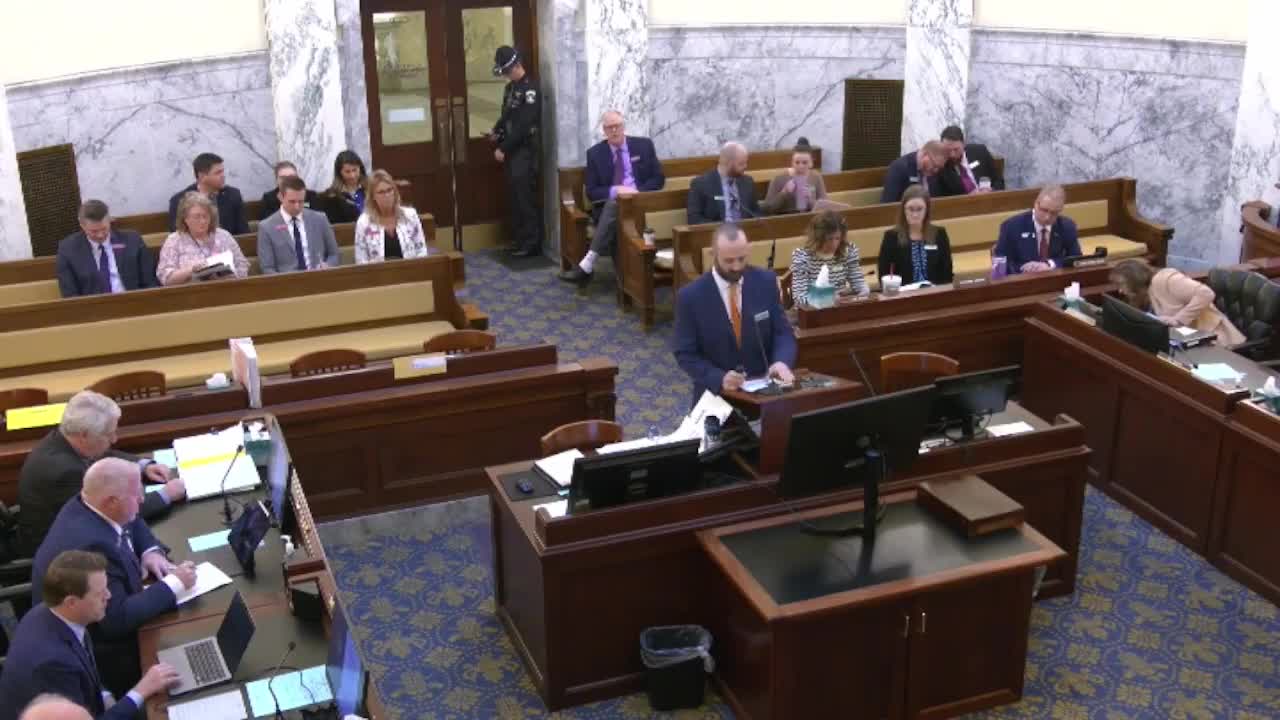
Jared Tetrault, deputy division manager in the Legislative Services Office Budget and Policy Analysis Division, told the Joint Finance-Appropriations Committee on March 4 that Idaho’s public school support budget is largely formula-driven and sensitive to changes in attendance and support-unit counts.
Jared Tetrault, deputy division manager in the Legislative Services Office Budget and Policy Analysis Division, told the Joint Finance-Appropriations Committee on March 4 that Idaho’s public school support budget is largely formula-driven and sensitive to changes in attendance and support-unit counts.
Tetrault said the state distributes most K-12 funding through “support units,” and that “for every support unit the state will fund 1.55 full-time equivalent positions.” He told the committee the state allocates salary-based apportionment for administrators, classified staff and the career ladder separately and that the Public Education Stabilization Fund (PSIF) is used to reconcile appropriations with actual distributions to districts.
The overview matters because the state’s per-unit allocations and one-time federal dollars have altered how much recurring money districts expect. Tetrault told legislators that a recent shift back to counting average daily attendance — as required by Idaho law — produced an effective drop in counted support units compared with pandemic-era counting methods, a change he said accounts for a reduction of roughly 200 support units in the current estimates. That shift, he said, has the practical effect of lowering some appropriations even when enrollment is roughly flat.
Committee members pressed for additional detail and data. Senator Ward Engle King asked why support units fell despite similar enrollment; Tetrault replied that “Idaho law requires that for funding purposes student counts be done on average daily attendance” and explained that attendance percentages remain lower than pre-pandemic levels, which lowers the state’s support-unit calculation. Representative Price and others asked about the dollar value of a support unit; Tetrault said the current average is about $147,000.
Lawmakers also discussed how one-time federal funds changed district budgeting. Superintendent Crishfield said roughly 80% of districts used federal ESSER funds for personnel in some form and that state leaders warned districts about the time-limited nature of that money. Crishfield said the U.S. Department of Education offered states an extension to use some federal funds, but she did not pursue an extension for Idaho and had notified districts to plan for the federal funding to end.
Other notable budget drivers and proposals discussed at the hearing included: - Facilities funding: Tetrault described the House Bill 292 school district facilities fund and the separate one‑time $1 billion allocation distributed by per‑student share; he said HB 374 would make the facilities fund a continuous appropriation if enacted, and that committee action later would determine whether to remove that fund from the committee’s annual appropriation process. Committee members asked for district-level distributions and project lists; Tetrault said those are in the fiscal facts and that the department previously provided project lists and would redistribute them to the committee. - Transportation and central services: Tetrault noted a request to shift $10 million from the general fund to the “other income” fund based on higher projected royalties and interest. He and department staff said pupil transportation is budgeted using the prior‑year actual expenditures formula in Idaho Code. The committee heard a separate request from the Department of Education for a statewide optional student-transportation routing software to help districts improve route efficiency and better match miles and ridership to the state’s formula. - Professional development and literacy: The department asked to reclassify some professional-development dollars from a state line item into discretionary funds under local control, and to repurpose roughly $10.85 million in professional-development services into discretionary funding tied to district priorities. The superintendent and staff emphasized that targeted coaches for K–3 literacy would be funded through a separate proposal.
The presentation included a high-level “big sheet” summary of the public schools budget showing general, dedicated and federal funds; Tetrault said the general‑fund request for the agency and governor ranged around $2.7–$2.8 billion, with federal funds near $260.6 million for the current year. He repeatedly cautioned that many distributions flow through statutory formulas in Idaho Code Title 33 and that some adjustments are “subject to appropriation.”
Committee members asked for follow-up data on: how many school staff receive state health-insurance allocations versus actual plan enrollment; district‑level facility project lists and how districts are spending one‑time facility dollars; how many districts already use routing software; and the breakdown of county/local levy contributions to overall school funding. Tetrault and department staff agreed to provide additional detail to the committee where available.
Looking ahead, Tetrault flagged pending bills that would affect appropriations, including legislation on a weighted student funding formula, a transportation funding formula and a special-needs student fund; some of those proposals were assigned to germane committees with hearings scheduled separately.
Tetrault closed by reminding the committee that many line items are statutorily formulaic and that the committee would see detailed statutory references in the budget book. He invited additional questions and said staff would supply district‑level breakdowns and the requested clarifying figures.
Less urgent follow-ups: committee members asked staff to circulate back‑up data on district health‑insurance participation, the list of district facility projects tied to the $1 billion allocation, and counts of districts already using routing software.