Get Full Government Meeting Transcripts, Videos, & Alerts Forever!
Get email alerts on the Water Resources topic
No spam. Unsubscribe anytime.
Idaho water officials outline ARPA-funded projects, seek staff to manage expanding water districts and recharge work
Summary
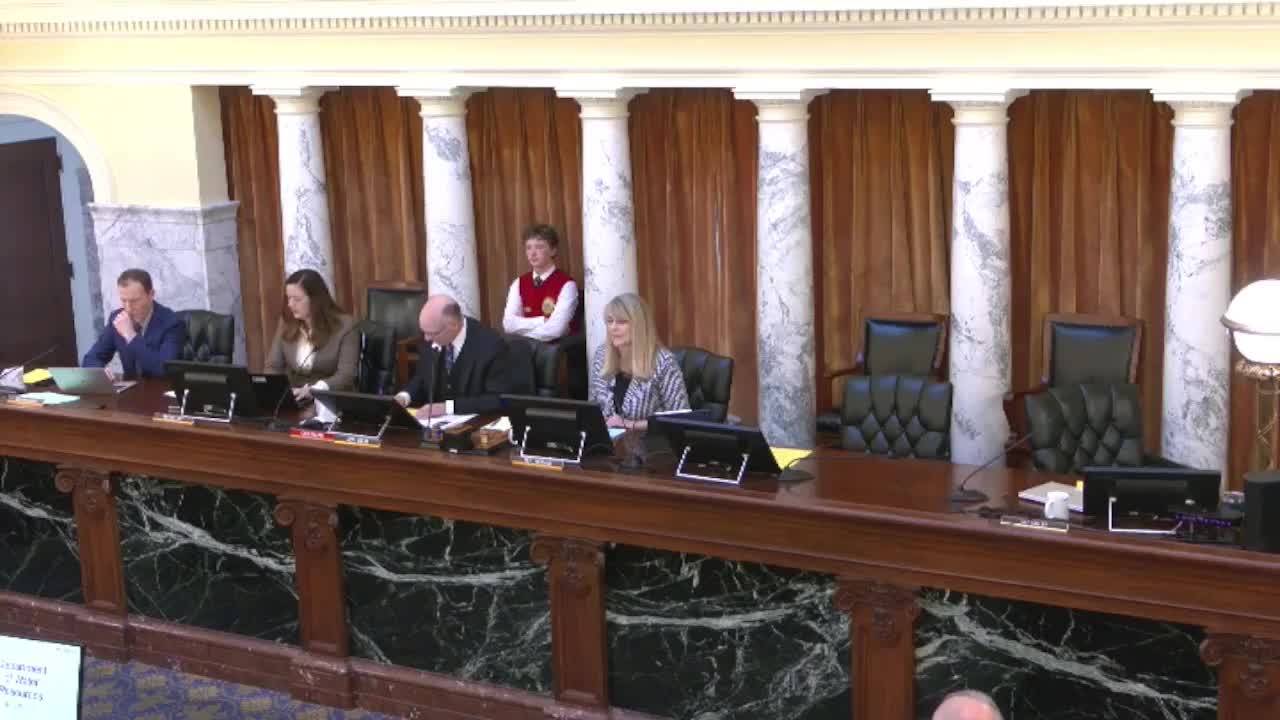
At a March legislative budget committee hearing, Janet Jessup, budget and policy analyst with Legislative Services, told lawmakers the Department of Water Resources has seen a sharp increase in appropriations after receiving State Fiscal Recovery (ARPA) funds and that agency leaders were asking for five new full-time positions to help manage water districts and administration work.
At a March legislative budget committee hearing, Janet Jessup, budget and policy analyst with Legislative Services, told lawmakers the Department of Water Resources has seen a sharp increase in appropriations after receiving State Fiscal Recovery (ARPA) funds and that agency leaders were asking for five new full-time positions to help manage water districts and administration work.
The request follows major project spending tied to ARPA and other sources and comes as the Idaho Water Resource Board and the department press to expand managed recharge and other supply projects — particularly for the Eastern Snake Plain Aquifer (ESPA). The board and department officials described tens of millions in committed projects, roughly $290 million in committed water-management funds, and roughly $29 million uncommitted cash in the water management account as of the most recent balances presented to the committee.
Department structure, ARPA infusion and staffing request
Janet Jessup told the committee the Department of Water Resources is organized under Title 42 of Idaho Code and that the Water Resource Board was created by Article 14 of the Idaho Constitution. She said the department was allocated about 170 full-time positions and historically spends close to 90% of its personnel appropriation. Jessup noted that the agency received a substantial ARPA award: "50,000,000 of this appropriation was one time and the other 50,000,000 was made ongoing," and that the ARPA dollars explain the large increase in fiscal-year 2023 expenditures.
Matt Weaver, director of the Idaho Department of Water Resources, asked for five additional positions to pair with about 11 existing water-distribution staff and to create a new water administration bureau. Weaver said the five positions include a bureau chief, resource-agency liaison positions and a technical records specialist. He told the committee the additional staff are intended to support statutory administrative duties and a growing workload related to the creation and support of water districts: "Currently right now we are not meeting the demand to create and support water districts across the state," Weaver said.
Why the request: water districts, settlement obligations and recharge
Weaver and Jeff Raybould, chairman of the Idaho Water Resource Board, described several drivers for increased workload: the settlement on the Eastern Snake Plain (discussed repeatedly during the hearing) that requires expanded administration and monitoring; demand for new water districts in basins south of the Snake River and in parts of the Clearwater; and ongoing projects in the Upper Salmon basin.
Weaver described the settlement's administrative expectations and the need for a real-time measurement program on the ESPA: "the expectation in the settlement ... was that by April 1, a year from now, all of those wellheads are being measured and reported in real time." He said fully meeting the settlement’s monitoring and administration obligations could require substantially more staff across state and local entities.
Raybould and Weaver also discussed recharge capacity. Weaver described targets raised in plans for the ESPA, noting the board has considered increasing the average annual recharge goal in its aquifer management plan "from...250,000 acre-feet a year to 350,000 acre-feet." Raybould summarized state and private contributions to recharge and pumping reductions from 2016–2024: "state-sponsored recharge was able to average 268,000 acre-feet a year," private recharge averaged 116,000 acre-feet a year, and groundwater users reduced pumping by 212,000 acre-feet a year — totalling roughly 600,000 acre-feet of aquifer-management activity in that period, Weaver said.
Fund balances, committed projects and uses
Committee materials and testimony laid out fund balances and commitments. Director Weaver and Jessup summarized the water management account as follows (figures as presented verbally to the committee): an ending balance after FY2024 of about $293,000,000; revenue through December of approximately $38,000,000; and expenditures of about $11,200,000, producing a cash balance the speaker rounded to about $320,000,000. The Water Resource Board has passed resolutions committing about $290,000,000 of those funds, leaving an uncommitted balance of roughly $29,000,000, Weaver told the committee.
Raybould listed projects and loan activity funded or partly funded from those accounts, including the Mountain Home Air Force Base water-supply pipeline, funding toward the Anderson Ranch dam raise, pipeline work linked to Dworshak (for hatcheries), work on Bear Lake storage carryover, the Priest Lake water-management project, loan and grant programs for groundwater-to-surface-water conversions ("There's been $13,000,000 out of $20,000,000 that was allocated"), Lewiston Orchards conversion work together with the Bureau of Reclamation, the Raft River pipeline and regional sustainability projects, monitoring and measurement, and canal efficiency and capacity improvements.
Loan balances and program mechanics
Committee testimony included figures on loans outstanding. Raybould estimated the revolving development account had about $23,000,000 in loans outstanding and said roughly $20,000,000 from the water-management account was out in loans. Raybould described the board's approach to deciding grants versus loans: some programs (for example, an aging-infrastructure grant) will cover up to one-third of project costs with a cap, while other projects receive loans or other mixes of funding. He said the board evaluates applicants' ability to fund projects, project importance to the state, and the return on investment when deciding loan versus grant terms.
Project timelines and reasons for spending lags
Multiple committee members asked why several line items — for example, a proposed $40,000,000 for statewide recharge infrastructure — remained largely unspent. Raybould and Weaver explained that many projects are large, require engineering and environmental review, and funds are released as projects meet milestones. Raybould said applicants often need time for design and engineering before the board releases funds and that the board is encouraging proponents to accelerate schedules where practicable.
Concerns and committee feedback
Several lawmakers pushed back on the request for ongoing $30,000,000 from the general fund (the governor's recommendation) without a detailed project list attached to the ongoing base. Representative Tanner and others said they favored funding projects more narrowly or on a project-by-project basis rather than adding a large ongoing appropriation without specific projects identified. Weaver and Raybould said they expect ongoing needs for operations and maintenance and monitoring tied to recharge and other projects and argued that some ongoing funding provides planning certainty.
What the committee asked for next
Members asked for additional documentation. Janet Jessup told the committee she would follow up with the list of projects the board maintains that are not yet funded. Committee members also pressed the agency to provide more detail about loans outstanding and project schedules. No formal committee votes occurred during the presentation; the hearing was a staff briefing and question-and-answer session.
Ending
The department and the board emphasized continuing needs: expanded administration for water districts, more recharge capacity, engineering and monitoring for large projects, and a mix of grants and loans to advance projects. Director Weaver closed by thanking the committee and underscoring that the department's enhancement requests aim to meet water-user needs statewide.
Quotes in this article are taken verbatim from the committee transcript and attributed to the speakers who made them in committee.