Lifetime Citizen Portal Access — AI Briefings, Alerts & Unlimited Follows
Tourism secretary urges lawmakers to keep marketing funds, create film office and make outdoor-recreation staff permanent
Loading...
Summary
Secretary Anne Sayers told the Assembly Tourism Committee that sustained marketing dollars, permanent staff for the Office of Outdoor Recreation, new group-travel positions and a film office with tax incentives are central to Governor Evers' budget proposal and would help the state reach a top‑20 tourism target.
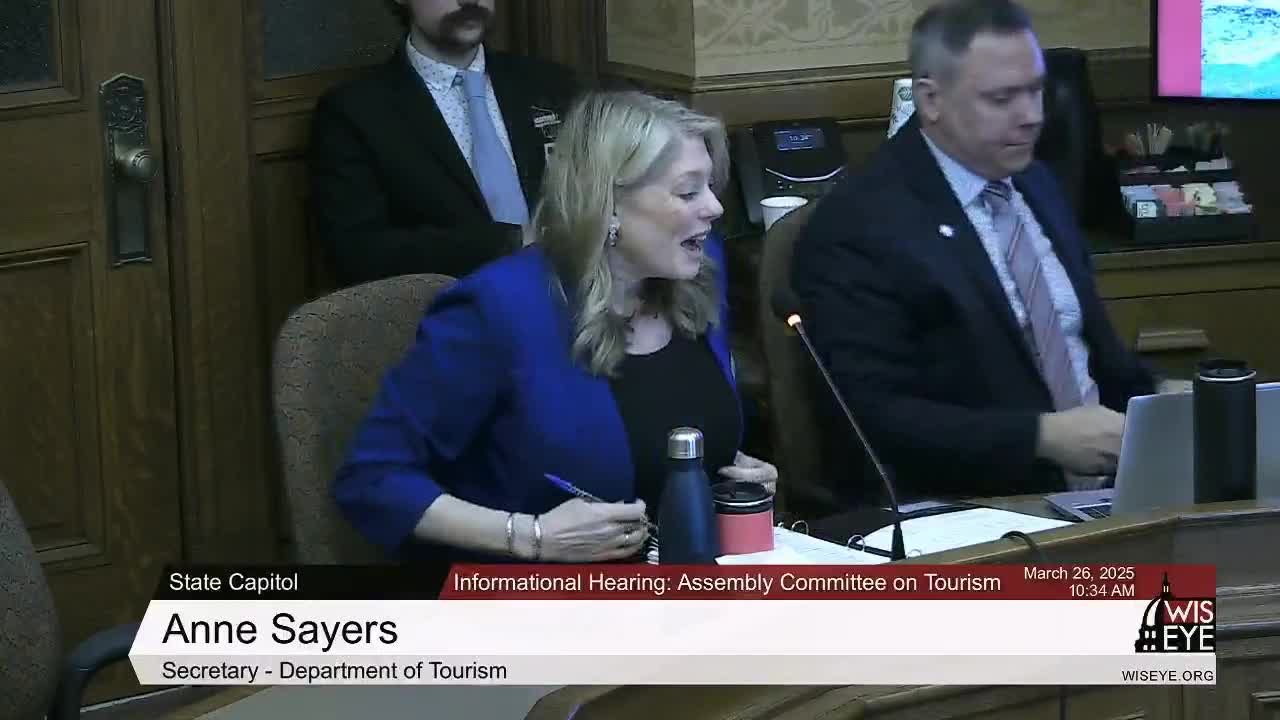
Anne Sayers, secretary of the Wisconsin Department of Tourism, told the Assembly Tourism Committee that continued investment in tourism marketing and several new staff and programs proposed in the governor's budget are needed to sustain recent growth and pursue a goal of becoming a top‑20 state for direct visitor spending.
Sayers said the department’s work under the consumer brand Travel Wisconsin helped lift statewide tourism to a $25 billion annual economic impact in 2023 and that marketing dollars produce measurable returns: “For every dollar that comes into the department of tourism that we spend in advertising, we can track that back to $22 in direct visitor spending,” she told the committee.
The department framed the governor’s proposal as largely restoring funds that have already driven recent gains. The proposal includes one‑time marketing funds, a proposed increase in base marketing dollars, provisions to make three Office of Outdoor Recreation positions permanent, two additional positions for the Office of Group Travel, a new film and creative‑industries office with three staff, and a $10 million film incentive administered through the Department of Revenue.
Sayers said Travel Wisconsin’s marketing and public‑relations work has expanded in recent years: the agency now runs three seasonal reports (trail, fall color and snow reports), a “Foodie Pass” promotion, and a content series called “Here’s to Being Here.” She described a modest staff that manages those programs — “we’re just at 27” permanent employees, she said — and urged that cuts to the marketing budget would be felt most acutely in advertising and promotions rather than operations.
Craig Trost, communications director for the Department of Tourism, described the department’s role in attracting film and television production, citing Top Chef as an example. “Top Chef took about three years to bring it here,” Trost said, describing fundraising and partner coordination that brought roughly $1.3 million in support from public and private partners and delivered short‑term hotel and local spending impacts.
Sayers and Trost told committee members that the Office of Outdoor Recreation — which has operated with three project positions for almost six years — should be made permanent because the outdoor recreation economy is large ($11.2 billion, by the department’s figures) and growing. The governor’s proposal would convert those project positions to permanent staff and add other staff to support group travel and film work.
Committee members asked about several operational topics during a question‑and‑answer session. Members discussed the department’s regional staffing for tourism development specialists and concerns from local partners about coverage in western and northern Wisconsin. On winter tourism, Sayers outlined a “no‑snow” campaign the agency uses to pivot promotion to indoor and non‑snow winter activities when snow conditions are poor. Representatives also asked about the economic lift and logistics around the upcoming NFL Draft and current film productions in Door County.
On tribal tourism, Sayers said the department proposes shifting management of the Native American Tourism of Wisconsin (NATOW) contract to the Department of Administration and increasing annual funding for the program from $200,000 to $1,000,000. She said tribal gaming revenues that currently fund some tourism activity would be backfilled with general purpose revenue under the governor’s plan.
Sayers noted specific budget numbers the department uses in its planning: a historic base biennial budget of about $18.2 million (annualized for context), current operating near $37.7 million with one‑time funds in recent years, and a proposed package that includes $28.6 million in one‑time marketing funds plus a $5.2 million base marketing increase (figures presented by the department). She also cited a $2.95 million annual increase proposed for the Wisconsin Arts Board and a $1 million rural creative‑economy grant program.
The presentation included several empirical claims and program metrics the department repeated throughout the hearing: 113 million annual visitor trips (department figure), 178,000 tourism‑related jobs, and $1.6 billion in state and local tax revenue attributed to visitor spending. Sayers and Trost stressed that marketing choices (markets, timing, seasonal campaigns) are data‑driven and the department uses market modeling to prioritize advertising markets such as Chicago and Minneapolis.
No formal committee action or vote occurred during the hearing; the session was an informational presentation followed by questions from committee members. The department left the committee with requests to answer follow‑up questions about regional staffing and to provide additional detail for the committee and joint finance deliberations.
The department provided many concrete examples of how marketing and production activity translated to near‑term local spending, including Door County’s ongoing Christmas‑movie production (estimated at about $600,000 spent locally for a three‑week shoot) and Top Chef’s estimated $5–6 million in local production spending.
Sayers closed by urging continued investment: the department said the proposed mix of marketing funds, permanent outdoor‑rec staff and film incentives would restore the department’s recent operating level, support rural creative economies and grow visitor spending statewide.
Looking ahead, committee members indicated interest in further detail about the arts board match with National Endowment for the Arts funding, the tribal tourism contract transfer, and whether the department would return with additional budget materials during the joint finance process.