Get Full Government Meeting Transcripts, Videos, & Alerts Forever!
Get email alerts on the Water Board Projects topic
No spam. Unsubscribe anytime.
Idaho Water Resource Board outlines $575 million in projects, calls for more recharge capacity
Summary
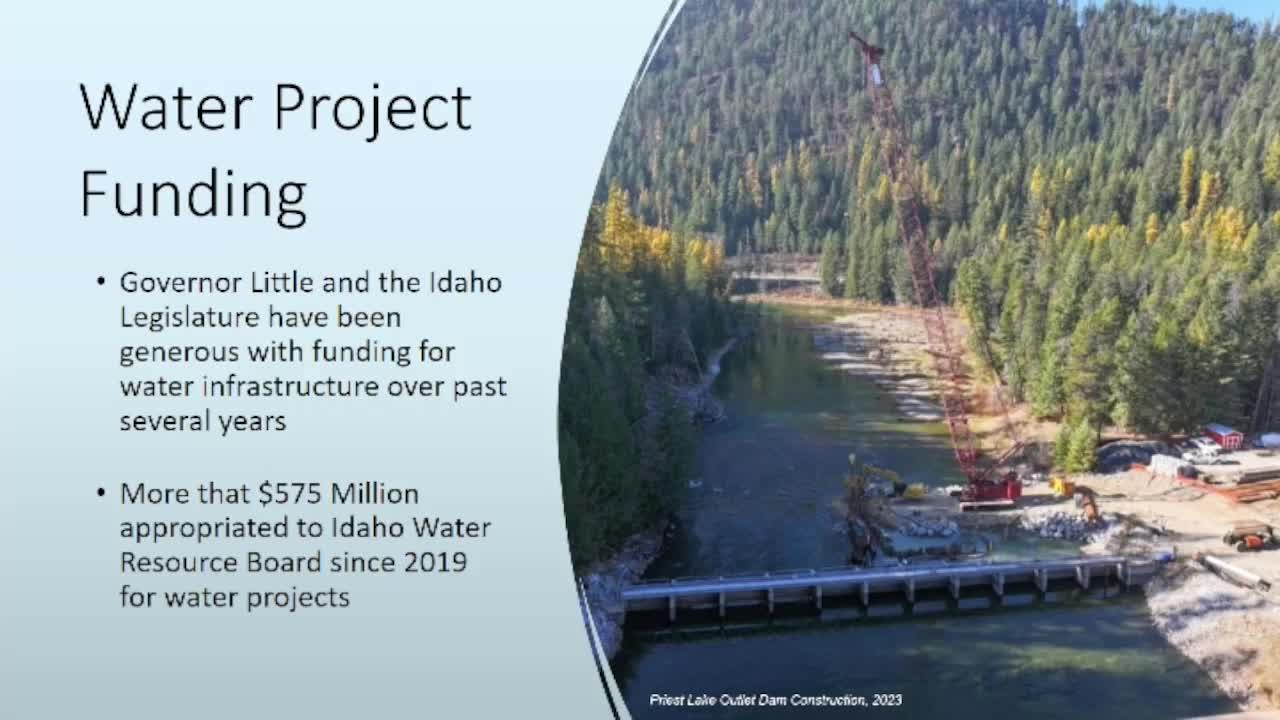
Board Chairman Jeff Rehbould told the House committee the board has overseen roughly $575 million since 2019 and is funding recharge, canal repairs, cloud seeding and reservoir projects but needs substantially more upper-basin recharge capacity.
Jeff Rehbould, chairman of the Idaho Water Resource Board, told the Idaho House Resources Committee the board has received significant funding in recent years and is distributing grants and loans for recharge, aging infrastructure, telemetry and other water-supply projects across the state.
"We’ve had about $575,000,000 appropriated to the board since 2019," Rehbould said, summarizing multi-year appropriations the board is managing for statewide projects.
Major programs and allocations
Rehbould described two principal funding sources: a water-management account with roughly $337 million (principal and interest) and an approximately $250 million allocation of American Rescue Plan Act funds. Board programs include aging-infrastructure grants (competitive grants that can cover up to one-third of project costs, capped at $2 million per project), groundwater-to-surface-water conversion grants (up to 50% of costs, $5 million cap), ESPA telemetry and monitoring grants (up to 50% of cost, $250,000 cap), and a flood-management grant program (up to 50% of costs, $200,000 cap).
Examples of projects funded
Rehbould listed numerous projects supported by the board: Anderson Ranch Dam raise (additional 29,000 acre-feet of storage planned with a six-foot raise; the board’s share of a near-$126 million project), Mountain Home Air Force Base pipeline and treatment plant (state pipeline cost about $40 million, with the Air Force building treatment facilities), American Falls spillway repair, New York Canal rehabilitation in Boise, Lewiston Orchards exchange project, Raft River pipeline, and numerous canal-conversion and recharge projects.
Recharge capacity and cloud seeding
The board reported average annual cloud-seeding gains of roughly 950,000 acre-feet across the Boise, Wood and Upper Snake basins at an average cost of about $3.77 per acre-foot; the program operates with Idaho Power and local water users using instrumentation and aircraft. Rehbould said the board’s ESPA recharge capacity currently is roughly 2,000 cubic feet per second (cfs) in the Lower Valley and nearly 600 cfs in the Upper Valley and that the board needs to roughly triple Upper Valley capacity to capture high-runoff years and better protect the aquifer. "We need to develop a lot more capacity in the Upper Valley," he said.
New and ongoing actions
The board has awarded grants under aging-infrastructure and conversion programs (90 projects funded across five rounds for aging infrastructure; 11 conversion grants awarded to date) and is preparing pilot recharge work in Treasure Valley to offset incidental recharge losses where canals are lined. Rehbould said the board weighs incidental-recharge impacts when financing canal-efficiency projects; in the New York Canal rehabilitation, estimated incidental-recharge loss was roughly 25,000–30,000 acre-feet per year, and the board supported lining a high-risk urban reach after weighing public‑safety concerns.
Ending
Rehbould urged continued investment in recharge and storage to stabilize aquifers and reduce future reliance on curtailments, saying the board seeks to balance infrastructure safety, water-supply reliability and long-term aquifer health.