Get Full Government Meeting Transcripts, Videos, & Alerts Forever!
Get email alerts on the Education Internet Safety topic
No spam. Unsubscribe anytime.
Tennessee House debates K–12 internet, social media and AI safety guidance; bill fails to reach constitutional majority
Summary
A bill requiring the Department of Education to develop guidance on social media, internet and AI safety instruction for grades 6–12 drew extended debate over classroom time, parental opt-outs and what counts as "age appropriate." The House vote did not reach a constitutional majority, according to the chamber record.
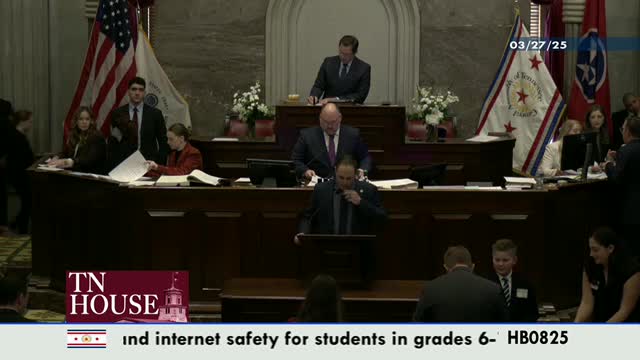
Representative Josh Mayberry, the bill sponsor, told the Tennessee House on Thursday that House Bill 8 25 would require the Department of Education to develop guidance by January 2026 for instruction on social media, Internet and artificial intelligence safety for students in grades 6 through 12.
Mayberry said the guidance would cover time management, healthy digital habits, mental-health risks and addiction, privacy and personal safety, spotting online predators and cyberbullying, and “understanding AI information and media manipulation,” and that instruction would begin in the 2026–27 school year. He also said parents could excuse a child from some or all of the instruction.
Rep. Justin Johnson (R) and other lawmakers questioned whether the bill adds instruction without adding classroom time. "Teachers right now cannot get in everything they need to do," Johnson said, urging the Legislature to consider whether districts would be forced to drop other material to make time for the new guidance.
Mayberry responded that the bill asks only for Department of Education guidance and does not mandate specific minutes per subject; he said local education agencies would decide how to implement the guidance. "I'm simply asking the Department of Education to give guidance on teaching these important lessons," Mayberry said.
Chairman Jeremy Clemens raised concerns about a provision on limiting the content students can access on school-provided Internet to "age appropriate" material, asking whether the bill would duplicate or expand existing statute that already bars access to material deemed "harmful to juveniles." Mayberry described the intent as protective rather than censorial and said the measure also discourages social-media use during school hours except for instruction.
Supporters cited research and recent cases involving AI. Rep. Mike McKelman noted a U.S. Surgeon General report that linked more than three hours daily social media use to higher risks of depression and anxiety among adolescents. Mayberry referenced the death of a Florida 14-year-old who formed a harmful relationship with an AI chatbot as part of the rationale for including AI in the guidance.
After floor debate, the House voted. The clerk reported the tally as "Ayes 88, 4 nays, 3 present," and the presiding officer then stated the bill "hasn't received a constitutional majority," according to the House record.
The bill would have required the Department of Education to develop the guidance by Jan. 2026 and to begin implementation in the 2026–27 school year. It included an opt-out for parents or guardians and a provision that social media not be used during school hours except for instructional purposes.
Lawmakers on both sides said they support informing students about Internet safety, but disagreement centered on implementation details and whether the state should create new required content without adding instructional time.
If the sponsor pursues the measure again, lawmakers said they would continue negotiating language on the age-appropriate-content clause and the practical time needs for school staffs and teachers.