Get Full Government Meeting Transcripts, Videos, & Alerts Forever!
Get email alerts on the Elections Voting Systems topic
No spam. Unsubscribe anytime.
Georgia senators debate bill to require hand-marked paper ballots, ballot-on-demand printers
Summary
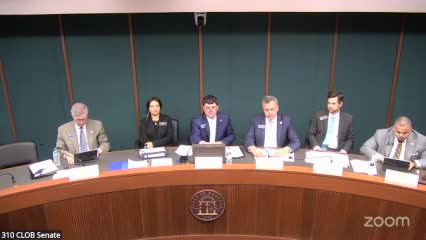
A Georgia Senate committee on Tuesday considered Senate Bill 214 (LC 473679S), legislation that would require most in-person voters to use hand-marked paper ballots that are optically scanned and tabulated, with ballots printed on demand at the polling place.
A Georgia Senate committee on Tuesday considered Senate Bill 214 (LC 473679S), legislation that would require most in-person voters to use hand-marked paper ballots that are optically scanned and tabulated, with ballots printed on demand at the polling place.
The bill’s author, identified in the hearing as Senator Barnes, told the committee the measure would “require that all votes are cast on a hand marked paper ballot, and that that paper ballot is then optically scanned and tabulated.” He said the proposal would rely on ballot-on-demand printers to provide each voter the correct ballot style and would allow the secretary of state to run pilot programs as the state implements optical scanning systems.
Supporters said the change would give voters a visible, physical record of their selections and improve auditability. Brad Carver, who identified himself as chair of the Georgia Republican Party’s Sixth Congressional District and chair of an “election confidence” task force, told the committee hand-marked paper ballots are used in multiple democracies and in most U.S. states. “Hand-mark paper ballots are used worldwide,” Carver said, adding they provide a “physical record that blends efficiency with security.” Victoria Cruz, a member of the public who testified in favor, called hand-marked ballots the “gold standard” of voter-verifiable records.
But county elections officials, disability advocates and other members of the public urged caution and asked for more analysis before the state moves forward. Joseph Kirk, an elections supervisor who identified himself as president-elect of the Georgia Association of Voter Registration and Election Officials (GAVRIO), said election officials can support exploring the approach but warned a change of this scale would require time for procurement, testing and training. “A change of magnitude is complicated, and we stand ready to offer our expertise,” Kirk said.
Key provisions and debates
- What the bill would do: The bill text discussed at the hearing would (1) define ballot-on-demand printing, (2) require that polling places use optical scanning voting systems that accept hand-marked ballots, and (3) keep an electronic option for voters with disabilities. The sponsor described the system as three layers of verification: the hand-marked paper ballot itself, an optical image of the ballot, and post-election audits.
- Ballot-on-demand versus preprinted ballots: The sponsor said print-on-demand reduces “stray” ballots because ballots are printed only after voter check-in; some senators and local officials argued counties sometimes prefer preprinted ballots on election day for logistical reasons. The bill language discussed would allow some flexibility for preprinting in limited circumstances, but the sponsor said he prefers print-on-demand.
- Accommodation for voters with disabilities: The bill would require each polling place using optical scanners to be equipped with at least one electronic ballot marker or other accessible voting machine for people with disabilities. Committee members pressed for clearer language to ensure machines remain available for voters who need them and asked that the bill explicitly preserve existing federal-access requirements.
- Cost and timing: Several senators and public commenters said implementation costs are unresolved. The sponsor cited wide cost estimates for ballot-on-demand printers—from “as low as $1,000 to upwards of $7,000 per unit”—and said the state could be a buyer. Other witnesses cited higher figures drawn from other states (one witness cited figures as high as $7,000 per printer and up to $22,000 for certain models in an Arizona example). Committee members repeatedly requested a fiscal note before committing to the measure; the chair said one was not yet available and that any implementation would occur after the current contract cycle, which several speakers said runs until 2028.
Public comment: wide split
Public testimony showed a clear split. Proponents, including local Republican party leaders and several citizen speakers, urged the committee to adopt hand-marked ballots to restore voter confidence and reduce reliance on QR codes and complex, proprietary software. Opponents, including disability advocates, civil-rights groups and some poll workers, warned that the bill lacks a fiscal note, could impose heavy costs on counties or disadvantage voters with disabilities and low literacy if not carefully implemented.
- Cost and procurement concerns: Cindy Battles of the Georgia Coalition for the People’s Agenda and Rachel Lastinger from the ACLU-affiliated Voter Access Project urged the committee to obtain a fiscal note and to consult local election officials before moving forward. Lastinger cited the state’s 2,696 precincts and said high-quality ballot-on-demand printers and scanners could cost tens of millions of dollars to buy and deploy.
- Access and rural logistics: Disability advocates and poll workers warned that printers can jam, that remote precincts may lack quick technical support, and that systems must ensure voters with disabilities can privately cast a ballot without undue assistance. Stephanie Alley of New Georgia Project described concerns about travel time between distant precincts and the operational strain new equipment could create.
- Chain of custody and auditability: Supporters argued print-on-demand tied to the voter check-in system reduces the risk of stray ballots and improves chain-of-custody. Opponents questioned whether optical scanning hardware already owned by counties would be compatible and noted some counties may prefer preprinted ballots for election day.
Next steps
Committee members asked the sponsor and counsel to refine language and to work with colleagues—some said the bill could come back for additional consideration as early as the next day. No committee vote was recorded at the hearing. The sponsor and colleagues acknowledged more work is needed on fiscal impacts, precise language on accommodations for voters with disabilities, and implementation timelines before the measure could proceed.
The hearing also included extended public comment with testimony both for and against the measure; no formal action or vote was taken by the committee at the meeting’s close.