Get Full Government Meeting Transcripts, Videos, & Alerts Forever!
Get email alerts on the Doc Security Contraband Transport topic
No spam. Unsubscribe anytime.
After staff shooting, Idaho DOC seeks digital mail scanning, drone detection and transport upgrades
Summary
Following a spring ambush that left three DOC staff shot, the agency asked the Joint Finance-Appropriations Committee for a package of security measures — mail digitization, drone detection, phone‑call transcription/analysis and expanded transport capacity — to reduce contraband and improve safety during high‑risk inmate transports.
The Idaho Department of Correction requested supplemental and ongoing funding to deploy advanced surveillance and transport safety measures after a spring incident in which DOC staff were shot while escorting an inmate to and from a hospital.
Noah Peterson, budget and policy analyst, told the Joint Finance-Appropriations Committee that the agency's supplemental requests were driven by vulnerabilities revealed when a transported inmate and a third party ambushed staff. "These supplementals and enhancements are proposed by the agency to address vulnerabilities that were discovered within the agency," Peterson said.
Major requests and the agency rationale: The DOC proposed three related security technology investments: - Digital mail scanning and off‑site mail digitization to remove paper mail as a routine vector for contraband; - Drone detection systems to identify and help interdict small unmanned aerial systems approaching facilities; - LEO‑brand intelligence tools for phone‑call transcription and analysis to surface threats and networked criminal activity in recorded calls (DOC reported residents made about 4,000,000 phone calls totaling roughly 49,000,000 minutes in 2023).
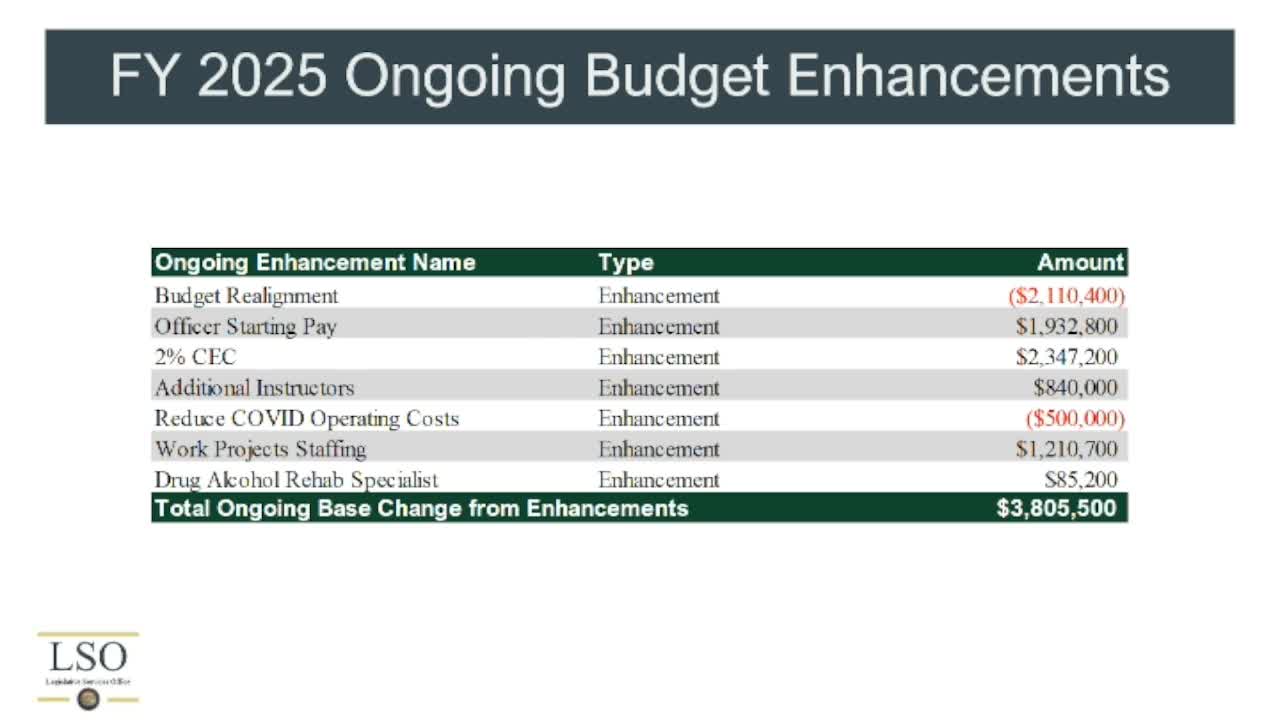
Peterson estimated the first‑year cost of implementing all three technologies at about $795,000 for the remainder of fiscal 2025 and $2,397,000 for a full year: roughly $1,011,000 for mail scanning, $385,500 for drone detection and $1,000,000 for phone transcription and analysis, all from the general fund.
Transport bureau expansion: The agency also proposed a $1.148 million one‑time supplemental to expand the statewide transport bureau with 12 new full‑time positions and new vehicles (six SUVs and one wheelchair van) to create a trained, equipped team to handle high‑risk and emergency medical transports. Peterson said the transport expansion includes personnel and operating costs for specialized vehicles and equipment.
Body‑worn camera pilot: The DOC requested a federal grant and state match to pilot body‑worn cameras at three sites (Idaho Maximum Security Institution, District 3 probation and parole, and the IDOC special investigations units). The fiscal 2025 supplemental request included approximately $1.05 million, mostly federal funds, to cover equipment, docking, storage and licenses; ongoing license costs require state matching in future years.
Agency explanation and committee questions: Director Josh Tewalt emphasized the rising sophistication of contraband introduction methods — including ink altered with drugs, autonomous drones and cell‑phone smuggling — and argued digital mail scanning would “completely eliminate our most porous point of entry for contraband in our facilities.” He said drone detection would allow the DOC to identify incoming unmanned aircraft and coordinate with law enforcement. On the transport bureau, Tewalt told the committee that relying on facility staff for emergency transports had generated large amounts of overtime (he cited roughly 20,000 overtime hours at one facility and 14,000 at another) and created operational vulnerabilities that the transport bureau expansion would address.
Governor recommendation and alternatives: The governor recommended contracting for seasonal snow removal at St. Anthony's work camp rather than the DOC purchasing a skid‑loader; that change reduced one capital request. The governor otherwise recommended the agency's technology and personnel items, subject to the committee's review.
Ending: Committee members asked for more detail on costs and operations, and DOC offered follow‑up documentation. The requests tied directly to safety measures after a violent incident, and the agency presented the measures as aimed at preventing similar events while improving systemwide contraband detection and evidence availability for law enforcement.