Get Full Government Meeting Transcripts, Videos, & Alerts Forever!
Get email alerts on the Recidiviz Case Management topic
No spam. Unsubscribe anytime.
Idaho DOC asks for ongoing funding for Recidiviz case‑management tools
Summary
The Idaho Department of Correction asked the Joint Finance-Appropriations Committee to approve ongoing general‑fund support to continue and expand work with Recidiviz, a nonprofit data‑integration partner used to streamline case management and prioritize probation and parole workloads.
The Idaho Department of Correction requested ongoing general‑fund support to continue and expand its partnership with Recidiviz, a nonprofit that aggregates and automates disparate corrections data for use in case triage, officer workload prioritization and outcomes analysis.
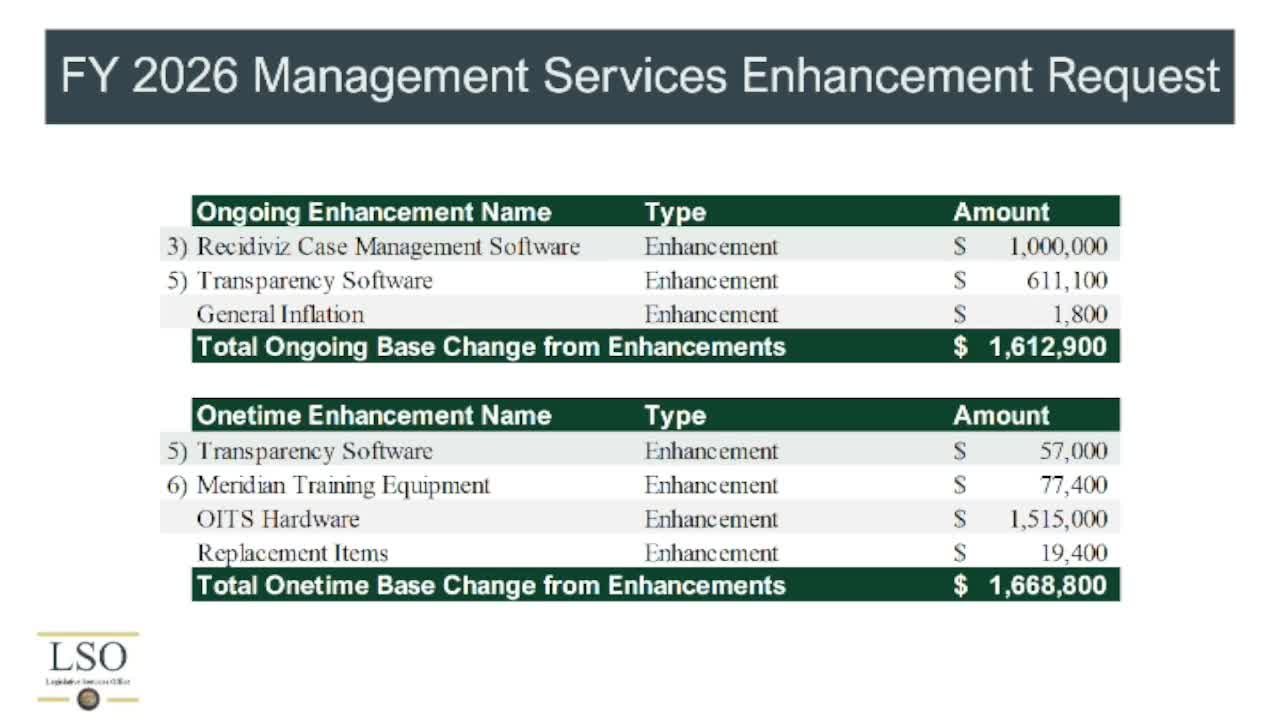
The request, presented Feb. 4 to the Joint Finance-Appropriations Committee, would move previously one‑time federal and other funds into ongoing appropriation to extend Recidiviz tools beyond probation and parole into the prison case‑management environment. Noah Peterson, budget and policy analyst with the Legislative Services Office, told the committee the Management Services Division requested appropriation “for recidivism case management software” that would be ongoing rather than one‑time.
Why it matters: The agency says Recidiviz helps surface data across legacy systems and automate routine back‑office tasks, freeing staff for more direct supervision and casework. Director Josh Tewalt described the partnership as highly influential: “It's probably the most transformative partnership we've entered into as an agency in my entire tenure there,” he told the committee, adding Recidiviz “creates overlays” across disparate data sources and produces case triage tools for probation officers.
What the agency says it does: Director Josh Tewalt said Recidiviz provides case triage reports that show staff where to prioritize interventions, tools to compare officer‑level outcomes and analytics to inform classification decisions. He said Recidiviz’s nonprofit status means private philanthropic funds typically match public spending, leveraging each dollar the state invests.
Questions from legislators: Senators and representatives asked for empirical evidence of return on investment and for the dashboards or outputs Recidiviz produces. Senator Cook asked for data showing ROI; Mr. Peterson said hard data was not available at that moment and offered to work with the agency. Representative Tanner and others requested sample dashboards and clarification on who controls the underlying data. Director Tewalt said the state retains control and data‑sharing agreements protect the source data; Recidiviz pulls data from Idaho systems rather than re‑creating or altering it.
Funding context and procurement questions: Committee members asked whether alternatives had been evaluated. Tewalt said Recidiviz's approach — aggregating data with minimal additional burdens on line staff — is not comparable to typical commercial off‑the‑shelf systems and that the department had considered other vendors but found no direct substitute for the model Recidiviz uses. He offered to provide additional comparisons and dashboards to the committee for evaluation.
Next steps: The budget request was presented as part of the Management Services Division enhancement requests; committee members asked the department to supply usage dashboards, outcome metrics and details about philanthropic matches and partners before the committee finalizes funding decisions.
Ending: Committee members signaled interest in more documentation on outcomes and controls. The agency committed to provide usage dashboards and clearer documentation of matching philanthropic funds and the data‑governance arrangements that preserve state control of records.