Get Full Government Meeting Transcripts, Videos, & Alerts Forever!
Get email alerts on the Employee Compensation topic
No spam. Unsubscribe anytime.
Lawmakers debate wage approach for state employees; motions withdrawn and compensation decisions postponed
Summary
Committee members debated competing compensation proposals for FY2026 — a flat $1.55 per hour across the board endorsed by the CEC committee and a substitute that would give $1.55 per hour or 4%, whichever is higher — along with targeted market and classification adjustments.
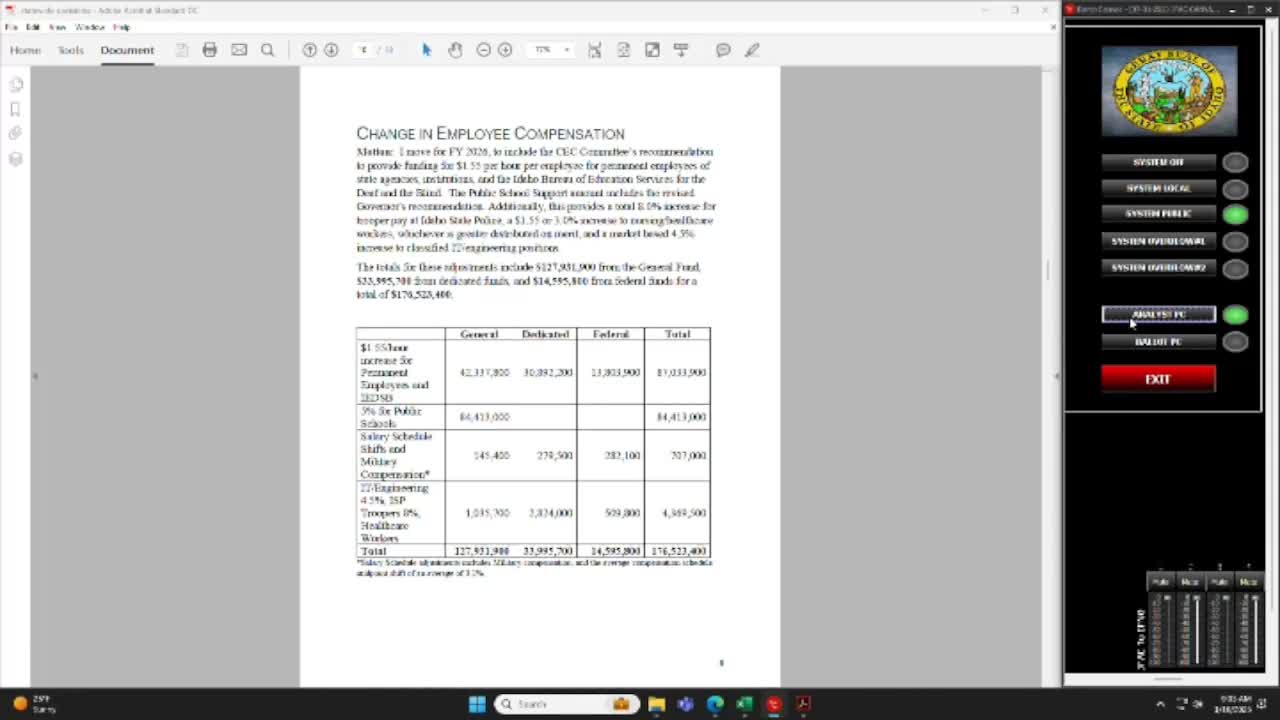
Committee members engaged in an extended and often heated debate over the change in employee compensation (CEC) proposal for FY2026, including competing substitute motions and several roll calls. The proposals on the table included a CEC committee recommendation of a $1.55 per hour increase for permanent employees (with additional targeted adjustments such as an 8% increase for Idaho State Police trooper pay, a 3% or $1.55 increase for nursing/healthcare staff — whichever is greater — and a 4.5% market adjustment for classified IT and engineering positions). A separate substitute, offered by Senator Cook, would increase ongoing annual salary by $1.55 per hour or 4%, whichever is higher, with similar targeted adjustments for troopers, healthcare and IT/engineering positions.
Representative Furness and others explained that the CEC recommendation was intended to address wage compression at the lower end of the pay scale and that a flat dollar increase produces larger percentage increases for lower‑paid employees. Senator Cook and other members argued for merit principles and expressed concern about the state competing with the private sector for high‑end talent.
Members repeatedly sought and received ledger and packet clarifications from staff; late changes were made to include non‑classified IT and engineering employees in the market adjustment, which prompted votes to be delayed while staff recalculated totals. After multiple roll calls, both the original and substitute motions were withdrawn by unanimous consent so staff could correct omissions and prepare clear, comparable fiscal tables. The committee chair announced the group would reconvene and that maintenance budgets would proceed the next day without finalized CEC and compensation decisions.
Ending: Both the CEC‑based and substitute compensation proposals were withdrawn to allow staff to correct and reformat motions and numbers; the committee postponed compensation action to a future session and will proceed the following day with maintenance budgets excluding unresolved CEC items.