Get Full Government Meeting Transcripts, Videos, & Alerts Forever!
Get email alerts on the Law Enforcement Training topic
No spam. Unsubscribe anytime.
POST asks for modest staffing and replacement funding as training demand grows
Summary
Peace Officer Standards and Training (POST) staff briefed the committee on funding pressures, rising training demand, accreditation and a backlog in certification processing; POST seeks a technical records specialist and replacement vehicles/IT items for FY2026.
Peace Officer Standards and Training (POST) staff and Legislative Services analysts told the Joint Finance and Appropriations Committee on Feb. 12 that POST is managing steady demand for basic and in‑service training while relying largely on dedicated revenue sources that have fluctuated.
Noah Peterson, the Legislative Services budget analyst, reviewed POST’s revenue streams and recent transfers. He noted that POST relies on a mix of court fines and fee revenues, fingerprinting and training fees and a liquor‑fund transfer authorized by House Bill 469 of 2022, which provided a 1.5% liquor revenue transfer mechanism for POST. Peterson said POST has historically spent above 80% of its appropriation but used one‑time transfers in recent years to cover pressure points such as cafeteria contract increases and pandemic/ inflation impacts.
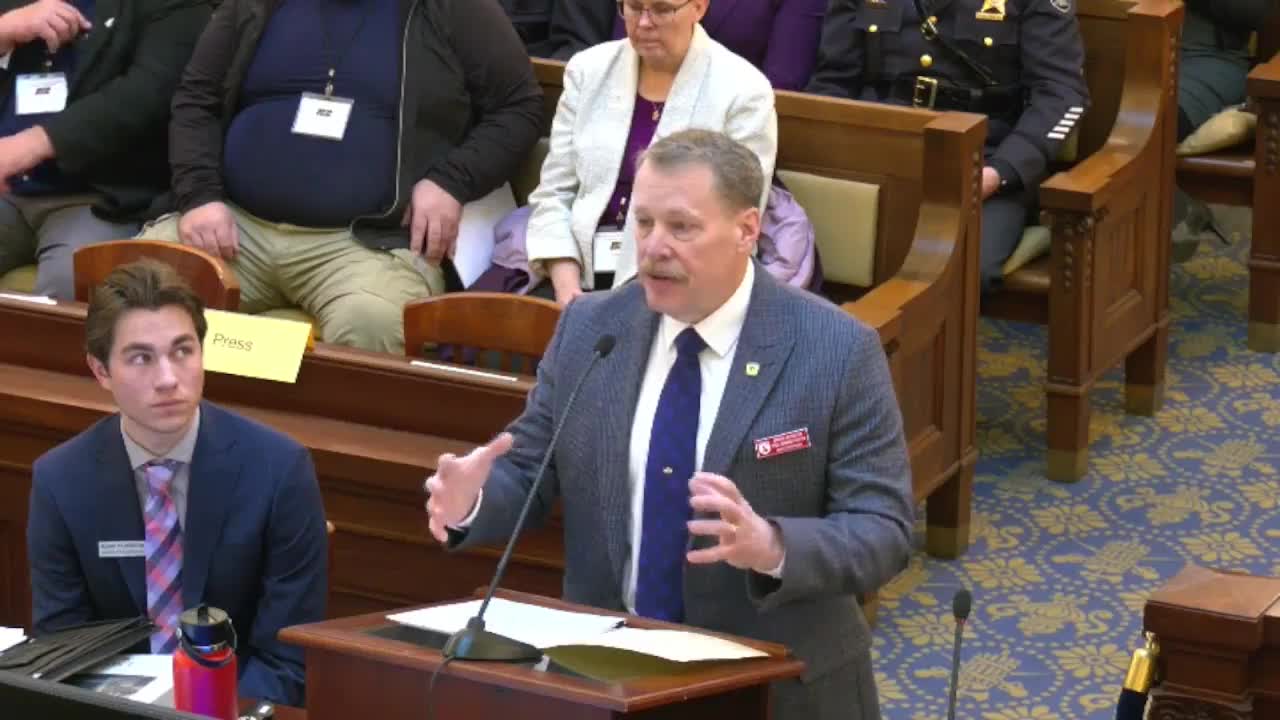
Brad Johnson, administrator of POST, described operational pressure and two specific program points for committee consideration. He said POST’s certification processing workload has lengthened: turnaround that was two to four weeks several years ago can reach three to six months during peak periods. To address that workload POST requested a technical records specialist (net 0.33 FTP, $20,800) to convert a current part‑time role to full time and reduce processing delays.
Johnson also described training‑cost collection and repayment agreements: students who attend certain POST academies sign multi‑year agreements. "Each student that, attends the academy signs a 2 year agreement in which they agree that if they leave the law enforcement profession, and leave their certified position within that 2 years, that they agree that they will pay back, all or some of a portion of the training that the state has paid for," Johnson told the committee. He said that POST recently sent delinquent agreements to a collections agency, which has increased recoveries and explains a recent rise in miscellaneous revenue tied to repayments.
Requested replacement items included a 15‑passenger van and a half‑ton pickup (agency noted the van was acquired in 2001) and IT replacements (laptops, desktops and monitors recommended by OITS totaling about $61,600). The agency requested $111,600 for the vehicle replacements and $61,600 for IT replacements; those items were recommended by the governor.
Committee members asked about academy enrollments, which declined during COVID and have been recovering, and about statewide training delivery and a working group convened by the POST Council to examine the long‑term basic‑training strategy. Johnson said the working group aims to present a plan within about a year and is reviewing college‑based programs, agency training capacity and the practical requirements (for example, training tracks and facilities) that a broader delivery model would require.
POST and committee staff agreed to provide the committee a further breakdown of tuition amounts for specific academies and updated enrollment and revenue projections. No appropriations or formal votes were taken on POST items during the hearing.