Get Full Government Meeting Transcripts, Videos, & Alerts Forever!
Get email alerts on the Personnel Benefits topic
No spam. Unsubscribe anytime.
Lawmakers debate health‑insurance funding and reserve risk; committee fails to adopt either CEC or governor recommendation
Summary
The committee debated two competing FY2026 health‑insurance recommendations — the CEC committee’s $13,960 per‑eligible‑FTP proposal and the governor’s $14,300 proposal — focusing on reserve levels, contractual minimums and potential risk charges.
The committee spent substantive time on FY2026 personnel benefit costs, especially the health‑insurance base used to set agency budgets and employee rates.
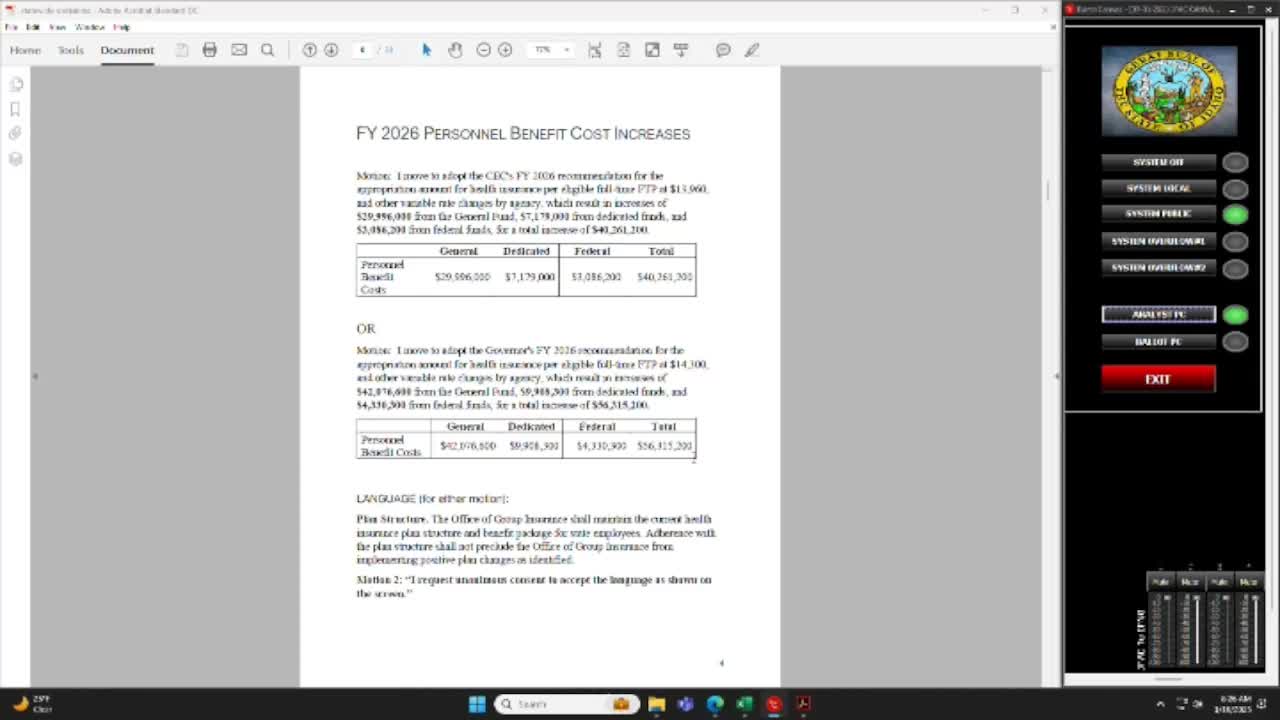
Keith Bybee told members the CEC (Change in Employee Compensation) committee had recommended setting health‑insurance per eligible full‑time position (FTP) at $13,960, which the analyst said would increase the general fund by $29,996,000 and total to $40,261,200 across funds. The governor’s recommendation set the base higher — a $1,300 increase to $14,300 per eligible FTP — and the motion on the table to adopt the governor’s plan listed total cost increases of roughly $56.3 million (including $42,076,600 from the general fund as stated in the motion on the floor).
Members asked repeatedly about the effect of the two approaches on the contingency reserve for the employee health plan. Bybee said Milliman projections showed the CEC recommendation would leave the reserve at about $51,600,000 — effectively the statutory 10% minimum for the plan — and the governor’s recommendation would leave roughly $61,400,000, leaving an additional cushion of about $10,000,000. DFM Administrator Laurie Wolf and Faith Knowlton, administrator for the Division of Insurance and Internal Support, told the committee that falling below the 10% contingency reserve could trigger a risk charge from the carrier, and that the 10% minimum is a contractual floor.
Representative Miller moved the governor’s recommendation (14,300 per eligible FTP). Representative Furness offered a substitute motion to adopt the CEC recommendation (13,960 per eligible FTP). The substitute motion passed in one house but the combined two‑house totals failed to produce the majority required from both the Senate and the House in committee; the chair announced that neither substitute nor original obtained the required two‑house majority and the committee did not adopt either option.
Members debated tradeoffs: Representative Furness and others said the lower CEC number draws down a high reserve and avoids overfunding; supporters of the governor’s number said the additional cushion reduces the chance of a risk charge or a larger increase next year. The session included multiple roll calls and a detailed back‑and‑forth among analysts, DFM and the insurance office about contractual consequences.
Ending: After consecutive failed roll calls on substitute and main motions, the committee left the health‑insurance decision unresolved; staff said the matter would be revisited and the maintenance budget meeting would proceed without a final change to the health‑insurance base.