Get Full Government Meeting Transcripts, Videos, & Alerts Forever!
Get email alerts on the Public Safety Police Budget topic
No spam. Unsubscribe anytime.
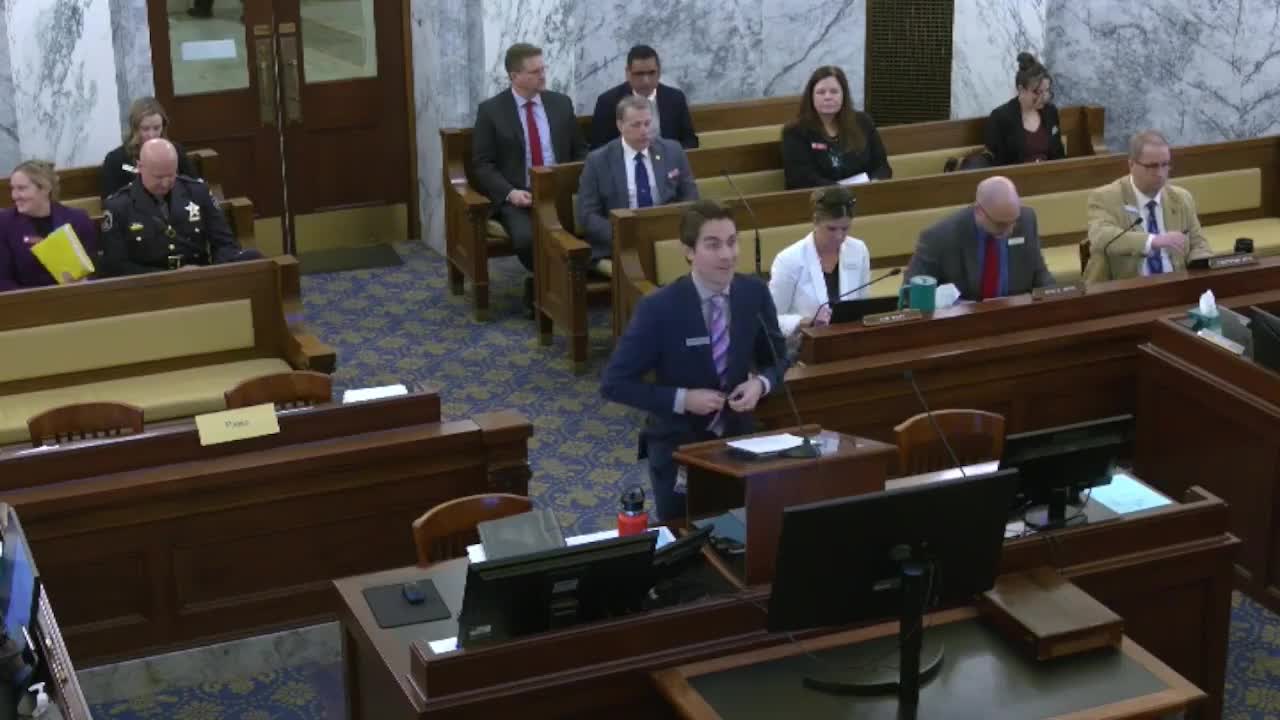
Idaho State Police tells committee staffing shortfalls and fentanyl response drive FY2026 budget requests
Summary
Director Colonel Bill Gardner and legislative analysts briefed the Joint Finance and Appropriations Committee on the Idaho State Police request for FY2026, stressing vacancies, a fentanyl‑focused unit and forensic lab expansion, and a proposed shift of Highway Distribution Account funds.
The Idaho State Police on Feb. 12 asked the Joint Finance and Appropriations Committee to approve a range of budget enhancements for fiscal 2026 aimed at sustaining patrol operations, expanding forensic capacity and bolstering drug‑interdiction efforts.
Noah Peterson, a budget policy analyst with the Legislative Services Office, reviewed the division’s request and budget history. He told the committee the division has 583.67 full‑time positions (FTP) and reported vacancies of 38.67 positions as of August, with an average fill rate of about 92.5% over five years. Peterson outlined dedicated funds used by the division, including the Project Choice Fund (vehicle‑registration fee revenue for personnel costs), the Drug Enforcement Donation Fund and the Idaho Law Enforcement Telecommunications Fund (ILETS).
Colonel Bill Gardner, director of the Idaho State Police, emphasized workforce shortages and operational pressures during committee questioning. "We ... seized over 65,000 fentanyl pills over a full pound of fentanyl powder, [and] 150 pounds of methamphetamine," Gardner said, later adding that in a recent single operation the agency seized 50 pounds of methamphetamine.
Peterson and the colonel described enhancement requests in the governor’s budget and the agency submission. Notable items included:
- A 10‑FTP enhancement and $1,043,300 to create a unit focused on fentanyl trafficking and mitigation (listed in the packet as a prior enhancement).
- Conversion of forensic contracted staff to permanent positions and a request for a forensic deputy lab manager (1 FTP, $118,200) tied to a new Meridian forensic laboratory under construction.
- A special investigations unit to handle criminal investigations at Idaho Department of Correction (IDOC) facilities in the Treasure Valley (4 FTP, total $757,300; $443,300 ongoing, $314,000 one‑time for vehicles and computers).
- A request to convert two part‑time fleet service contractors to full‑time positions (2 FTP, $63,300 net personnel increase) to address an upfitting backlog.
- A transfer request tied to the Highway Distribution Account (HDA) shift: Peterson described a proposed transfer of $4,995,500 and 37.48 FTP in FY2026 to sustain patrol operations after statutory reductions in HDA distributions (Senate Bill 1201 of 2019 reduced HDA transfers to the Law Enforcement Fund in stages).
- A proposed $233,000 ongoing ILETS disaster‑recovery database appropriation and other IT and replacement‑item requests totaling several million dollars (replacement items were listed at about $5.09 million, of which $4.7 million were from dedicated funds).
On a related policy point, Gardner urged additional tools to follow illicit financial flows. He described difficulty tracing cartel money and recommended limited administrative subpoena authority for financial information tied to drug and trafficking investigations: "administrative subpoena power would be a huge help to us."
Committee members pressed the agency on IT centralization, the location and function of a new forensic lab, and recruitment and retention. Senator Woodward pointed to state population growth and said patrol staffing has not kept pace, and asked how that gap affected public safety. Colonel Gardner said recruitment and retention were central concerns and that pay differentials with city and county agencies were causing departures: "we spend almost a million dollars per trooper training them ... and somebody scoops them up and takes them to another agency." He said the agency is seeking to stop that ``bleeding'' and will continue to work with DHR and the department of finance on pay and retention solutions.
On the fentanyl anti‑stigma/awareness campaign, the governor recommended a one‑time $500,000 appropriation from the Millennium Income Fund for operating costs; Division of Financial Management staff confirmed the recommendation is one‑time and that Millennium Fund review will occur.
DFM and agency staff agreed to provide the committee additional details on OITS position transfers (the governor recommended moving 16 IT positions to OITS rather than the 20 the agency initially proposed) and on the status and timing of the Meridian forensic lab and Twin Falls laboratory renovation.
No formal committee vote occurred on the agency’s FY2026 packet during the hearing; members requested follow‑up materials on grant balances, vacancy and turnover rates, and financial detail on federal grants for the Sexual Assault Kit Initiative and other federal funding lines.