Get Full Government Meeting Transcripts, Videos, & Alerts Forever!
Get email alerts on the Child Welfare Adoption topic
No spam. Unsubscribe anytime.
Senate committee advances bill to speed placement of surrendered newborns with licensed adoption agencies
Summary
Senate Bill 1058 would require faster placement of newborns surrendered under Idaho’s Safe Haven law to vetted adoption agencies, add timing requirements and ICWA notice provisions; the committee approved the bill despite some objections about normalizing anonymous surrender and training.
Senator Tammy Nichols told the Senate Health and Welfare Committee that Senate Bill 1058 would streamline placement of newborns surrendered under Idaho’s Safe Haven laws by requiring the Department of Health and Welfare to maintain a list of licensed adoption agencies and, in many cases, transfer custody to a selective adoption agency within 24 hours.
Nichols said the bill aims to reduce unnecessary foster-care placements for newborns surrendered at licensed hospitals, fire stations, law enforcement agencies or baby boxes and to speed placement with vetted adoptive families. “The proposed amendment ... aims to address gaps in that current process,” Nichols said, adding that the measure was developed with tribal input.
The nut graf: sponsors and supporters argued the bill would improve outcomes for surrendered infants by minimizing transitions and placing newborns more quickly with adoptive families; tribal representatives and the Department of Health and Welfare worked on language to ensure compliance with the Indian Child Welfare Act (ICWA).
Adoption-agency representatives and tribal advocates supported the measure at committee. Kara Walsh, a licensed social worker with New Beginning Adoption Agency, said adoption agencies operate 24/7 pregnancy crisis lines and are prepared to “handle the additional caseload effectively.” Tyrell Stevenson, legislative director for the Coeur d’Alene Tribe, and Blake Hude of the Shoshone-Bannock Tribes testified that the bill clarifies ICWA notice and coordination when a surrendered infant may be an Indian child.
Opponents and some foster parents raised concerns about bypassing foster-care training and the potential for adoptive families to encounter newborns with unknown medical or behavioral needs. Whitney Wunderlich, whose daughter was adopted after being surrendered under the Safe Haven Act, told the committee she “disagrees with this bill because it would place vulnerable babies with potentially complex unknown medical and behavioral conditions with adoptive parents that would not likely have the same required training and experience of Idaho foster parents.” She suggested as an alternative expediting adoption within the foster system for Safe Haven infants.
Senator Wintrow said she would vote no, citing worries that anonymous surrender and baby boxes could be normalized and that more social supports for parents in crisis would be preferable.
Key provisions described by Nichols include a 24-hour custody-transfer target to a licensed adoption agency unless medical care or other circumstances require the child to remain in hospital; a 48-hour hospital stay if no adoptive family is immediately available, after which courts and prosecutors must be notified for a shelter-care hearing; and a requirement that ICWA notices be issued within 10 days when the child may be an Indian child. Supporters said the bill should not increase state General Fund costs because it mostly clarifies and shortens timing in existing processes.
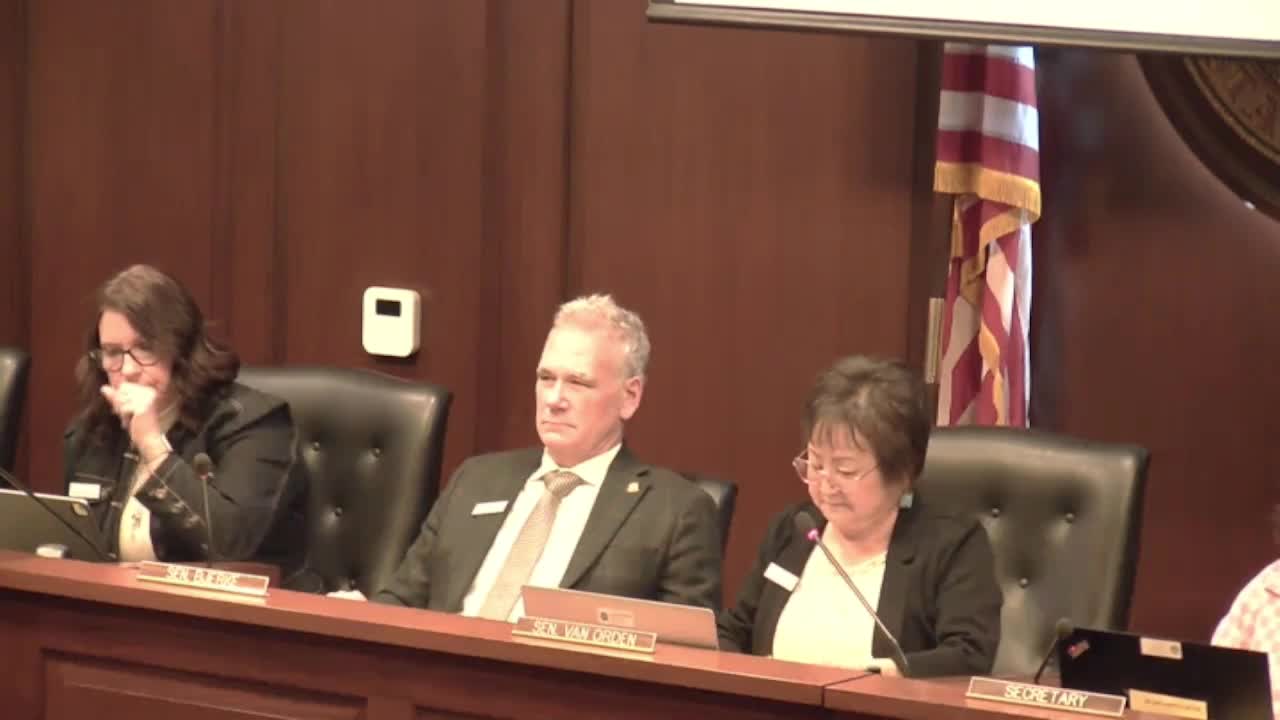
After testimony and questions, Senator Keiser moved and Senator Beierke seconded that the committee send Senate Bill 1058 to the floor with a due-pass recommendation. The motion carried; the committee advanced the bill despite at least one recorded objection during discussion.
The bill now advances to the full Senate for further consideration.