Get Full Government Meeting Transcripts, Videos, & Alerts Forever!
Get email alerts on the State Health Insurance topic
No spam. Unsubscribe anytime.
Joint Finance-Appropriations Committee approves $14,130 per-FTE health insurance funding for FY2026
Summary
The Idaho Joint Finance-Appropriations Committee voted to set the state health insurance funding level at $14,130 per eligible full-time equivalent for fiscal year 2026, a compromise motion that committee members said balances reserve targets and projected insurance costs.
The Joint Finance-Appropriations Committee voted Jan. 31 to set health insurance funding at $14,130 per eligible full-time equivalent position for fiscal year 2026, approving changes to agency personnel benefit budgets that committee staff said will increase appropriations across fund sources.
Committee analysts told members the adopted figure represents a midpoint option between the state personnel committee recommendation and the governor’s request and includes related employer-paid adjustments such as workers’ compensation and Social Security.
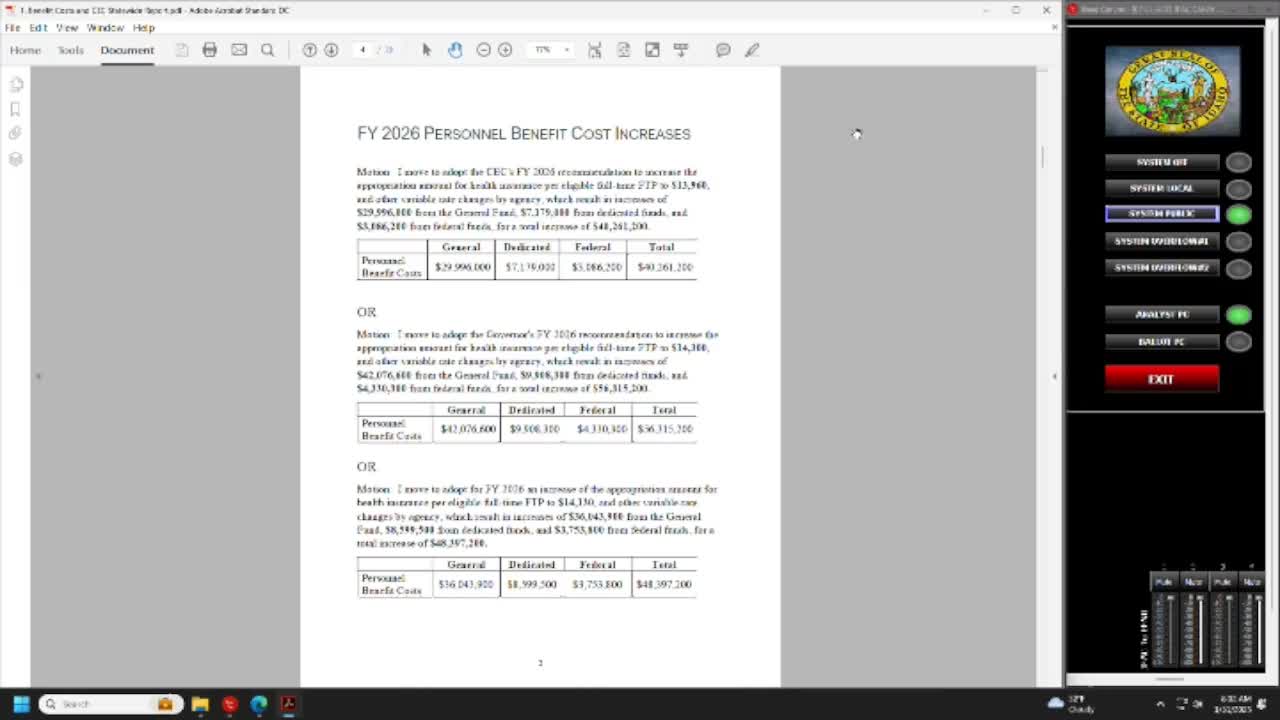
The committee considered three dollar-amount options: $13,960 per FTE (the CEC recommendation), $14,300 per FTE (the governor’s recommendation) and a midpoint, $14,130 per FTE. Senator Cherie Woodward moved the $14,130 figure; Representative Tanner seconded the motion. In the motion text presented to the committee, staff calculated the resulting increases as $36,043,900 from the general fund, $8,599,500 from dedicated funds and $3,753,800 from federal funds, for a total increase of $48,397,200. The motion passed by the joint committee and was given a “due pass” recommendation.
Why it matters: The committee repeatedly cited the size of the health-insurance reserve as a reason to consider different funding levels. Committee staff projected different year-end reserve balances depending on which motion passed: roughly $51.6 million under the lower CEC figure of $13,960 per FTE and roughly $61.4 million under the governor’s $14,300 figure. Members said those reserve projections and the county and school impacts factored into their votes.
Committee debate highlighted competing priorities. Representative Furness, who supported the lower figure, said actuarial projections from Milliman have tended to be conservative and argued the reserve has been larger than necessary in recent years. “They are conservative. They’re very conservative,” Furness said, urging a lower premium estimate. Senator Ward Engelking said buying down premiums with reserves in prior years created a misleading baseline and argued the committee should “reflect the actual cost of insurance.”
Senators and representatives also discussed procedural questions about how joint voting would be tallied; staff explained the ballot is programmed to require a majority of the quorum present in each chamber for a motion to pass under the joint procedure in use. After roll call the committee reported a combined 17 ayes, 0 nays and 3 members absent/excused; the chair announced the motion had passed and would carry a due-pass recommendation.
The action affects the Office of Group Insurance’s budget baseline and will change appropriations routed to state agencies, institutions, and related programs. The committee included related, smaller employer-paid cost adjustments (workers’ compensation and Social Security) in the fiscal impact.
Committee members directed staff to move onto the agenda’s change‑in‑employee‑compensation discussion following the vote; no further amendments to the health-insurance dollar amount were offered at the time.
Votes at a glance
- Motion: Adopt for FY2026 an increase of the appropriation amount for health insurance per eligible full-time FTP to $14,130 and other variable rate changes by agency, resulting in increases of $36,043,900 (general fund), $8,599,500 (dedicated funds) and $3,753,800 (federal funds) for a total increase of $48,397,200. Mover: Senator Cherie Woodward; second: Representative Tanner. Outcome: Approved by joint committee; due-pass recommendation. Tally: combined committee 17 ayes, 0 nays, 3 absent/excused.
Background/context
Staff explained the principal driver of the personnel-benefit adjustments is health insurance; the packet presented to members included calculators showing both a flat-dollar approach and percentage-based options. Committee discussion noted prior-year actions that used reserves to reduce premiums temporarily and cautioned that those buy-downs can make year-to-year changes appear larger.
What’s next
The committee recorded the due-pass recommendation; further action will follow the Legislature’s committee and floor processes. The committee did not change the adopted health-insurance language in the meeting’s session of record and moved on to other agenda items.