Get Full Government Meeting Transcripts, Videos, & Alerts Forever!
Get email alerts on the State Prisons Contraband Transport topic
No spam. Unsubscribe anytime.
After staff shootings, Idaho DOC seeks drone detection, mail scanning and a transport expansion
Summary
The Idaho Department of Correction told the Joint Finance Preparations Committee on Feb. 4 that several supplemental and ongoing budget requests are driven by a spring incident in which a corrections staff convoy was ambushed and staff were wounded during an emergency return from a hospital.
The Idaho Department of Correction told the Joint Finance Preparations Committee on Feb. 4 that several supplemental and ongoing budget requests are driven by a spring incident in which a corrections staff convoy was ambushed and staff were wounded during an emergency return from a hospital. Director Josh Tewalt and agency analysts said the items aim to reduce contraband and improve transport safety.
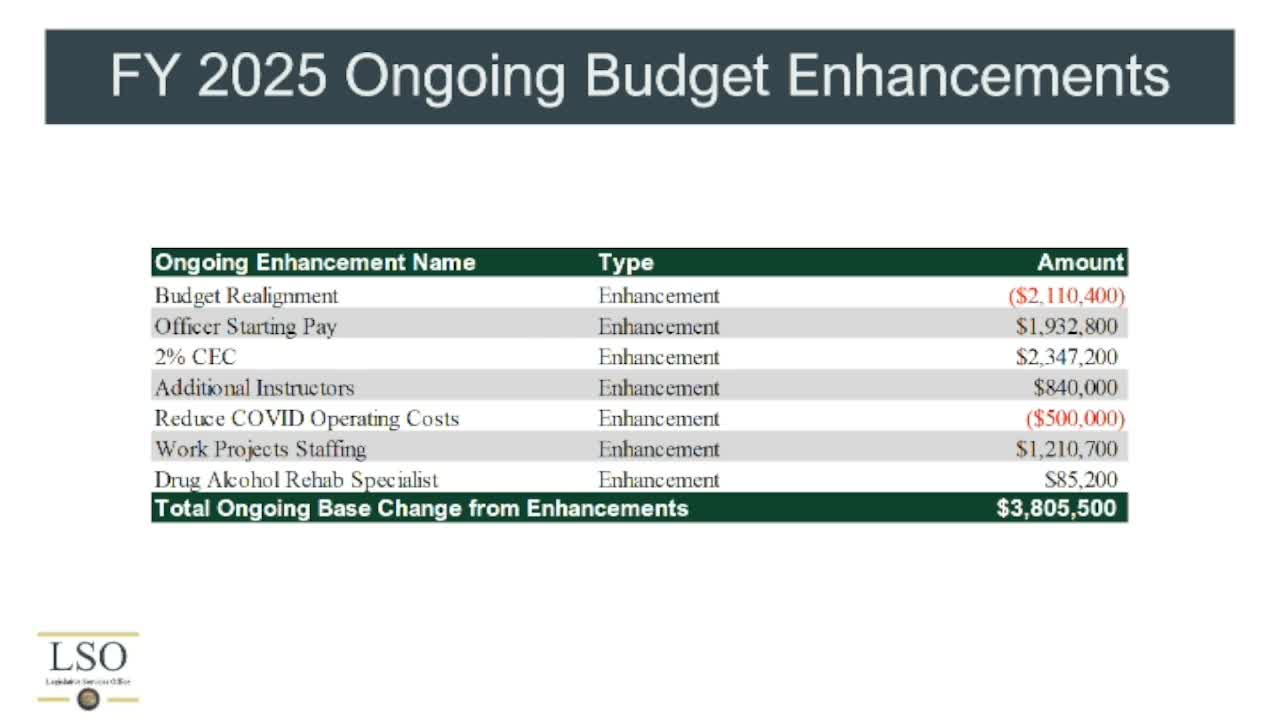
The department requested a package it calls “advanced surveillance technology,” which would include digital mail scanning (scan and deliver mail digitally off‑site), a drone‑detection layered sensor system, a phone‑call transcription and analysis tool identified as LEO intelligence, and a standalone unit for illicit substance testing. The agency said residents made roughly 4 million phone calls totaling about 49 million minutes in 2023. The supplemental request for the remainder of FY2025 was $795,000; the ongoing annual cost for all three technologies was estimated at $2,397,000 (breakouts included $1,011,000 for digital mail scanning, $385,500 for drone detection and $1,000,000 for the LEO phone transcription technology).
To reduce risks during emergency medical transports, the department proposed a $1,148,000 one‑time supplemental to expand the Transport Bureau by 12 full‑time positions (FY25 personnel costs estimated at $455,000 and $693,000 in operating costs), and seven fully‑equipped vehicles. Director Tewalt explained that emergency transports previously relied on facility staff assigned to other duties, which left staff insufficiently trained and created reliance on large amounts of overtime; the agency reported roughly 20,000 overtime hours at ISCC and 14,000 at ISCI following the incident.
The department also requested a federal grant‑backed body‑worn camera pilot for three sites (Idaho Maximum Security Institution, District 3 probation and parole, and special investigations units). The supplemental FY2025 request includes roughly $1.05 million, primarily federal funds, to cover pilot startup costs; the agency anticipates state matching costs appearing in FY2026 and FY2027 if the pilot proceeds.
Other proposals included a one‑time request to purchase a skid loader (noted by the agency as a seasonal snow‑removal need at St. Anthony Work Camp) and the governor's alternative recommendation to contract snow removal at $30,000 ongoing rather than buy equipment outright.
Director Tewalt described the sophistication of contemporary contraband methods—custom‑treated printed materials and autonomous drones—and said mail digitization removes the department's most porous contraband entry point. The committee asked about offsets and whether expanding the statewide Transport Bureau would allow eliminating other full‑time positions; the analyst deferred to the agency, and the director described relief‑factor staffing needs that make simply “reassigning” posts impractical without significantly increasing headcount at facilities.
The committee did not take budget votes during the presentation; the agency’s LBB materials show the governor’s recommendations alongside the agency’s requests for consideration in the FY2026 budget process.