Get Full Government Meeting Transcripts, Videos, & Alerts Forever!
Get email alerts on the Workers Compensation Rules topic
No spam. Unsubscribe anytime.
Senate commerce panel accepts Industrial Commission rewrite but rejects rule language requiring an in‑state office
Summary
The Senate Commerce Committee approved the Industrial Commission’s workers’ compensation chapter rewrite but rejected a provision that the commission interpreted as potentially requiring a brick‑and‑mortar office in Idaho, after extensive testimony from insurers, trial lawyers and the commission.
The Senate Commerce Committee approved rule docket 17‑0101‑2301, the Industrial Commission’s chapter rewrite of workers’ compensation administrative rules, but the committee voted to reject subsection 305.01(A), the provision that required that carriers “maintain an office within the state of Idaho.”
Paul Jeffreys, rules presenter for the Industrial Commission, told the committee the rewrite is the result of negotiated rulemaking meetings with stakeholders and public hearings. The commission described the rewrite as a ZBR (zero‑based regulation) chapter rewrite intended to streamline and modernize operations under the Idaho workers’ compensation law.
Jeffreys and the commission’s benefits administration manager, Patty Vaughn, said the commission interprets Idaho Code §72‑305 as not requiring a so‑called brick‑and‑mortar office. “The commission does not consider that this rule requires a so called, brick and mortar office,” Jeffreys said, adding the commission instead interprets “office” broadly to require a physical in‑state presence for adjusting rather than a specific storefront.
Industry representatives and consumer advocates expressed differing views. Elizabeth Kreiner of the American Property Casualty Insurance Association asked the committee to strike subsection 305.01(A), saying the ZBR process was the appropriate place to clarify that brick‑and‑mortar presence is not required. Barbara Jordan of the Idaho Trial Lawyers Association opposed removing the sentence that required offices to be “staffed by adequate personnel,” saying in‑state adjusters are important for timely contact and hearings and for claimants’ access to the process.
Chris Wagner of Intermountain Claims, a third‑party administrator, warned that the term “licensed resident adjuster” can be misleading: because many states have reciprocal licensing, an adjuster who holds a designated home‑state license can often obtain another state’s license with a fee, and work performed outside Idaho could satisfy a licensing requirement unless the rule specifically requires a physical Idaho office. Wagner said removing the office language could “begin to move towards removing the … in‑state adjusting requirement.”
Committee members debated whether subsection B of 305.01, which requires carriers to “authorize and require a member of its in‑state staff or an Idaho licensed resident adjuster to service and make decisions regarding claims,” already provides the necessary in‑state standard and whether the subsection A language was redundant or confusing. Some members said the commission’s longstanding guidance memo had attempted to clarify the issue and that statute takes precedence over rule.
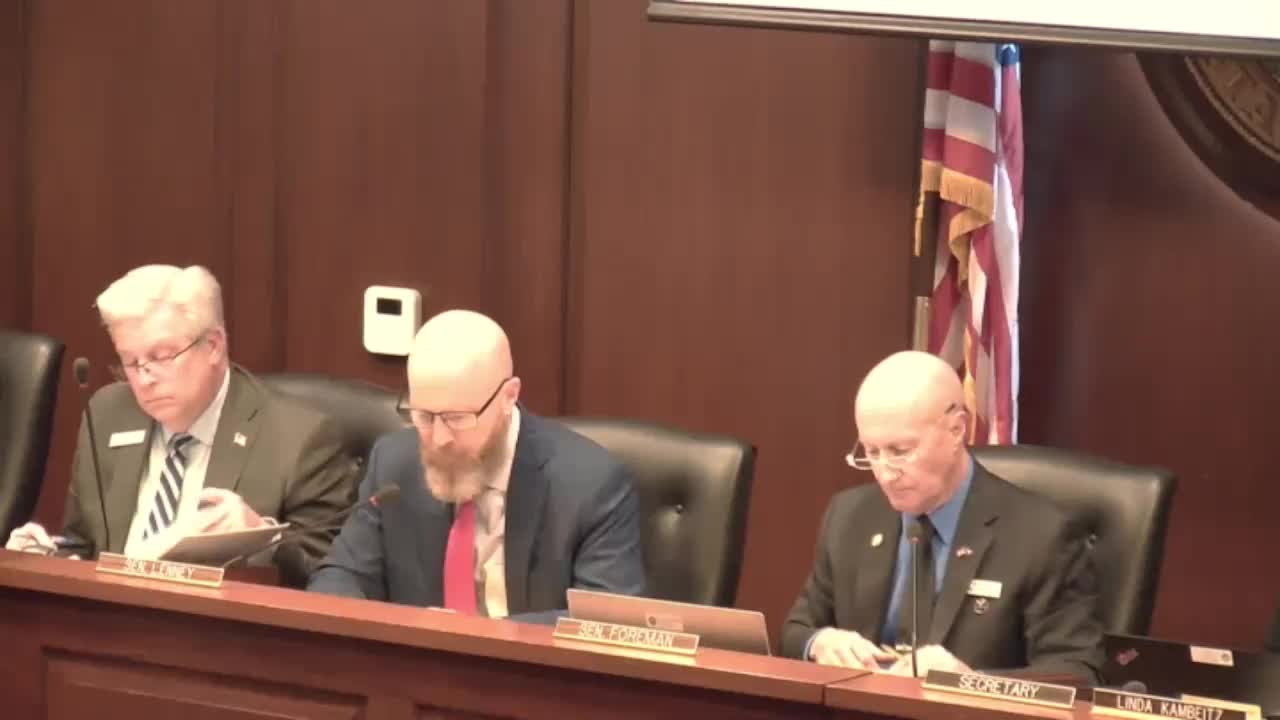
The committee approved the chapter rewrite while rejecting subsection 305.01(A). A motion to accept docket 17‑0101‑2301 while rejecting 305.01(A) was offered by Senator Foreman and seconded by Senator Burts; the committee’s voice vote approved the docket with that exception.
The commission told the committee the rewrite simplifies certain administrative procedures — for example, allowing sureties to pay benefits electronically — and said the proposed rules reflect stakeholder input from multiple negotiated rulemaking sessions and two public hearings in October 2024.
The committee’s action will return the final rule text to the commission with the committee’s rejection of 305.01(A). The commission may revise the language in response to the committee’s direction or pursue statutory clarification, according to testimony.