Get Full Government Meeting Transcripts, Videos, & Alerts Forever!
Get email alerts on the Strategic Plan topic
No spam. Unsubscribe anytime.
Board hears midyear strategic-plan progress; attendance and targeted-school flags draw focus
Summary
District leaders reported mixed academic trends, steady staff retention, expansion of AP/CTE options and continued concern about chronic absenteeism — particularly among high-school students — and outlined next steps including student surveys and targeted supports.
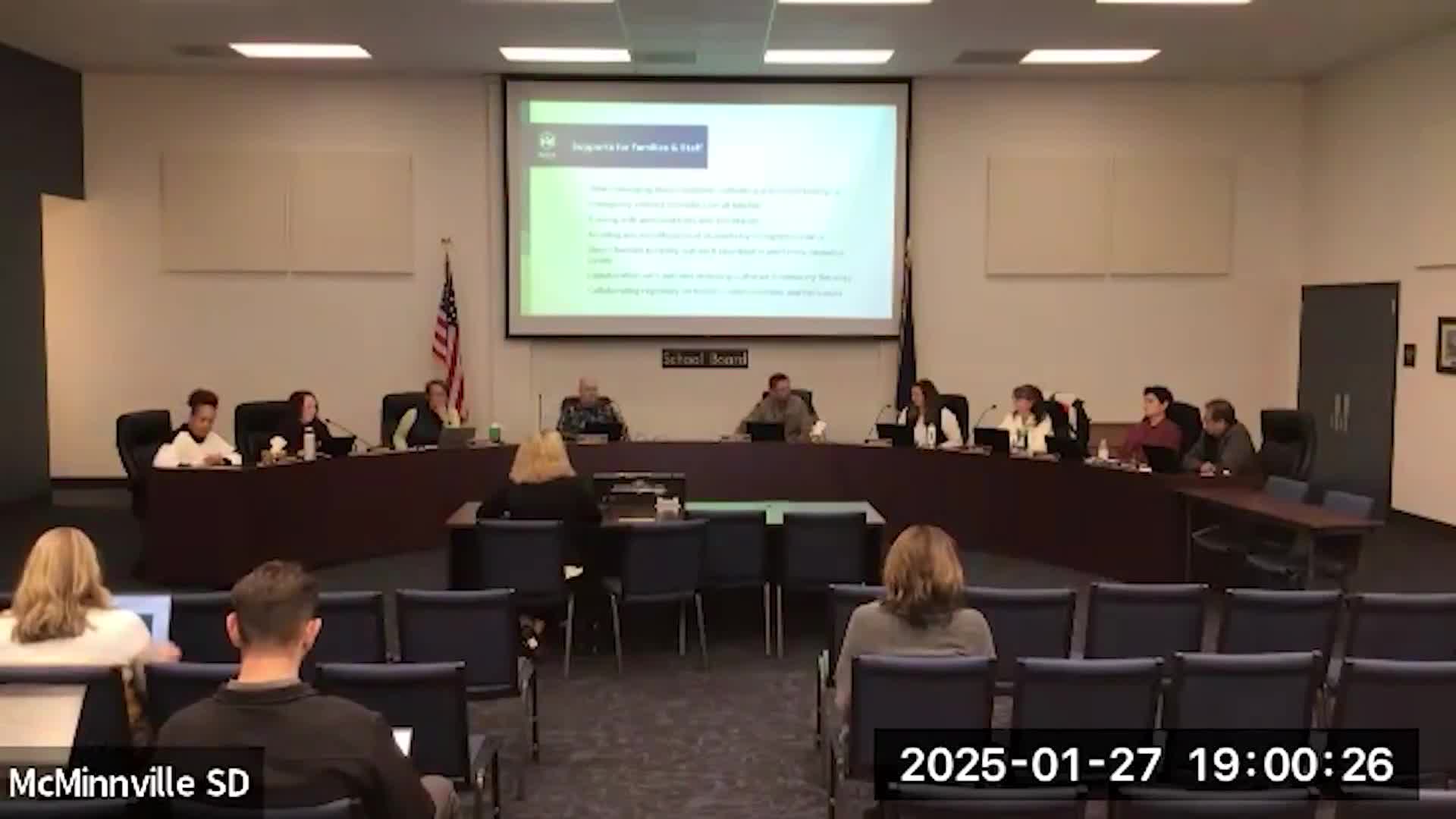
Superintendent Dr. Brockett and cabinet directors presented a midyear progress report on the McMinnville School District strategic plan during the Jan. 27 work session, reviewing student performance data, social-emotional learning rollout, human-capital metrics and operations improvements, and highlighting attendance and targeted-school status as immediate priorities.
The district tied its strategic objectives to state reporting tools and found mixed academic signals: some grade bands and focal groups showed gains while other metrics remain below internal goals. The superintendent and directors said the district will focus on reengaging high-school students, accelerating math and English-language-arts gains at upper grades, and supporting targeted schools with school-by-school plans.
Key data points reported to the board included daily monitoring of attendance, a district regular-attenders rate of 71.74 percent (district target: 75 percent) and a concern that ninth- and 10th-grade students are disengaging at higher rates than other groups. “We are at 71.74% right now,” Superintendent Dr. Brockett said when summarizing regular-attender progress. District staff said elementary and middle school attendance have improved, while high school attendance and on‑track rates remain the largest challenge.
On academic measures, the district emphasized long-term trends and the complication of changing cohorts and testing participation. Directors noted ODE’s public dashboards and the district’s internal longitudinal tool are available for deeper school-level analysis. The presentation also said the number of schools identified as “targeted” rose to four this year, up from three the year before; district leaders said those labels reflect data the state identifies for additional monitoring.
The board also heard progress on college and career goals: advanced placement participation has increased (the district reported a 12 percent rise in unique students enrolled in AP courses and a 15 percent increase in total AP course seats), and the district is expanding career-technical education offerings, including a cosmetology pathway that will begin this year. Enrollment projections for the cosmetology program were not yet specified.
Human-resources director reporting showed a 96.36 percent staff retention rate as of Jan. 21 (the presenter noted the district’s end-of-year retention rate was 92.18 percent in June) and a small increase in culturally and linguistically diverse staff to about 16.16 percent. The district has added onboarding supports, new-hire check-ins at 90 days, and embedded professional development for classified and licensed staff.
Several proactive steps were presented on innovation and operations: an innovation team is drafting AI-in-classroom guidelines to be shared in February; the district has begun automating monthly budget reports and synchronizing student data with state dashboards; and school safety plans have been documented and communicated to staff at all nine schools.
To address chronic absenteeism among older students, district and high‑school leaders plan a short, targeted student survey to identify reasons for disengagement and inform individualized interventions. Leaders said the survey will be issued when students return from break and that Tier 3 attendance mediation — individualized home visits, meetings and supports — will continue for the highest-need cases.
Board members asked for more time to review the data packet and requested follow-up items: expanded school-level breakdowns for the targeted-school list, clarification on which student groups are counted in each focal population, budget-line reporting for online/dropout-prevention programs (Pearson, Graduation Alliance, Measure 98 allocations) and an update on the district’s planned AI guidelines and academic integrity policy.