Get Full Government Meeting Transcripts, Videos, & Alerts Forever!
Get email alerts on the Decarbonization topic
No spam. Unsubscribe anytime.
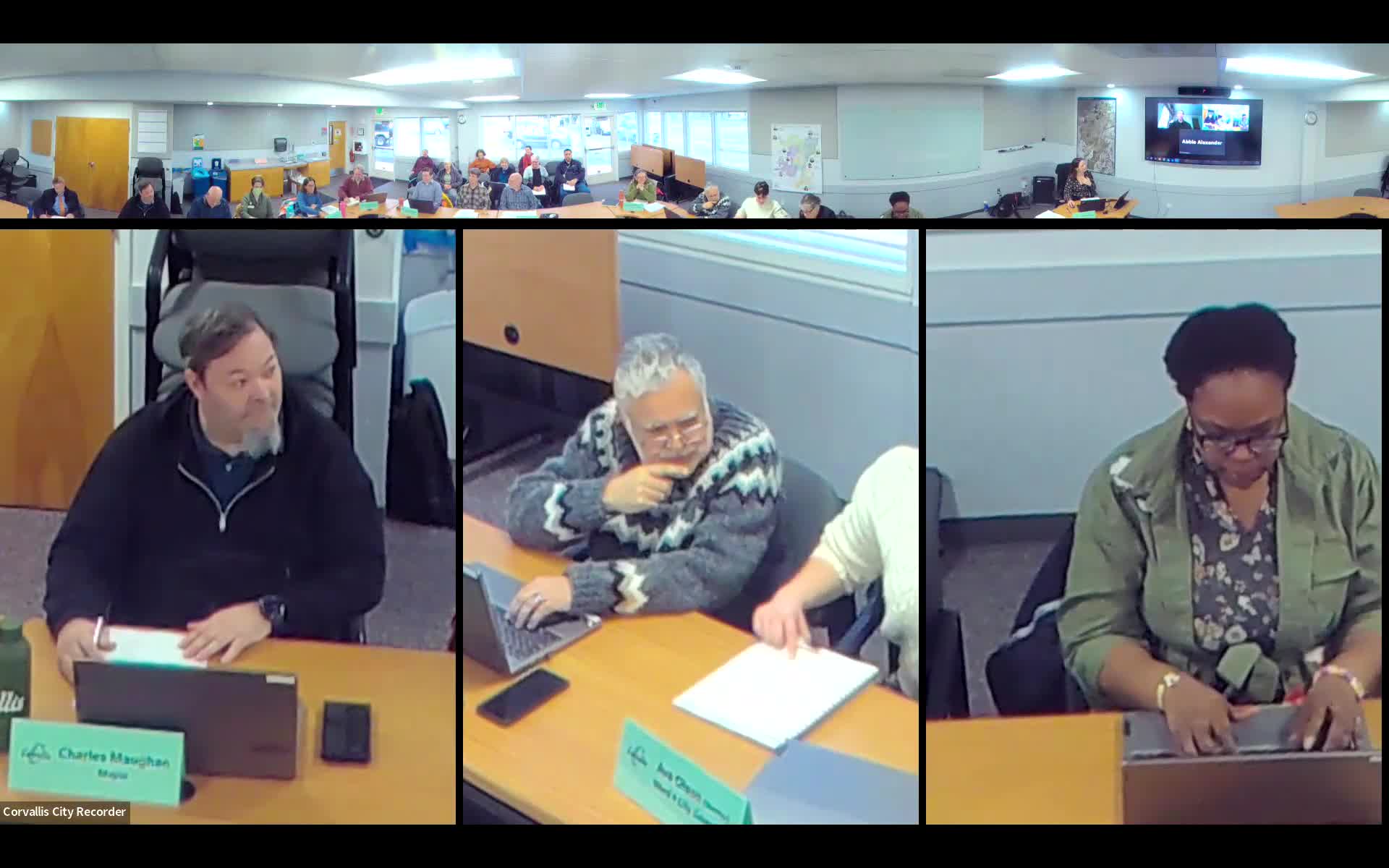
Corvallis decarbonization work group presents 8 actions; council asks staff for focused follow-up
Summary
A city-appointed decarbonization work group presented eight draft actions to cut community greenhouse-gas emissions from buildings. Council asked staff and the group to narrow research next steps—beginning with retrofitting building envelopes and efficient appliances—and to return with a staff report and gap analysis.
Members of Corvallis’s decarbonization work group presented a set of eight possible actions to reduce community carbon emissions from buildings and asked the City Council which items it wanted staff to research further.
The group, represented in the meeting by Wendy Byrne, Bill Fender, Brandon Trailstead and Karen Bloom and supported by Abby (the city’s innovation manager), laid out actions ranging from retrofitting building envelopes and encouraging efficient appliances to a mandatory home energy score, a local recognition program for resiliency, a carbon-impact fee for new construction, NOx-emission thresholds, a centralized incentives webpage, and city-hosted community solar.
The presentation was explicitly framed as an information-gathering step. Abby told council, “We don't need to make any full determinations today about implementing or committing to ideas. We just need to start with where you all would want to receive additional information follow-up.” The work group said the options were selected from state and local greenhouse‑gas analyses and earlier climate task-force recommendations.
Why it matters: Buildings are a major source of community emissions, and council and staff said they want to prioritize follow-up where the city's limited staff and resources can have the most effect. Several council members noted that some items could be executed quickly or by community partners, while others would require more legal review or staff time.
Key points from the presentation and council discussion
- The eight actions presented: 1) facilitate adoption of envelope efficiency measures in existing residential and commercial buildings; 2) facilitate adoption of efficient appliances in existing residential and commercial buildings; 3) implement a mandatory home energy score; 4) create a local recognition program for resiliency efforts; 5) adopt a carbon-impact fee for new buildings/equipment that use combustion; 6) regulate building NOx emissions as a proxy for combustion; 7) centralize and publicize incentives (solar, heat pumps, weatherization, etc.); and 8) pursue city-hosted community solar on available city property.
- Several councilors recommended narrow, stepwise follow-up rather than pursuing all eight at once. Multiple speakers urged that staff and the work group conduct a gap analysis to identify what in the list is already being handled by state or community partners (for example, the Sustainability Coalition, Energy Trust of Oregon and the Community Services Consortium) and where the city should add value.
- On the two proposals aimed at new construction (a carbon-impact fee and NOx regulation), presenters said the approaches have different legal and political profiles: the carbon-impact fee is structured as a fee tied to estimated lifetime emissions and a social cost metric; the NOx‑limit approach would be a regulatory threshold that effectively restricts combustion. Presenters noted Ashland City Council had recently approved a carbon‑impact fee ordinance in first reading and that some jurisdictions and legal scholars are still watching NOx‑regulatory approaches for legal challenges.
- Councilors repeatedly raised implementation questions: how much staff time would each item require, what legal risks exist (including possible litigation), which partners (utilities, builders, state agencies) should be engaged, and what land the city might have available for community solar.
Directions given and next steps
- Council gave staff and the decarbonization work group direction to narrow follow-up. Multiple councilors asked staff to conduct a gap analysis and to return with additional information focused initially on items they heard most often in the discussion—particularly actions 1 (building envelope efficiency) and 2 (efficient appliances). Staff and CAB will scope the next research step, including likely resource needs and potential partners.
- Council requested staff to bring back a revised staff report on the voluntary/mandatory home energy score for council consideration; several councilors said this item could come back quickly because prior work has been conducted on the topic.
- Council asked staff to check the availability and constraints on city‑owned land for a possible community solar site and to report back on logistical and utility interconnection considerations.
- The presenters and several council members stressed the city should avoid duplicating state and nonprofit efforts and instead leverage existing programs and funding sources where possible.
Clarifying details from the meeting
- The work group presented eight items (listed above) as an initial menu for council guidance; they emphasized they do not expect the city to pursue all items at once.
- The presentation referenced the State of Oregon’s integrated greenhouse‑gas analyses (the TIGER-like table discussed in the packet), and presenters cited a social‑cost metric maintained by federal agencies (updated periodically) for estimating lifetime emissions costs. The work group also noted Ashland’s recent first‑reading approval of a carbon‑impact fee ordinance as an example being watched by other municipalities.
Community relevance and likely resource impacts
- Geography: citywide (Corvallis).
- Affected groups: homeowners, renters, low‑income households, developers and builders, community organizations that deliver weatherization and solar programs.
- Funding sources under discussion included federal and state incentives, existing utility rebate programs, and local funding mechanisms such as revolving loan funds or a carbon‑impact fee.
What remains undecided
- Council did not adopt or formally direct implementation of any of the eight actions at the meeting. Instead, council asked staff and the work group to return with more focused research—beginning with a gap analysis and more detail on items 1 and 2, home energy scoring, and community solar site feasibility.
Ending note: Council members emphasized they would prefer a staged approach that leverages community partners, avoids unnecessary duplication of state programs, and focuses city staff effort where local government can add the most value.